

On this page
Preparing for competitive exams is expensive, but several government schemes help students from economically weaker sections. If you aim for engineering or medical colleges, you need not rely solely on private coaching.
The central and state governments have launched initiatives providing free coaching for JEE and NEET. These range from open-access online platforms to fully funded residential programmes that select students through merit or entrance exams.
Do government schemes offer free coaching for JEE and NEET?
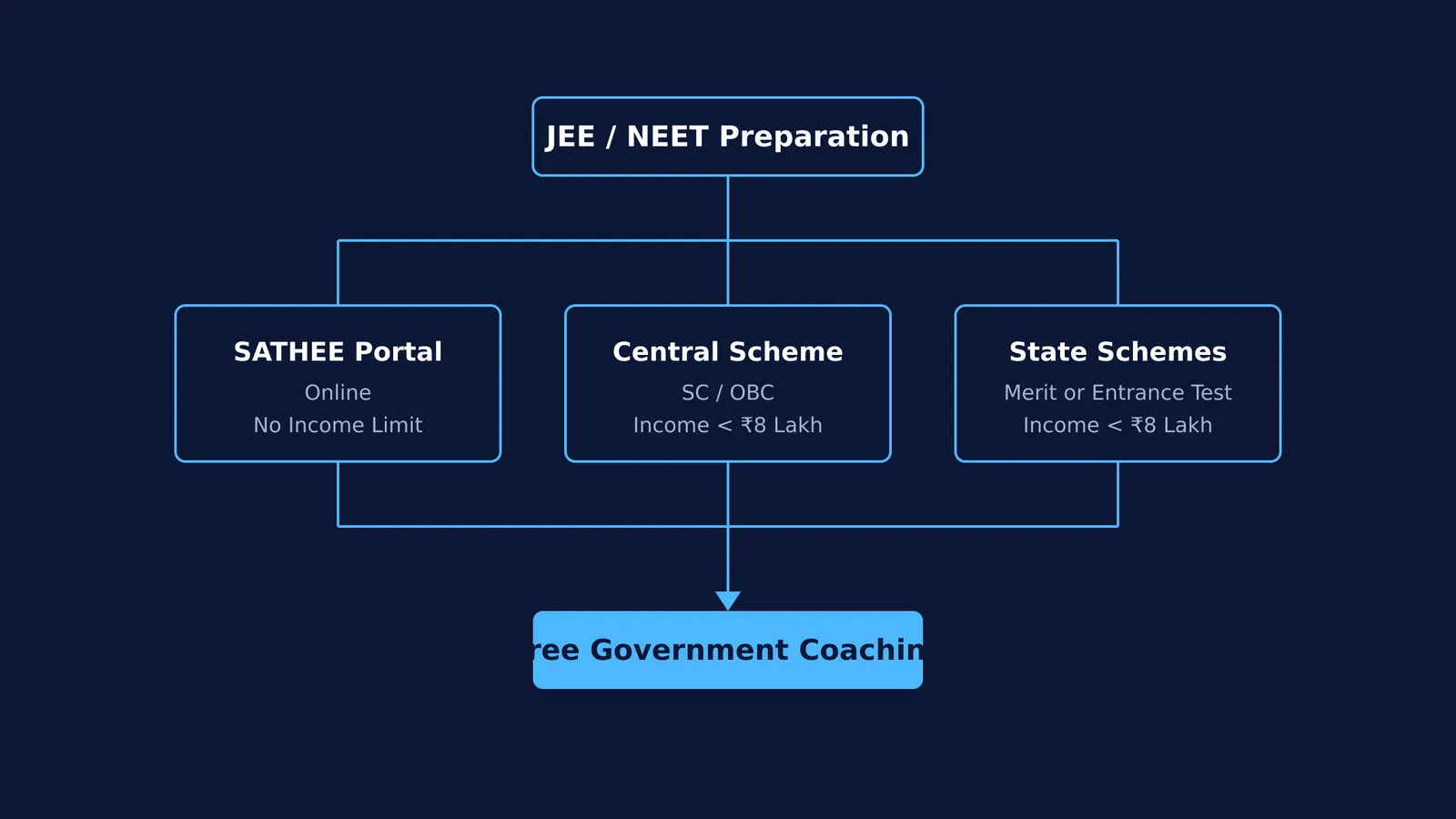
Yes, there are multiple avenues for free government-backed coaching. At the national level, the Ministry of Social Justice and Empowerment runs the Free Coaching Scheme for SC and OBC Students (source). This Central Sector Scheme is designed to help students afford private coaching at empanelled institutes. To qualify, your total family income from all sources must not exceed ₹8.00 lakh per annum. The scheme maintains a 70:30 ratio between SC and OBC students, and reserves at least 30% of its seats for female candidates.
For immediate study, you can review topics such as Limits of the form 1^∞: the e-power shortcut for JEE or the Contact process for sulphuric acid: steps and conditions for JEE using free online materials while waiting for scheme applications to open.
How does the SATHEE portal work?
If you prefer online learning or do not meet the category requirements for specific state schemes, the central government offers an open alternative. The Ministry of Education, in collaboration with IIT Kanpur, developed the SATHEE (Self-Assessment, Test and Help for Entrance Examination) portal (source).
SATHEE provides free, high-quality learning materials, including video lectures delivered by professors from the IITs and IISc. The platform offers live classes, recorded sessions, and extensive mock tests based on the NCERT curriculum. Because it is completely free and accessible to anyone with an internet connection, it is one of the most widely available resources for JEE and NEET aspirants across the country.
As you start working through practice problems on your own, you might need help figuring out why a particular step went wrong. Fermi's AI tutor teaches rather than answers: it holds a line of reasoning across a session, notices where you are stuck, and decides whether to explain, ask or show. If you are struggling with a tricky question, the Fermi Problem Library provides a step-by-step solver that explains the reasoning behind the solution.
What is the selection process for state coaching schemes?
Many state governments run their own free coaching programmes, but admission is rarely direct. Because seats are limited, states use either entrance examinations or board exam merit lists to select candidates.
In Uttar Pradesh, the Mukhyamantri Abhyudaya Yojana provides free offline coaching for exams like NEET and JEE (source). The Social Welfare Department conducts a state-level entrance test, which typically tests aptitude and subject knowledge in physics, chemistry, biology or mathematics. Based on the marks obtained in this test, a merit list is drawn up, and successful students are allotted seats in physical coaching centres at the divisional or district level.
In Rajasthan, the Mukhyamantri Anuprati Coaching Yojana takes a different approach. The selection is strictly merit-based, calculated using the marks obtained in Class 10 and Class 12 board exams (source). For the JEE and NEET streams, students must have secured at least 50% marks in Class 10 to be considered for the merit list.
How do income limits and eligibility work?
State-run programmes are targeted at low-income families, so strict economic criteria apply.
For schemes like Rajasthan's Anuprati Yojana, the total annual income of the candidate's parents or guardians must be less than ₹8 lakh (source). The student must also be a native resident of the state and belong to specific categories such as SC, ST, OBC, MBC, EWS, or Minorities.
These state schemes often cover more than just tuition fees. If a student under the Anuprati Yojana is allotted a coaching institute in a city other than their home town, they receive an additional ₹40,000 per year for boarding and lodging expenses (source).
Checklist for applying to government coaching schemes
Gather certificates early: Obtain an updated income certificate (showing family income below ₹8 lakh) and a caste certificate from your local administration. These can take weeks to process.
Update your online profiles: For state schemes, ensure your details are linked to regional portals (such as the Jan Aadhaar portal in Rajasthan).
Keep your board marks ready: Have your Class 10 and Class 12 marksheets scanned and ready to upload, as many schemes use these to generate the merit list.
Prepare for screening tests: If your state requires an entrance exam, revise your Class 11 science and maths syllabus, along with basic general knowledge. For example, reading up on Photodiode, LED and solar cell I-V curves for JEE Main can help you tackle physics questions in the screening test.
Start by gathering your income and caste certificates, or visit the SATHEE portal today to begin.


