

On this page
Most school examinations reward memorised algorithms and formula substitution: you identify a quadratic, compute the discriminant, and write down the roots. Mathematical and junior science olympiads test something fundamentally different: non-routine reasoning, pattern recognition, and creative persistence.
Class 8 is the ideal year to begin this transition. Without the immediate pressure of Class 10 board examinations or entrance coaching, you have time to build deliberate problem-solving habits and explore mathematical ideas at your own pace.
Why is Class 8 the right time to start olympiad preparation?
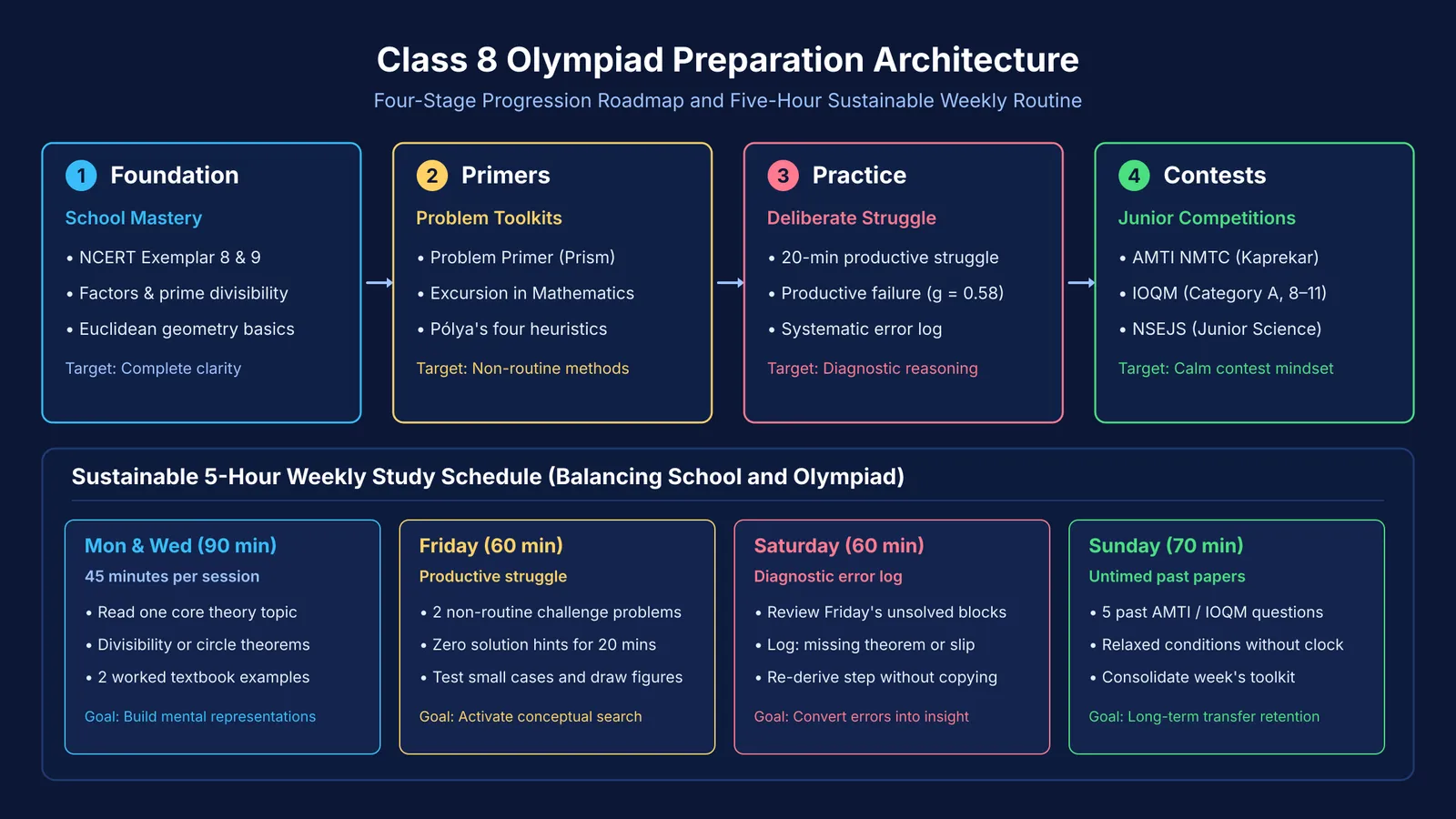
Cognitive research confirms the value of tackling non-routine problems early. A 2021 meta-analysis by Tanmay Sinha and Manu Kapur in the *Review of Educational Research*, analysing 53 studies across 166 comparisons, showed that problem solving prior to instruction produces a moderate to strong advantage (Hedges' g between 0.37 and 0.58, rising to 0.87 when adjusted for publication bias) over instruction-first approaches. When you grapple with an unfamiliar problem before reading a proof, your working memory maps the structure and spots conceptual gaps.
Class 8 students already know foundational algebra, factorisation, and basic Euclidean geometry. As John Dunlosky and colleagues showed in their 2013 review of learning techniques, distributed practice and practice testing provide the highest utility for long-term retention. Solving two non-routine problems three days a week builds far deeper spatial and numerical intuition than cramming dozens of routine exercises.
Which junior olympiads can Class 8 students actually write?
In India, three major competitions welcome Class 8 students:
Indian Olympiad Qualifier in Mathematics (IOQM): Organised jointly by the Mathematics Teachers' Association of India and the Homi Bhabha Centre for Science Education. Students in Classes 8 through 12 write a single common three-hour paper of 30 integer-answer questions (00 to 99). Class 8 participants compete in Category A (Classes 8 to 11) for Regional Mathematical Olympiad qualification, as outlined in our guide to getting started with the maths olympiad in India: IOQM and beyond.
National Standard Examination in Junior Science (NSEJS): Administered by the Indian Association of Physics Teachers and HBCSE. Class 8 students meeting the age cutoff (typically aged 14 to 15) can write this objective exam across physics, chemistry, biology, and basic mathematics.
AMTI National Mathematics Talent Contest (NMTC): Organised by the Association of Mathematics Teachers of India. Its Sub-Junior division (the Kaprekar Contest) is designed specifically for Classes 7 and 8, featuring a preliminary objective round and a subjective final.
Which beginner books should a Class 8 student choose?
Jumping straight into senior competition problem sets often discourages young learners. Instead, establish your foundation through four accessible resources:
NCERT Exemplar for Classes 8 and 9: Before buying specialised titles, finish the higher-order thinking problems in the official NCERT Exemplar. Our guide on how to use NCERT Exemplar problems explains how to extract deep conceptual value from these questions.
*Problem Primer for the Olympiad* by C. R. Pranesachar, B. J. Venkatachala, and C. S. Yogananda: Published by Prism Books, this concise text introduces number theory, geometry, and algebra with clear toolkits and complete proofs.
*An Excursion in Mathematics* edited by M. R. Modak, S. A. Katre, V. V. Acharya, and V. M. Sholapurkar: Published by Bhaskaracharya Pratishthana, Pune, this text builds modular arithmetic and synthetic geometry intuition.
*How to Solve It* by George Pólya: This classic outlines the four universal heuristics: understand the unknown, devise a plan, carry out each step, and look back.
How do you build a daily problem-solving routine without burnout?
Olympiad preparation should never compromise sleep, schoolwork, or sports. Our article on supporting your child's olympiad preparation: time and pressure emphasises that sustainable growth comes from low-pressure consistency rather than marathon cramming.
A five-hour weekly routine balances rigour with recovery:
Monday and Wednesday (45 minutes each): Read a single topic—such as divisibility tests or circle theorems—and work through two introductory examples.
Friday (60 minutes): Attempt two non-routine challenge problems without looking at solutions. Draw accurate figures, test small values, and write out reasoning in sentences.
Saturday (60 minutes): Error analysis. Record every unsolved question in an error log, noting whether the block was a missing theorem, an algebraic slip, or an incorrect diagram.
Sunday (70 minutes): Untimed past-paper practice. Solve five questions from past AMTI Sub-Junior or IOQM papers under relaxed conditions.
When an unfamiliar concept emerges during practice, the Fermi Concept Library maps every concept across mathematics and science with its own dedicated lesson. When you get stuck mid-proof, the Fermi Problem Library offers worked problems with a step-by-step solver that explains the reasoning rather than printing an answer.
Starting olympiad preparation in Class 8 is an apprenticeship in thinking clearly, handling productive confusion with patience, and enjoying the thrill of finding a clean solution.


