

On this page
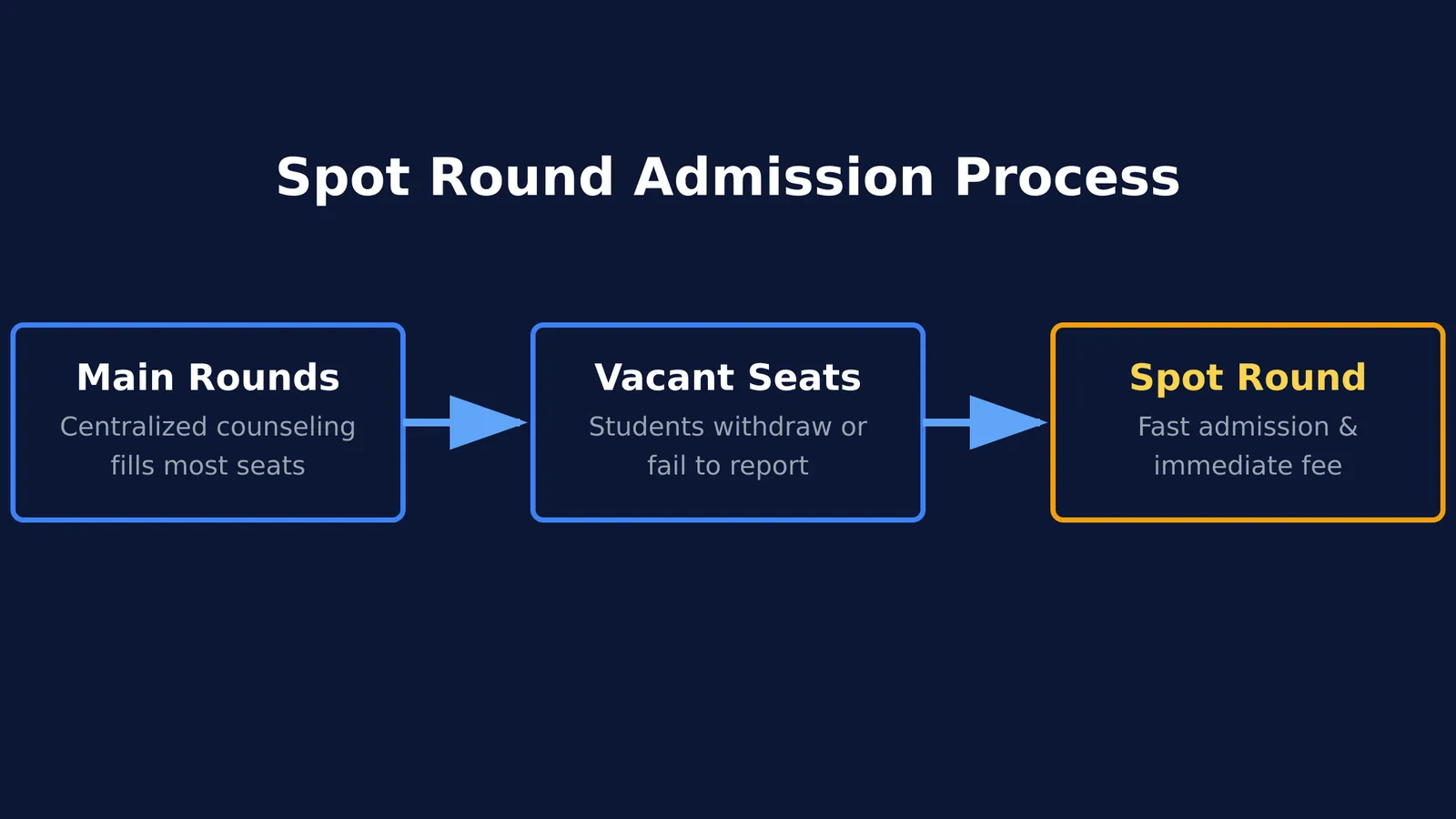
Spot round admission in Indian engineering colleges is the final, high-speed phase of the counseling process. Conducted to fill seats that remain vacant after all centralized counseling rounds (like JoSAA, CSAB, or state-level CAP rounds) have concluded, it offers a final opportunity to secure a college seat, according to AICTE.
However, because it happens at the very end of the admission season, the process is extremely fast and can be financially demanding. You are often expected to verify your documents and pay large seat acceptance fees on the same day. Here is what you need to know before you attend a spot round.
What is spot round admission in engineering colleges?
Spot rounds act as a "mop-up" phase for colleges to ensure their classrooms are running at full capacity before the academic session begins. Seats usually become available because earlier candidates withdrew their admission, failed to report to their allotted college, or upgraded to another institute in a different counseling process.
Depending on the conducting authority, spot rounds can be centralized and online (such as the CSAB special rounds for NITs, IIITs, and GFTIs) or offline and institutional (conducted physically at the college campus). Because these are the last remaining seats, the closing ranks are often significantly lower than in the main rounds, giving students with lower ranks a chance at better colleges.
While you might find favorable cutoffs, the risk is higher. If you surrender a previously secured seat to participate in an upgradation spot round, you could lose both seats if you are not allotted a new one.
What documents do I need to carry?
If you are attending an offline spot round, you will not have time to run home for forgotten paperwork. You must bring your original documents along with two to three sets of self-attested photocopies, according to College Nirnay.
Use this checklist before you leave for the counseling venue:
Entrance Exam Proof: Your JEE Main or State CET admit card and rank scorecard.
Academic Records: Class 10th and 12th marksheets and passing certificates (the 10th certificate acts as date of birth proof).
Identity Proof: Your Aadhaar card and 6 to 10 recent passport-size photographs.
Category Certificates: SC, ST, OBC-NCL, EWS, or PwD certificates. (OBC and EWS certificates often must be issued after April 1st of the current year).
Transfer and Health: Your School Leaving Certificate (TC), Migration Certificate, and a Medical Fitness Certificate in the prescribed format.
How much is the fee and what is caution money?
In spot rounds, you must often pay the full seat acceptance fee immediately to freeze the seat. Colleges rarely accept cash, cheques, or UPI at the physical counseling desk, making Demand Drafts (DD) the mandatory payment method.
For instance, the JAC Delhi spot round requires candidates to carry a Demand Draft of ₹95,000 on the spot (JAC Delhi). If you do not have the exact amount ready in the specified format and drawn in favor of the correct authority, the seat is instantly passed to the next person in the merit list. If you are not allotted a seat, you simply take the uncashed Demand Draft back to your bank to cancel it.
Part of this admission fee might include "caution money"—often ranging between ₹5,000 and ₹25,000 depending on whether it is a government or private institute, as noted by College Nirnay. This is a refundable security deposit meant to cover potential damages to college property like lab equipment, library books, or hostel furniture. It is returned to you after the four-year course is complete, provided you have no pending dues.
What is the AICTE refund policy if I withdraw?
If you accept a seat in a spot round and later decide to cancel your admission, getting your money back depends heavily on timing.
According to the AICTE refund policy for the 2024-25 session, if you withdraw before the course starts, you are entitled to a full refund of your fees minus a processing charge of up to ₹1,000.
However, spot rounds happen at the tail end of admissions. If you withdraw after classes begin and the college is unable to fill your vacated seat, they are not legally obligated to refund your tuition fees. In that case, only the security deposit and your original documents must be returned to you. If a valid refund request is approved, the institution must return the money and certificates within seven days (AICTE). If a college refuses a valid refund, students can approach the Grievance Redressal Committee or file a complaint on the AICTE portal.
Once you navigate the admission maze, you can start focusing on your studies. As you prepare for university-level physics or calculus, Fermi's AI tutor can work out what you already know and build a plan for the session, so you sit down to a clear next step instead of a blank page. You can also read about **Your first semester at science or engineering college: what changes** and **How to improve your CGPA: a semester plan backed by research** to start the year strong.


