

On this page
In short
To claim university sports quotas and stipends like Khelo India, your certificates must come from recognized bodies like SGFI or CBSE and bear the right countersignatures from state authorities.
If you are a student-athlete, your performance on the field can open doors in the classroom. In India, a well-maintained sports file can help you secure university admissions through supernumerary quotas and even provide financial support to fund your education and training.
However, not every participation certificate carries the same weight. Admissions offices and sports authorities look for specific credentials from recognized bodies.
How do sports quota admissions work in universities?
The sports quota allows athletes to gain admission to colleges even if their academic scores are slightly below the general cutoff. These seats are typically supernumerary, meaning they are added over and above the regular seat count for general and reserved categories.
At Delhi University, colleges reserve up to 5% of their total undergraduate seats for a combination of Sports and Extra-Curricular Activities (ECA), according to the University of Delhi admissions portal. While the combined total must be at least 5%, individual colleges have the discretion to decide the exact split, such as allocating 3% to sports and 2% to ECA.
For these seats, academic marks are only part of the equation. Admissions are calculated using a hybrid weightage system: 25% of the score comes from the CUET (UG) exam, while the remaining 75% is based on the evaluation of your sports certificates and performance in physical trials. The same 25:75 ratio applies to the ECA quota, where the 75% weightage goes to certificates and physical auditions.
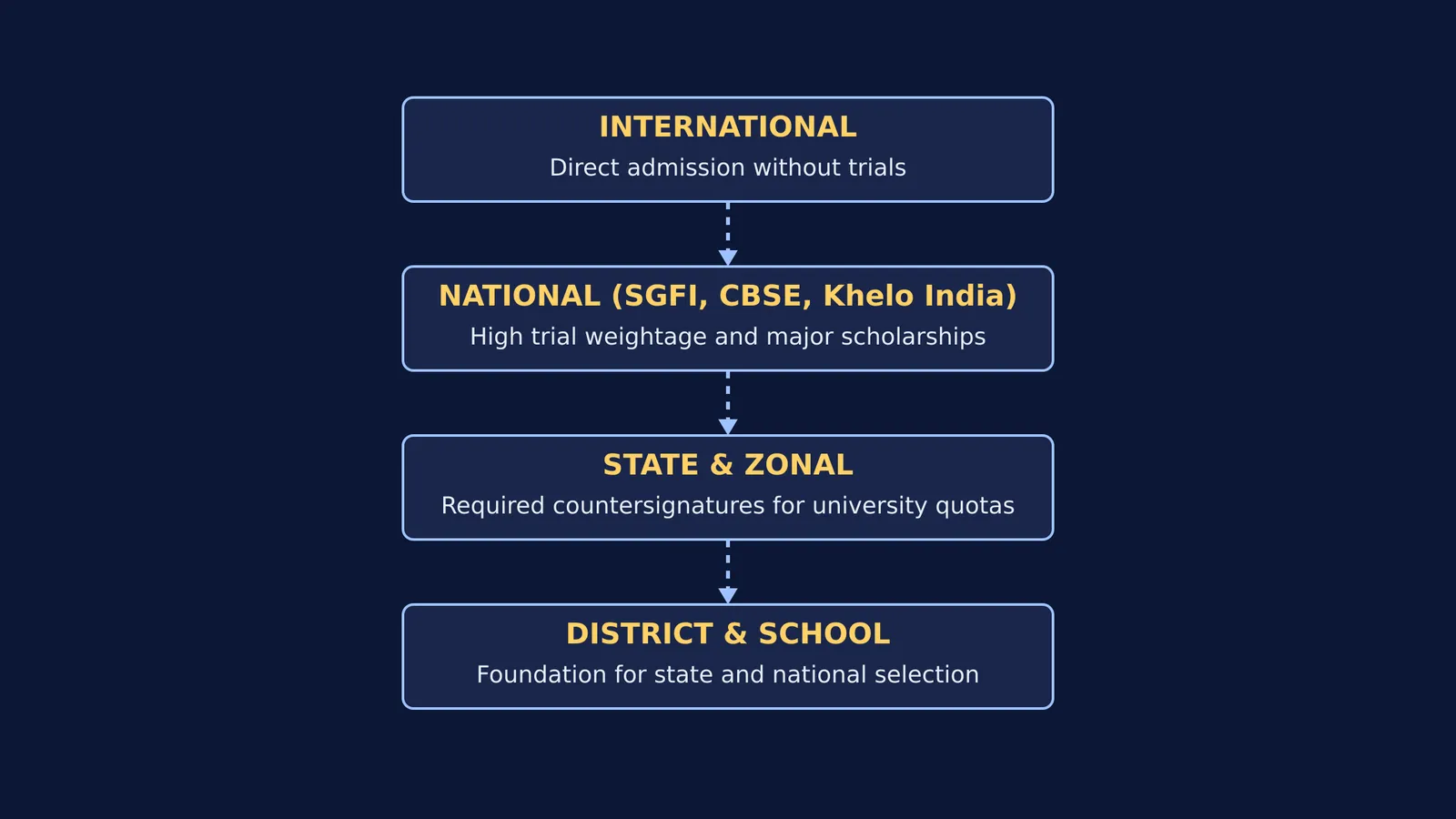
Athletes who have represented India in recognized international competitions, such as the Olympics, World Championships, or Asian Games, are often eligible for direct admission without trials.
When tournament travel pulls you out of school, keeping up with the syllabus can be difficult. If you return to find you have missed foundational lessons, Fermi's AI tutor works out what you already know and builds a plan for the session, helping you catch up at your own pace.
Which certificates are valid for the sports quota?
A drawer full of medals means little if the organizing body is not recognized. For a certificate to hold weight in university admissions, it must be issued by an approved sports federation.
The gold standard for school-level athletes is the School Games Federation of India. However, participation alone is not enough; SGFI certificates must generally be countersigned by the Director of Sports or the Secretary of the State School Games Association to prove their authenticity before universities accept them. SGFI has also integrated with DigiLocker, allowing students to download verified digital versions of their certificates, which simplifies the verification process for universities.
Certificates from CBSE Nationals and recognized National Sports Federations (NSFs) affiliated with the Indian Olympic Association are also widely accepted by most universities (such as the University of Delhi). Universities generally only consider certificates earned in the last three to four years, so recent performance matters most.
If you are struggling with a specific concept after missing a week of classes for a zonal tournament, the Fermi Concept Library covers every concept in physics, chemistry, biology, mathematics and computing, each with its own lesson and its place in the map. You might come back just in time for a physics exam on finding the distance in the nth second or a maths test on quadratic word problems—these resources can close the gap.
Are there scholarships for students who play sports?
Beyond university admissions, top-tier athletes can secure financial backing to support both their education and their sport.
The most prominent initiative is the Khelo India scheme, administered by the Sports Authority of India. Through this program, selected athletes receive an annual scholarship of ₹6.28 lakh, which includes a ₹10,000 monthly out-of-pocket allowance for up to eight years, while the remaining funds cover training, coaching, and sports science support at specialized academies. This scheme is part of the broader National Programme for Development of Sports, which aims to identify talent at the grassroots level.
State governments and public sector organizations, such as ONGC and Indian Oil, also offer monthly stipends to students who win medals at the national level.
What should be in your sports file checklist?
If you plan to apply for a sports quota or scholarship, prepare your documentation well before the admission cycle begins. Use this checklist to build your sports file:
Original certificates: Gather your merit and participation certificates from SGFI, CBSE, or your state federation.
Countersignatures: Check that your state-level and SGFI certificates bear the official seal and signature of the Directorate of Education or the competent state authority.
Validity window: Ensure your best three certificates fall within the last three to four academic years, depending on the specific university guidelines.
Digital backups: Scan your countersigned certificates and save them as clear PDFs. You will need to upload these during registration, such as on the Common Seat Allocation System (CSAS) portal for Delhi University.
Tournament proof: Keep copies of your tournament eligibility forms and official fixture sheets as secondary proof of participation.
By organizing your credentials early, you can focus on your entrance exams and physical trials without scrambling for paperwork at the last minute. The sooner your documentation is ready, the more time you have to balance your training schedules and academic goals.


