

On this page
You know what chlorophyll does. You can draw the chloroplast. Then, in a five-mark answer, you write "chlorophyl" or "heamoglobin", and the examiner has to wonder whether you know the word at all. The fix takes about ten minutes a day: a list of your own problem words, a quick look-cover-write check, and one short test each week.
Why do you keep misspelling the same science words?
Many students misspell the same handful of words again and again, partly because seeing a word in the textbook feels like knowing it. Recognising a spelling and producing it from memory are different jobs, and only the second happens in an exam hall.
In Roediger and Karpicke's 2006 study, students who took recall tests on prose passages remembered more after two days and a week than students who restudied the passages as many times, even though the restudiers felt more confident. A large review by Dunlosky and colleagues rated practice testing and spaced (distributed) practice as the two most useful of ten common study techniques, and rated rereading as low.
Spelling has been tested directly. In three classroom experiments, Jones and colleagues compared retrieval practice, where children wrote words from memory and then checked them, with rainbow writing, where they copied words in different colours. As the Learning Scientists summary reports, in the third experiment second-graders' scores rose by an average of 34% with retrieval practice against 9% with rainbow writing, and the advantage held five weeks later. Those were young children, not Class 11 students, but the idea likely carries over: copying keeps the word in front of you, while writing from memory makes you build it.
How do you build a personal spelling list?
Your list should only hold words you have got wrong or hesitated over, collected from marked tests, practice papers and your notes. Fifteen to twenty-five words is a good working size.
For each word, write one line: the correct spelling, the word split into chunks, your usual wrong version, and a meaning hook. Science words are built from parts that mean something, which helps.
haemoglobin: haem + o + globin. Haem relates to blood, globin is the protein. Your mistake: heamoglobin.
chlorophyll: chloro (green) + phyll (leaf), with a double l at the end. Your mistake: chlorophyl.
oesophagus: oeso + phagus, where phag- means eat, as in phagocyte. Your mistake: esophagous.
phosphorus: the element ends in -us. Phosphorous with -ous belongs in compound names such as phosphorous acid. Your mistake: using -ous for the element.
mitochondrion: the singular. Mitochondria is the plural, so "a mitochondria" is wrong.
Stick to the spelling your textbook uses, and use it the same way every time.
If a word will not stick because you are not sure what it means, that is a concept gap, not a spelling gap. The Fermi Concept Library has every concept in physics, chemistry, biology, mathematics and computing, each with its own lesson, so you can learn the idea behind the word and then come back to the list.
What is look-cover-write-check, and how do you do it?
Look-cover-write-check is a short self-test for one word at a time. Do it by hand, on paper, as in the exam.
Look at the word and say it aloud in its chunks: chloro-phyll.
Cover it with your hand or a card.
Write it from memory, in full.
Check it letter by letter against the original. A tick only counts if every letter matches.
If it is wrong, cover it and write it again straight away, then mark it for tomorrow.
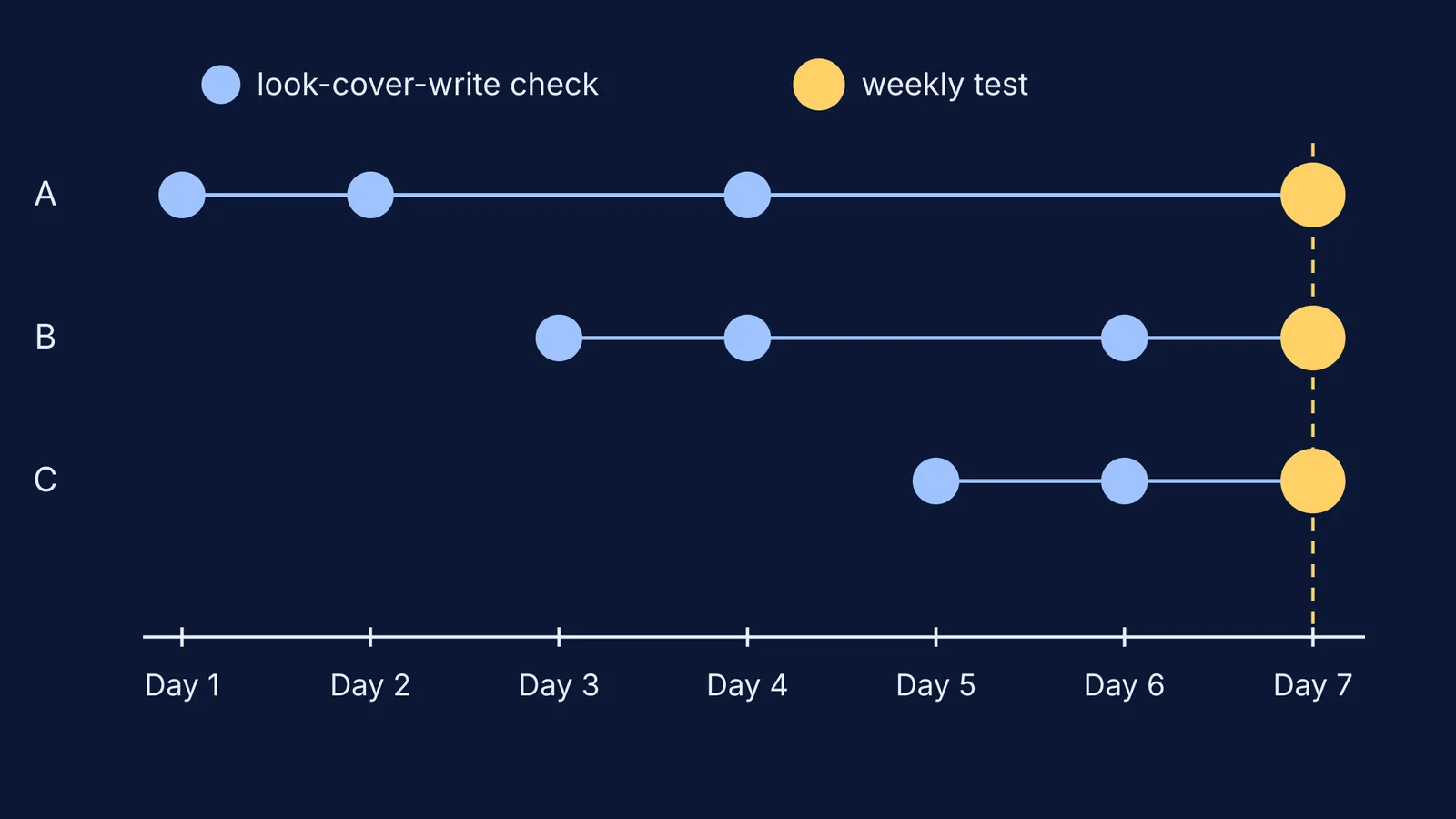
Check each new word on the day you add it, the next day, and two days after that. It then waits for the weekly test. For more on spacing reviews out, see this 4-week spaced revision schedule.
How should you test yourself each week?
Once a week, ask a parent, sibling or friend to read the whole list aloud while you write each word; they need no science. If nobody is free, record yourself saying the words and play it back a day later. To make it closer to an exam, write each word inside a short sentence, then score it.
Right in two weekly tests in a row: move the word to a "safe" list you test once a month.
Wrong: back to daily look-cover-write checks.
New mistakes from this week's tests and homework: add them to the list.
The week at a glance:
Sunday: update the list from marked work (10 minutes).
Monday to Saturday: checks on the words due (5 to 10 minutes).
Weekend: the weekly test, then sort words into "safe" or daily.
If you think in another language, read our guide to studying science in English, and use these tips on making flashcards that work to add your trickiest words to a deck.
Start tonight: open your last marked biology or chemistry test and write down every word the examiner circled.


