On this page
You read "a block slides down a smooth incline" and reach for incline formulas. Often that is the wrong move: what a question asks for says more about the method than the objects in it. This card-sorting drill trains you to spot the method from the question text.
Why do students pick the wrong method for a physics problem?
In a classic study, Chi, Feltovich and Glaser (1981) asked physics novices and experts to sort mechanics problems into groups, and found that experts started from the underlying physics principles while novices started from the problem's surface features.
You can see the difference in the names of the piles. According to Mason and Singh's summary of that study, 75% of the novices made a "springs" pile and 50% made an "inclined plane" pile, while none of the experts used "inclined plane" as a category. Two incline problems can need completely different laws, so a pile named after an object does not tell you where to start.
The good news: when Mason and Singh gave a sorting task to three introductory physics classes, each with more than a hundred students, they found a large overlap between the sorts of calculus-based introductory students and those of graduate students. Sorting by principle is a habit you can build.
How do you recognise the type of a physics problem quickly?
Read the last sentence first: what is being asked? Then scan for clue words. These cues are our own rules of thumb for school mechanics, not laws; use them for a first guess, then check it.
Speed at a different height, or after a spring lets go, with no time asked: try conservation of energy.
Collides, sticks together, explodes, recoils, pushes off: try conservation of momentum.
Acceleration, tension, normal reaction, friction force, at rest or in equilibrium: draw a free-body diagram and use Newton's second law.
How long or how far under a constant force: forces first, then the equations of motion.
Rolls, spins, torque, about an axis: rotational dynamics, often with energy.
Two events in a row, such as a collision and then a swing: split it and name a principle for each stage.
How does the card-sorting drill work?
In the Mason and Singh study, students grouped problems by similarity of solution, explained each group, and were told they did not need to solve any problems.
Copy problem statements from several different chapters onto index cards, one per card.
Shuffle. On the back of each card, write the principle you would start with, in one or two words. Do not solve.
Make piles by principle, not by chapter or object.
Check each card against a worked solution, and note which clue word misled you.
Re-sort the cards you got wrong the next day.
Here is a worked set of six cards.
A: A block slides from rest down a smooth incline of height h. Find its speed at the bottom.
B: A block slides down a rough incline. Find its acceleration.
C: A compressed spring launches a ball straight up. How high does it rise?
D: A heavy skater pushes off a light skater on ice. Find their speeds afterwards.
E: A bullet embeds in a hanging wooden block. How high does the block swing?
F: A mass hangs at rest from a spring. Find the extension.
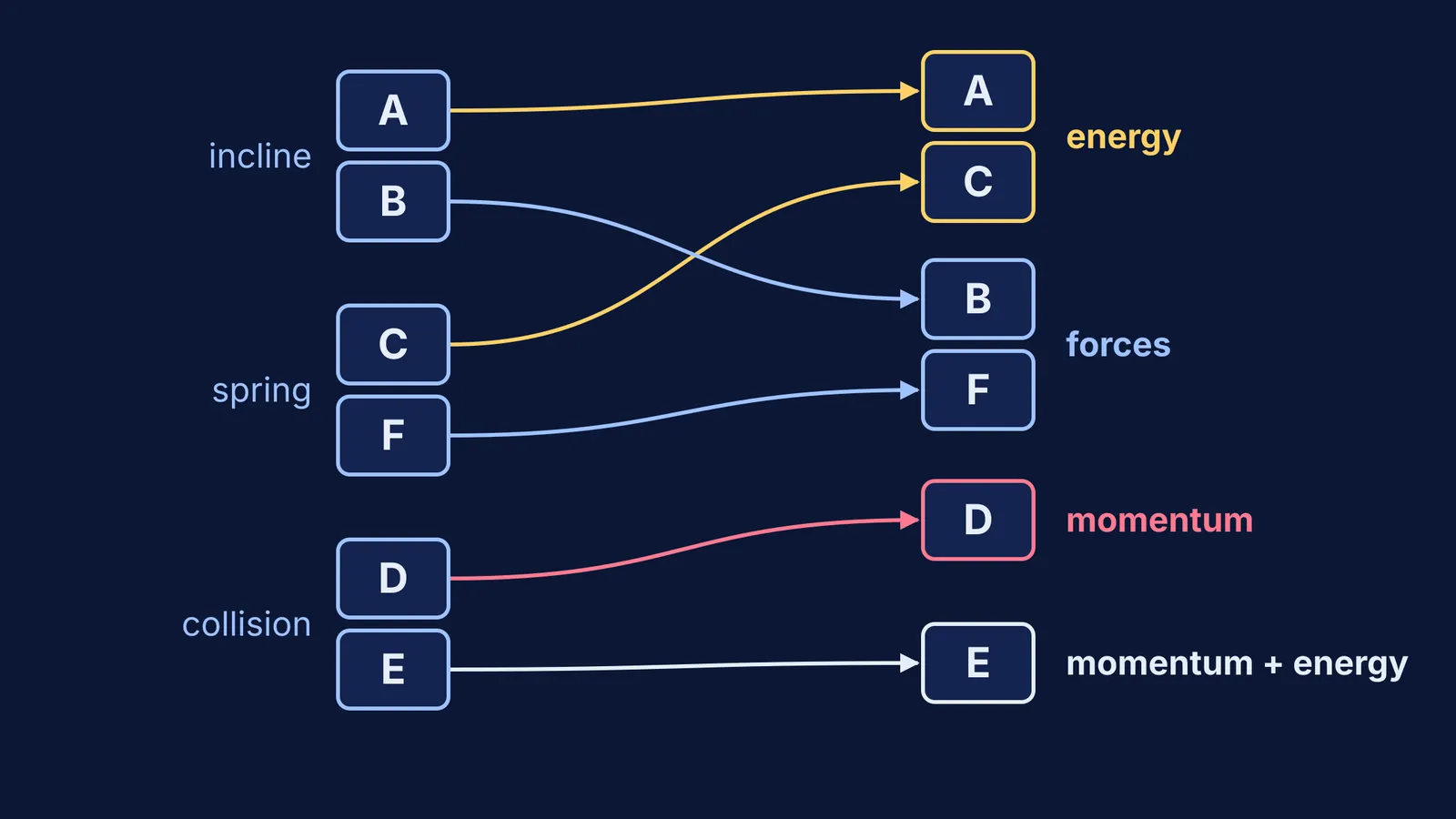
A surface sort gives three tidy piles: incline (A, B), spring (C, F) and collision (D, E). Every one of them is mixed. Sorted by principle, A and C are energy, B and F are forces, D is momentum, and E is momentum for the collision followed by energy for the swing.
If a card keeps landing in the wrong pile, you may be missing the concept, not misreading the question. The Fermi Problem Library has worked problems with a step-by-step solver that explains the reasoning rather than printing an answer, so you can see which principle the first line uses.
How often should you practise sorting before the exam?
Mix the cards; never sort one chapter at a time. In the second of Rohrer and Taylor's 2007 experiments, college students who practised maths problems mixed by type did vastly better on a test a week later than students who practised them blocked by type. Mixing makes you choose the method, which is the exact skill an exam tests. Our guide to interleaved practice and why mixing problem types works has a fuller plan.
A simple routine for the weeks before a test:
Twice a week, sort one shuffled deck in a short sitting.
Add cards from every chapter you finish, so old and new topics stay mixed.
Keep a list of the clue words that fooled you, and read it before each mock test.
In mocks, write the principle in the margin before you start each question.
Sorting tells you where to start. To carry the solution through, see how to solve physics problems step by step, with a worked example.