On this page
Testing software is no longer just about clicking buttons to see what breaks. Today, it is an engineering discipline known as Quality Assurance (QA). As companies push out apps and updates faster than ever, they rely on testers to catch bugs before users do. A single critical flaw in production can lead to security breaches, financial losses, or a damaged reputation.
The industry is growing steadily. According to Grand View Research, the global software testing market was valued at $45.31 billion in 2022 and is expected to grow at 5.0% annually through 2030.
What does a software tester actually do?
A software tester ensures that a product works exactly as it should. They write test cases, run them against the software, and report any failures back to the developers.
There are two main approaches to the job:
Manual testing: The tester acts like a real user, navigating the application to find glitches in the design or logic. This often involves exploratory testing, where the tester creatively tries to break the system in ways a developer might not have anticipated.
Automation testing: The tester writes code to automatically check the software. This is much faster for repetitive tasks, such as regression testing, which ensures that a new feature did not accidentally break an old one.
What is the career path from fresher to SDET?
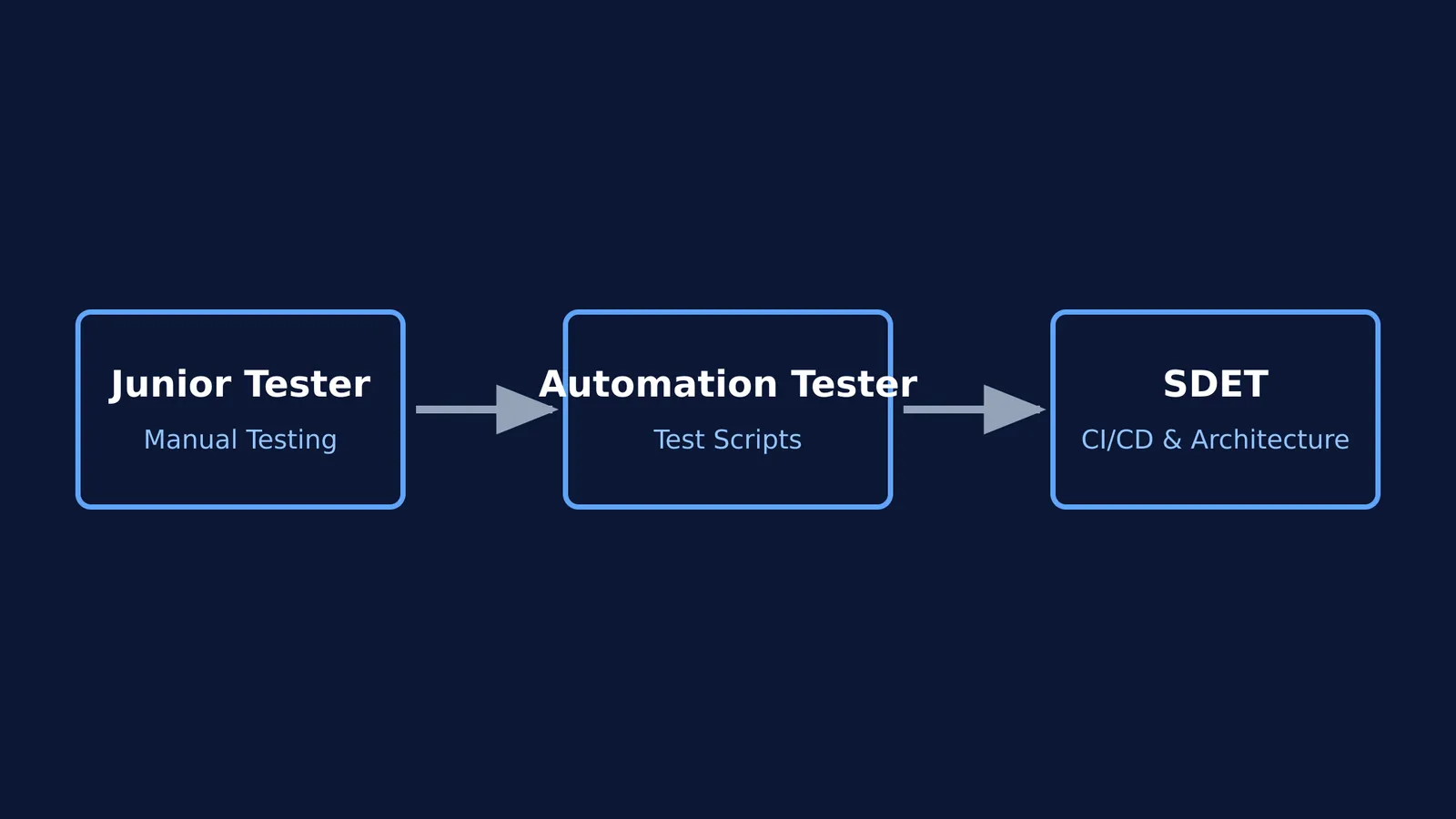
For a fresher, a career in testing often starts as a QA Analyst or Junior Tester. In this phase, you learn the software development life cycle (SDLC) and how to write clear, actionable bug reports.
As you gain experience, the path splits. You can move into a management track as a QA Lead or Test Manager. However, the most popular technical route today is becoming a Software Development Engineer in Test (SDET). An SDET is a developer who specialises in testing. They build complex frameworks that automatically test the application every time a developer changes the code.
This process, often part of a Continuous Integration and Continuous Deployment (CI/CD) pipeline, ensures that software is always in a releasable state. Because SDETs bridge the gap between development and testing, they are in high demand and often command higher starting salaries.
The US Bureau of Labor Statistics projects 106,100 job openings per year on average for software developers, quality assurance analysts, and testers over the coming decade.
What skills do you need to start?
While some roles still accept manual-only testers, many opportunities require a mix of skills.
Programming basics: You need to know at least one language like Python, Java, or JavaScript to write automation scripts.
Testing tools: Familiarity with frameworks like Selenium or Playwright is a huge advantage.
API testing: Modern applications rely heavily on Application Programming Interfaces (APIs) to communicate. Learning tools like Postman to test APIs before the user interface is even built is highly valued.
Database queries: Basic SQL helps you verify that data is saved correctly.
Communication: Testers constantly negotiate with developers to get bugs fixed without causing friction.
If you are brushing up on fundamental logic, the Concept Library has every concept in physics, chemistry, biology, mathematics and computing, each with its own lesson and its place in the map. This helps when learning how software architectures fit together. If you get stuck while learning to write your first automation scripts, Fermi's AI tutor holds a line of reasoning across a whole session, notices where a student is stuck, and decides whether to explain, ask, or show.
How do you land your first testing role?
You do not need a computer science degree to become a tester, but you do need to prove you can do the job. Start by learning the basics of manual testing and the Agile methodology. Then, pick up Python or Java and write a few simple automation scripts for a public website.
You may also consider studying for the ISTQB (International Software Testing Qualifications Board) Foundation Level certification. While not strictly required, it provides a structured introduction to testing terminology and proves your foundational knowledge to recruiters.
What is a 30-day learning plan for freshers?
Days 1 to 7: Learn the software development life cycle (SDLC) and practice writing detailed bug reports.
Days 8 to 14: Pick one programming language (Python is a great start) and learn loops, variables, and functions.
Days 15 to 21: Learn an automation framework like Selenium or Playwright to control a web browser with code.
Days 22 to 30: Write an automated test for a public website (like an e-commerce login page) and put the code on GitHub as your portfolio.
It is also useful to understand the broader trends in tech. Knowing which skills matter more as AI spreads can help you focus on areas like test strategy rather than just routine execution. If you are a parent helping your child navigate these choices, it is completely normal when your child's career choice differs from yours — the modern tech industry has many paths that did not exist a decade ago.