

On this page
Why is textbook reading speed so slow in science?
Sitting down with an NCERT physics or chemistry chapter often feels like hitting a wall. You might glide through general articles easily, but a single page of electromagnetism or organic reaction mechanisms can take twenty minutes to finish. Students often assume this sluggish pace reflects poor focus or reading fluency, but cognitive science demonstrates that technical text is processed through completely different mental mechanics.
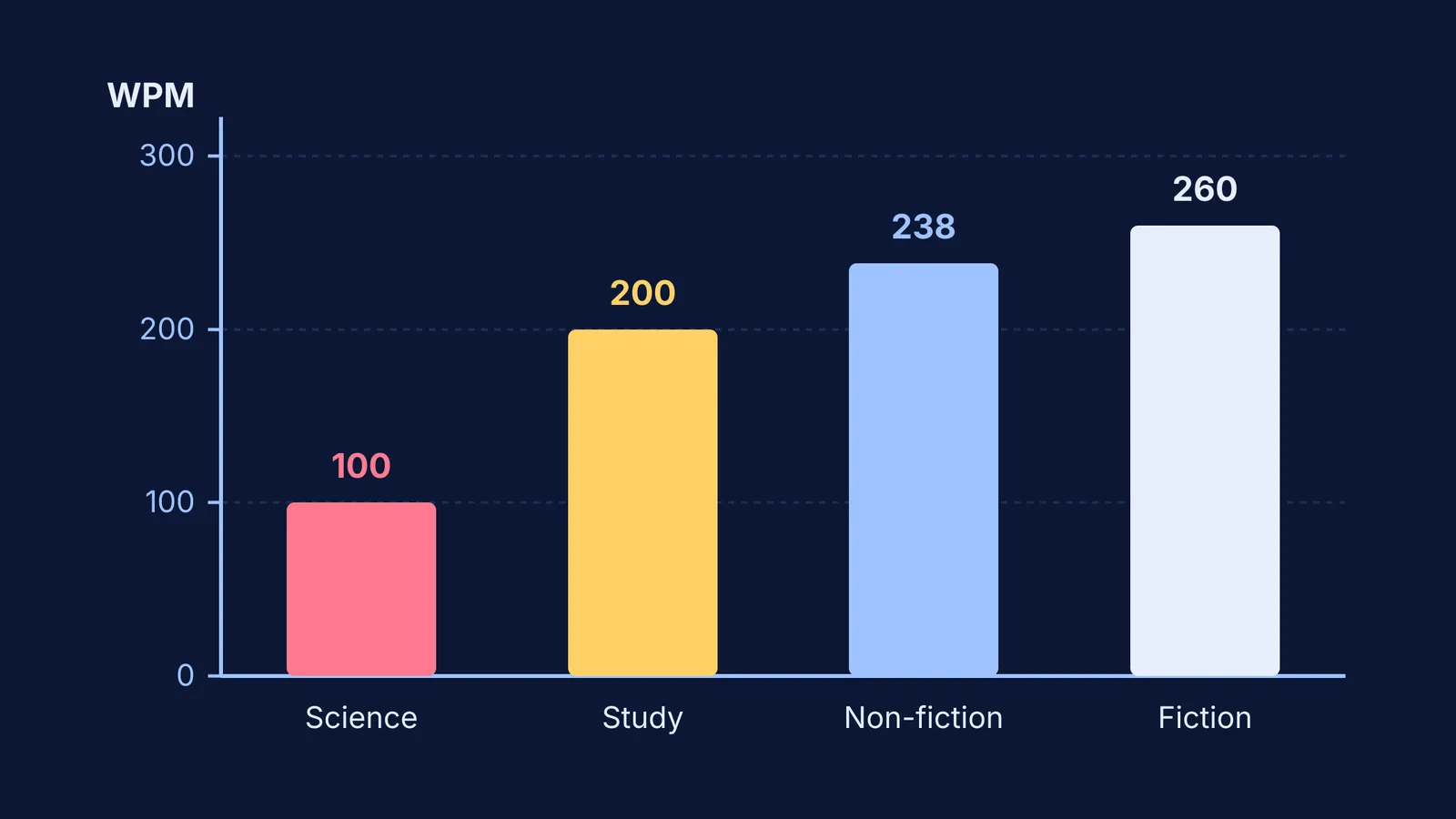
A comprehensive meta-analysis of 190 studies and 18,573 participants published in the *Journal of Memory and Language* by Marc Brysbaert (2019) established that silent non-fiction reading averages 238 words per minute. However, that baseline assumes standard continuous prose where grammar carries meaning. Science textbooks are fundamentally different: they pack dense conceptual dependencies, symbolic equations, and spatial diagrams into every paragraph.
Reading researcher Ronald P. Carver demonstrated in *Reading Research Quarterly* that readers operate in distinct cognitive gears. While typical reading ("rauding") proceeds at roughly 300 words per minute, shifting into deep study or technical learning drops the optimal processing rate to between 100 and 200 words per minute. In dense STEM chapters where terms are mathematically constrained, processing speed naturally settles between 75 and 125 words per minute. Attempting to force a faster pace causes sentence comprehension to break down.
How does reading line by line overload working memory?
Reading a science textbook line by line bottlenecks working memory. Eye-movement research synthesized in *Psychological Bulletin* reveals that readers fixate on words for 225 to 250 milliseconds and dedicate 10% to 15% of their saccades to regressions (moving their eyes back to re-read earlier words). When text introduces unfamiliar scientific laws, regressions spike as the brain resolves logical contradictions.
A landmark review in *Psychological Science in the Public Interest* by Keith Rayner and colleagues confirmed that there is an unavoidable trade-off between reading speed and comprehension. Speed-reading techniques that attempt to eliminate eye pauses or inner speech sacrifice the very cognitive operations needed to understand complex material.
Technical textbooks are demanding because words alone do not carry the message. Eye-tracking experiments published in the *Journal of Memory and Language* by Mary Hegarty and Marcel Just (1993) showed that readers do not inspect text and illustrations in separate passes. Instead, they make rapid, alternating eye movements between sentence fragments and diagram components to assemble an animated mental model of the system. Reading line by line forces your brain to hold abstract verbal definitions in temporary storage while hunting for visual counterparts.
When static textbook diagrams make it hard to visualize physical processes, Fermi Simulation Lab provides interactive simulations for ideas that are easier to see than to read.
Why should you preview headings and diagrams first?
Linear reading is inefficient for STEM subjects because you enter each paragraph with no schema to organize incoming terms. When you preview headings, subheadings, bold terms, and summary boxes before reading the text, you provide your brain with an advance cognitive scaffold.
Inspecting figures and graphs first establishes visual spatial anchors. When you later encounter a technical sentence—such as how a magnetic field exerts force on a moving charge—your mind already possesses a mental picture of the vectors. This approach relies on dual coding with diagrams and notes, allowing your verbal and visual working memory to divide the cognitive load rather than competing for limited bandwidth.
If missing background knowledge makes a chapter difficult to navigate, the Fermi Concept Library maps every concept across physics, chemistry, biology, mathematics, and computing with individual lessons placed in context.
How does reading with a question change text comprehension?
Passive reading treats every word on the page with equal priority. Cognitive psychologists Matthew McCrudden and Gregory Schraw explained this in *Educational Psychology Review* through the Goal-Focusing Model. Their research showed that when readers receive pre-reading questions or relevance instructions, they allocate attention selectively: they read goal-relevant sentences more deliberately, construct clearer mental models, and retain core mechanisms significantly better.
Instead of asking "What does page 42 say?", start by turning subheadings into investigative questions. For instance, turn "Factors affecting capacitance" into "What physical change doubles the stored charge?" This shifts your mindset from passive decoding to how to read a science textbook actively. Pairing this with asking why while studying forces you to evaluate whether each sentence actually answers your target query.
A five-step active reading framework for STEM chapters
To stop feeling guilty about your reading pace and improve factual retention, replace linear reading with this structured routine:
Survey the section landscape: Spend three minutes scanning the section title, bold subheadings, formulas in boxes, and the final summary paragraph to map the chapter's architecture.
Turn subheadings into target questions: Write two or three specific questions in your margins based on what the section promises to explain.
Decode figures before paragraphs: Examine the diagram, identify what each axis or arrow represents, and read the caption before diving into the body text.
Read in learning gear: Read through the section at a deliberate pace of roughly 100 words per minute, stopping whenever a sentence directly answers your target question (Carver, 1982).
Close the book and retrieve: Before moving forward, cover the page and write down the core mechanism or formula derivation from memory.
When a derivation stalls your reading session, Fermi's AI tutor can work out what you already know and teach through the problem by writing on a board and checking your understanding as you go.


