

On this page
When navigating your first semester at college, the sudden freedom over your own schedule can feel intoxicating. Unlike school, nobody stands at the gate taking roll call every morning. If a professor spends an hour reading bullet points off a projector screen, it is tempting to believe your time is better spent studying alone in your hostel room or the library. But is it actually okay to skip lectures in college?
Why is class attendance the strongest predictor of college grades?
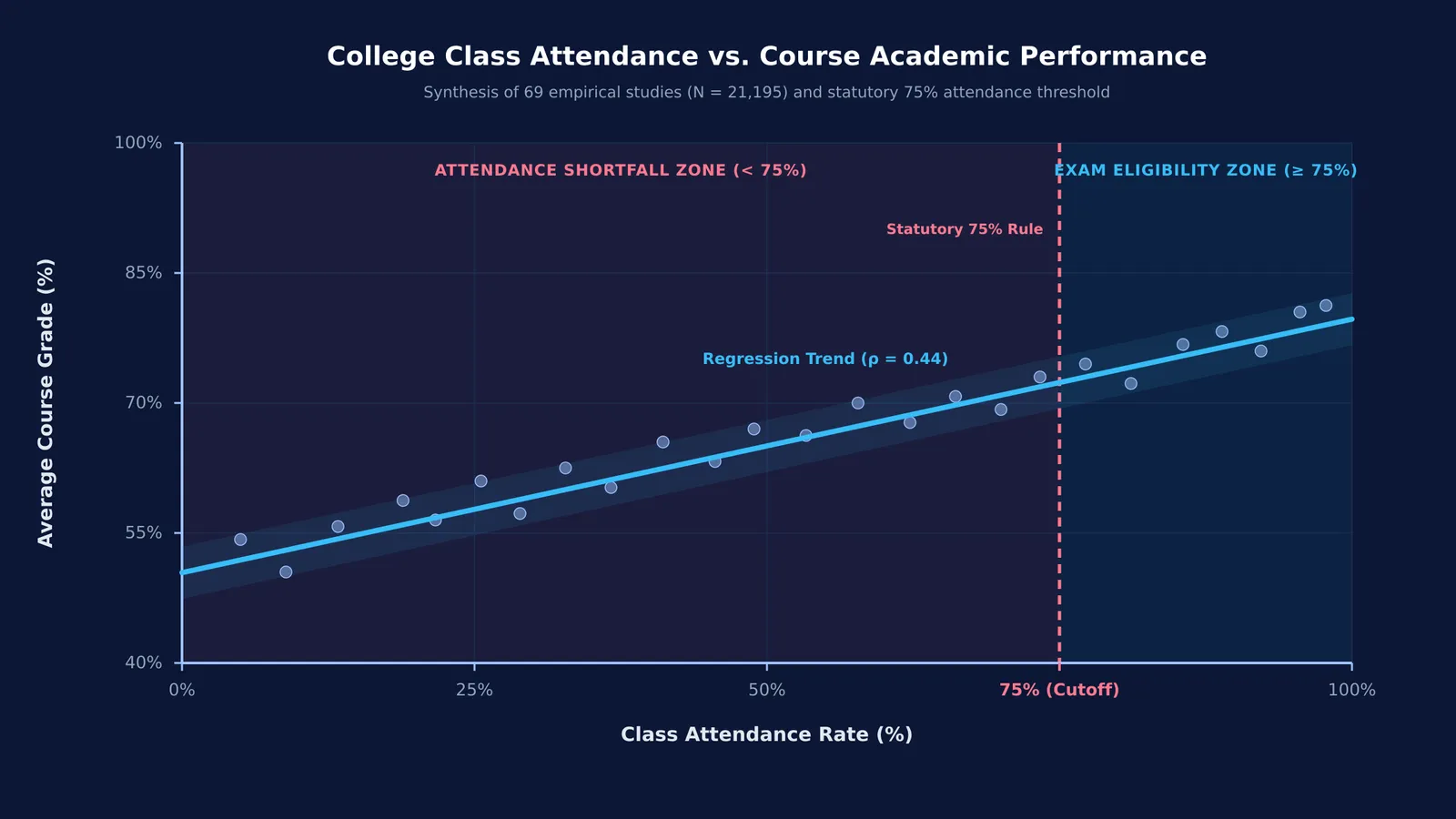
Academic research consistently shows that attending class is the single best predictor of your academic grades, surpassing even prior test scores and study habits. In a landmark meta-analysis published in the *Review of Educational Research*, researchers Marcus Credé, Sylvia Roch, and Urszula Kieszczynka analysed data across 69 studies covering 21,195 college students (Credé et al., 2010). They found that class attendance correlated strongly with individual course grades at 0.44 and with overall GPA at 0.41. Remarkably, attendance explained more unique variance in college performance than standardized entry test scores or high school GPA.
Earlier econometric work by David Romer in the *Journal of Economic Perspectives* uncovered similar patterns across undergraduate university courses (Romer, 1993). Romer documented that student absenteeism averaged roughly 33%, and attendance alone accounted for nearly 31% of the variation in exam scores. Even after controlling for student ability and homework completion, attending lecture had a significant, positive causal impact on final marks. Presence in class provides structural rhythm: you hear which points the instructor emphasizes, observe live problem-solving missteps, and absorb contextual framing that textbooks omit.
How do attendance rules and debarment work in Indian colleges?
Beyond learning gains, attendance is a rigid institutional requirement across Indian higher education institutions. Under the guidelines of the University Grants Commission (UGC), universities ordinarily enforce a minimum requirement of 75% attendance across lectures, practicals, and tutorials to be eligible to sit for end-semester examinations. The All India Council for Technical Education (AICTE) applies the same 75% threshold to engineering institutes, while regulatory bodies for medical education mandate up to 80% attendance in laboratory and clinical sessions.
Most institutions calculate attendance subject-wise. If your attendance slips below the 75% cutoff in a single subject, you cannot balance it with 95% attendance in another. Colleges typically allow condonation—a relaxation of up to 10%, lowering the threshold to 65%—only for documented medical emergencies or official university representation. Falling below this condonation floor results in exam debarment (detention), forcing you to re-register for the course and carry a backlog into subsequent semesters. Protecting this buffer is essential to any sensible semester plan to improve your college CGPA.
Why does watching recorded lectures fail to make up for missed classes?
Many students justify skipping live classes by planning to watch recorded lectures at double speed later in the week. However, empirical findings show that recorded lectures rarely replace the benefits of attending live sessions. A matched-cohort study published in *Higher Education* evaluated what happened when recorded lecture capture was introduced (Edwards and Clinton, 2019). Access to recordings caused a significant drop in physical lecture attendance, but viewing the recordings did not compensate for the resulting drop in exam grades.
The issue is behavioural: when attendance is optional, students allow recordings to accumulate until exam week, leading to passive binge-watching without active recall or problem solving. Furthermore, econometric analysis by Wiji Arulampalam, Robin Naylor, and Jeremy Smith in the *Economics of Education Review* demonstrated that missing class imposes a direct negative causal effect on grades, with the penalty falling heaviest on high-achieving students (Arulampalam et al., 2012). While tackling mind wandering in lectures takes deliberate mental effort, being physically present forces active engagement that passive playback rarely matches.
How should you decide which lectures matter most?
Not all lectures offer equal value. A dense mathematical derivation taught by an engaged professor provides far more learning value than an instructor simply reading textbook slides verbatim. When evaluating whether skipping a particular lecture makes strategic sense, apply this four-question triage checklist:
The Attendance Safety Check: Is your verified attendance in this specific subject currently sitting safely above the statutory 75% cutoff mandated by university regulations, leaving a comfortable margin for unforeseen illnesses or emergencies?
The Session Format Test: Is the class an interactive tutorial, laboratory demonstration, or discussion session where attendance directly generates marks or hands-on practice?
The Active Replacement Plan: Do you have an immediate, scheduled block of focused self-study ready to run during that exact hour, rather than spending it scrolling or sleeping?
The Examination Signal Factor: Does this instructor share specific homework problem walkthroughs, exam formats, or syllabus emphasis that do not appear in the prescribed textbook?
If a lecture fails the Attendance Safety Check or covers high-signal problem solving, you should always attend. If you do make a deliberate exception for an unengaging slide-reading session, you must immediately convert that hour into active study.
How do you catch up when you have to miss a lecture?
When illness or unavoidable scheduling conflicts force you to miss class, execute a rapid recovery protocol within 24 hours:
Borrow and compare two sets of notes: Never rely on a single classmate's summary. Cross-referencing notes from two peers highlights which derivations or definitions the professor spent the most time explaining.
Isolate key concepts and derivations: When you miss an introductory theoretical topic or a dense derivation, the Fermi Concept Library covers every concept across physics, chemistry, biology, mathematics and computing, each with its own lesson and its place in the concept map.
Work through practice problems actively: If the missed session was a numerical tutorial or problem-solving class, the Fermi Problem Library provides worked problems with a step-by-step solver that explains the reasoning rather than printing an answer.
Build a structured study routine: To structure your catch-up time efficiently after falling behind, Fermi's AI tutor can work out what you already know and build a plan for the session so you sit down to a clear next step.
Missing an occasional lecture will not ruin your degree, provided you protect your attendance buffer and execute a disciplined study plan. But treating class attendance as optional is a costly gamble that decades of academic evidence strongly advise against.


