

On this page
Six months left for board exams how to study?
Six months is enough time to comfortably cover the syllabus and lock it in. But if you treat it as one long block of time, you risk coasting at the start and cramming in the final weeks.
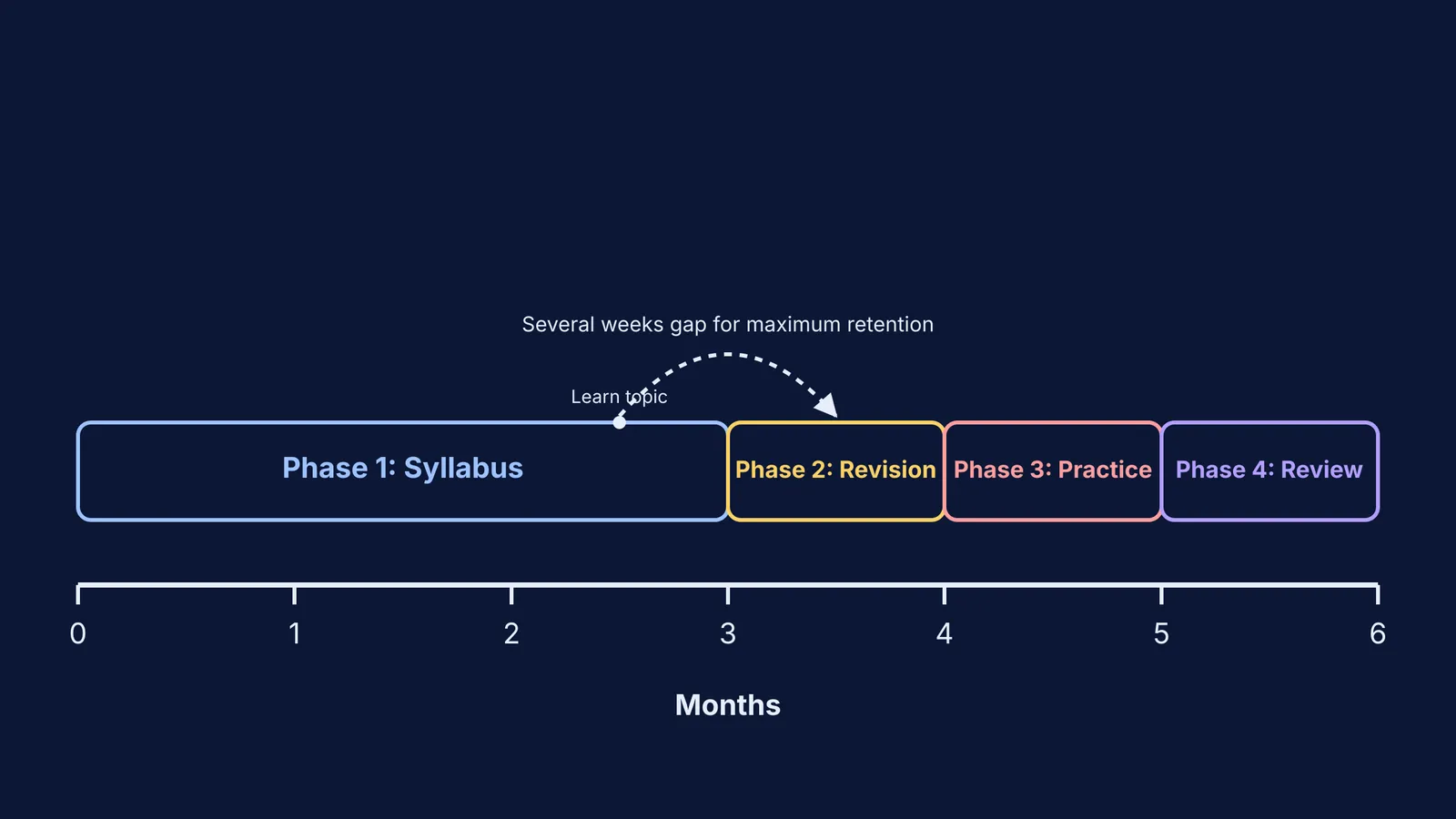
Instead, split your remaining time into a four-phase plan. This structure forces you to finish new material early, avoids the trap of endless note-taking, and builds in the exact spacing your memory needs to perform on exam day.
Here is the framework:
Phase 1: Syllabus completion (Months 1 to 3). Focus on reading, understanding, and solving the first round of textbook questions.
Phase 2: First revision (Month 4). Revisit the concepts you learned in Phase 1, using spaced practice.
Phase 3: Sample papers (Month 5). Move from chapter-wise study to full-length, timed exams.
Phase 4: Final review (Month 6). Polish your weak spots, memorise standard proofs, and regulate your sleep.
If you do not know where to begin your revision, Fermi's AI tutor can work out what you already know and build a plan for the session, so you sit down to a clear next step.
How do I split my time between new topics and revision?
In the first three months, your primary goal is to finish the syllabus. However, you should not wait until you have finished every single chapter to start revising. Your brain needs time to forget and relearn.
A 2008 study of over 1,350 people found that for a six-month test delay, the optimal gap between learning and reviewing a topic is several weeks (Cepeda et al., 2008). If you learn a chapter on thermodynamics in week two, reviewing it in week six gives you the strongest long-term retention.
Month 4 is built into the schedule precisely to catch those topics from earlier months. When you revisit a chapter in Month 4, do not just read the textbook again. Try to write down everything you remember on a blank sheet of paper, and then fill in the gaps.
If you hit a topic that makes no sense the second time around, the Fermi Concept Library holds every concept in physics, chemistry, biology, mathematics and computing, each with its own lesson and its place in the map.
Why is practice testing better than rereading?
By Month 5, you should put your notes away and switch entirely to solving timed sample papers.
Rereading highlights and notes makes you feel fluent because the information is right in front of you, but testing is what actually builds memory. In a 2006 study, students taking a practice test without feedback retained substantially more material on a delayed test than those who spent the exact same amount of time rereading the text (Roediger & Karpicke, 2006). The struggle to retrieve an answer from your memory is what strengthens the neural pathway to it. (Our deeper look at study techniques rated explores why this works so well).
When you take sample papers, simulate exam conditions. Sit at a desk, set a timer for three hours, and do not look at your phone. When you make a mistake on a paper, do not just read the correct answer from a marking scheme. The Fermi Problem Library has worked problems with a step-by-step solver that explains the reasoning rather than printing an answer.
What should I do in the final month before boards?
Month 6 is for final, calm review. This is not the time to start learning heavy new chapters from scratch.
Instead, look over the mistakes you made during your Month 5 sample papers. Focus on memorising the standard, predictable questions that appear every year, such as physics derivations in CBSE boards.
You should also use this month to fix your body clock. If you have spent the last five months studying late into the night, your brain will be sluggish during morning exam hours. Shift your sleep schedule so that you are awake, alert, and doing active problem-solving between 9:00 AM and 12:00 PM.
Finally, remember that the board exams are a marathon. If the pressure ever feels overwhelming, talk to a parent or teacher, or call the free national Tele MANAS helpline at 14416.


