

On this page
Your phone can record a two-hour class with no effort, so it feels like a free safety net. The research on lecture recordings, mostly from university courses, says it catches less than you expect. A recording helps when you go back to it soon, for a reason, and for a few minutes.
Does recording a lecture actually help?
It can, as an extra. It does not replace being in the room and paying attention.
A UK study by Martin Edwards and Michael Clinton compared one second-year module before and after recordings were introduced, with 161 and 160 students, and found that attendance "substantially dropped" once recordings were available (Higher Education, 2019). Watching the recordings did not make up for the effect of low attendance on marks.
A University of Aberdeen study by Emily Nordmann and colleagues found a kinder picture for first-year students: attendance and recording use both predicted better results (Higher Education, 2019). Weaker students benefited from recordings used as a supplement, but only stronger students' use of recordings helped overcome low attendance. The authors suggest providing recordings for "supplementary use".
Why do most class recordings never get replayed?
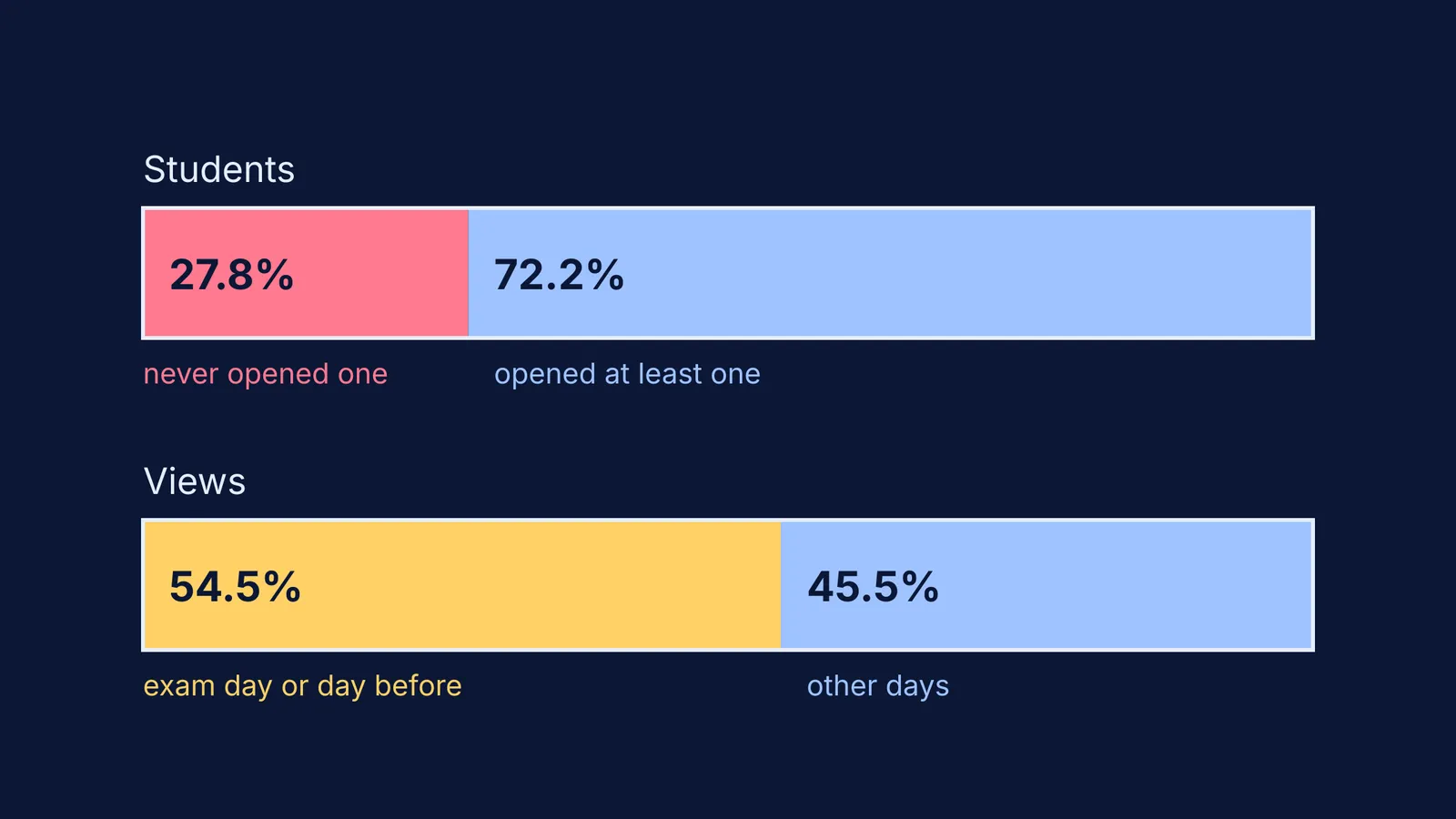
In a 2025 study of 299 students in three biology courses at Trent University, Kirk Hillsley found that 27.8% never opened a single lecture video (FEBS Open Bio, 2025). Of all the views, 54.5% came on the day of the exam or the day before: "later" often arrives all at once.
In the same study, spikes of viewing above a student's own usual level went with lower exam scores, while students who watched more overall tended to score higher. These are associations, not proof of cause, but the author reads them as favouring steady habits over cramming.
Replaying a whole class is also passive. Henry Roediger and Jeffrey Karpicke found that students who tested themselves on prose passages remembered substantially more after two days and after a week than students who restudied them, even though restudying made them more confident (Psychological Science, 2006). Relistening from start to finish is restudying.
How do you use a recording for a targeted relisten?
Imperial College London's student guide suggests recalling the main points first, finding your gaps, and rewatching "specific sections" related to those gaps, ideally within two to three days (Imperial College London). Here is that as a routine for your phone.
In class, mark the moment. When something loses you, write the recording time in the margin with a question mark, such as "22:40 ? why sin θ".
The same evening, recall first. Close your notes and write the main ideas from memory. Every blank or shaky point joins your list.
Relisten only the marked minutes. Start a little early and pause as soon as it clicks. Write the explanation in your own words.
Test the fix. Do one question that uses the idea, without your notes.
Rename or delete. Keep a clip only if it is still useful, renamed by topic.
Worked example. In a long physics class on rotational motion, you lose the thread twice: when torque is written as r F sin θ, and when the moment of inertia of a rod about its end is derived. Your margin says "22:40 ?" and "61:05 ?". That evening you can state the torque formula but cannot say where sin θ comes from. You play from 22:10 until you can, write two lines in your own words, then solve one torque problem. The rod derivation you now recall without help, so you skip that clip.
Sometimes the relisten shows that the gap is an idea you never had, and hearing the same words again will not fix it. The Fermi Concept Library gives every concept in physics, chemistry, biology, mathematics and computing its own lesson and its place in the map, so you can go back a step. If the gap is in applying the idea, the Fermi Problem Library has worked problems with a step-by-step solver that explains the reasoning rather than printing an answer.
When should you record, and when should you skip it?
In the Hillsley study, more than a quarter of students never opened a recording at all (FEBS Open Bio, 2025), so be honest with yourself before you press the button.
Record when:
the class is fast and dense, such as a long derivation, and you will relisten that week
you have to miss a class and will listen to all of it within a week, taking notes as if you were there, as Imperial's guide suggests
your school has agreed to recording as support for a learning need
Skip it when:
having it on your phone makes you switch off in class
you already know you will not open it
your teacher has said no, or classmates are sharing personal things
Parents: instead of "Are you recording your classes?", ask "Which bit did you relisten to this week, and can you explain it to me now?"
Next class, try one timestamp in the margin and one short relisten that evening.


