

On this page
For years, students preparing for Indian competitive exams have trained on "free navigation" papers. In a three-hour exam like JEE Main, you can jump freely between Physics, Chemistry, and Mathematics at any point. This format allows a very popular testing strategy: students often rush through the Chemistry section and "borrow" that saved time for the more calculation-heavy Mathematics questions.
But a growing number of testing agencies are abandoning this flexible format and adopting strict sectional time limits. The Common Admission Test (CAT), for example, assigns a strict 40-minute limit to each section. Once the countdown timer for a section ends, the system immediately locks those questions, and any unused time cannot be carried over to the next subject.
How do sectional time limits affect exam pacing?
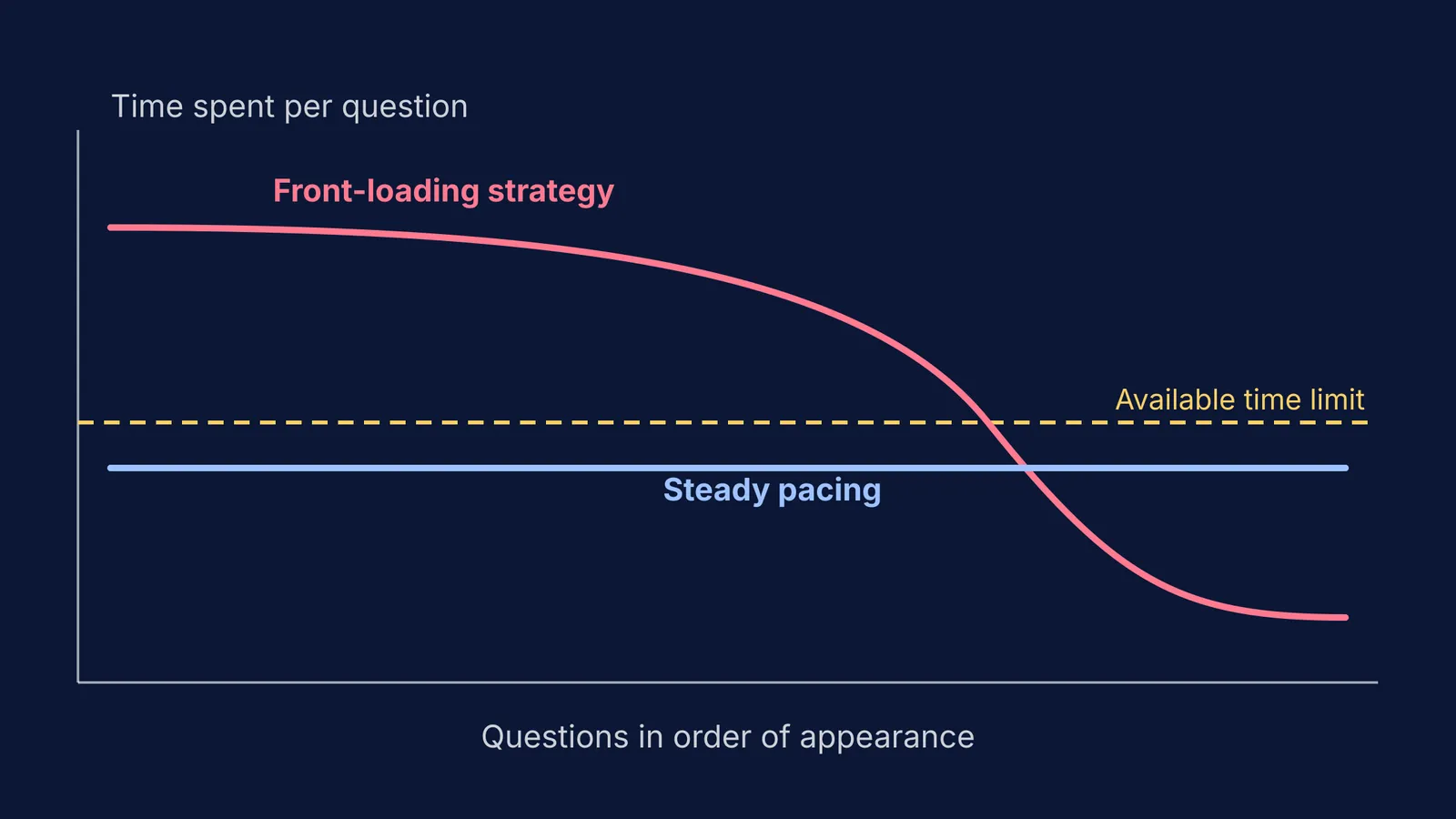
When the exam clock is rigid, a poor time-per-item strategy in the first ten minutes can ruin an entire section. A 2004 study published in the journal Academic Medicine analyzed how examinees managed their test pacing when taking a strictly timed section of the United States Medical Licensing Examination (USMLE). The researchers found that test-takers consistently used maladaptive pacing strategies, spending too much time at the beginning of a section.
Instead of keeping a steady and mathematically logical pace, students tended to use significantly more than the average allotted time at the beginning of a section. For instance, one group of students spent an average of 82 seconds on early items even though they only had an average of 78 seconds available per question.
This behavior created a compounding time debt. By the end of the section, these same students were forced to rush frantically, spending only 66 seconds per item. This imbalance led to a sharp drop in their accuracy and a much higher rate of incomplete papers. The study found that even when the examiners gave students more total time, the students simply shifted their strategy to spend even more time on the initial items, maintaining the exact same end-of-section drop-off.
What is the best strategy for a timed section?
When you cannot borrow time from another subject, you have to manage the clock within the section itself. This requires a mental shift from a "solve everything in order" mindset to one that prioritizes momentum, integrating Time management in the exam hall: a two-pass plan for JEE and NEET.
Calculate your strict time budget: Before you enter the exam hall, divide the sectional time by the total number of questions. For example, in a 24-question, 40-minute CAT section, you have exactly 100 seconds per question. This is your absolute limit for an average question.
Use a two-pass approach: Read through the section and answer the obvious, fast questions first. If a question clearly takes more than your time budget, leave it and move on. This guarantees you secure all the easy marks before the clock runs out, preventing the front-loading trap entirely.
Never ego-solve: In a free navigation exam, spending five minutes on a difficult physics problem might just mean you have to rush later. In a sectionally timed exam, a five-minute problem directly costs you four other questions you might have known the answer to. If you are stuck, abandon the question immediately.
Practice with a strict timer: Taking a mock test without a running clock builds a false sense of security. You must train your brain to recognize exactly what 70 seconds feels like while you are working. You can build this into your routine when considering How to analyse a mock test: a 60-minute review routine.
How can Fermi help find your time sinks?
One of the hardest parts of preparing for a timed exam is identifying which specific types of questions act as your personal "time sinks". Many students struggle to understand why they keep running out of time, assuming they simply need to read faster. This is where Fermi's AI tutor changes how you prepare for exam day.
When you bring a problem set or a scanned assignment, the tutor works out what you already know and builds a plan for the session. If you consistently spend three minutes on a kinematics question that should take 60 seconds, the tutor notices where the line of reasoning breaks down and steps in to help.
You can then practice these specific, time-consuming problem types in the Fermi Problem Library, which features a step-by-step solver that explains the reasoning rather than printing an answer. By fixing the conceptual gaps that slow you down, you can flatten your pacing curve, stop the end-of-section rush, and discover How to build a study routine that lasts longer than a week.


