

On this page
Teaching science after a Master of Science (MSc) opens two distinct paths in India: teaching senior secondary classes in schools or lecturing undergraduates in colleges. The rules for each track are set by national bodies, and deciding early saves time and effort. While both roles require a deep understanding of your subject, the daily responsibilities and the mandatory qualifications differ significantly.
How to become a science teacher in a school after MSc?
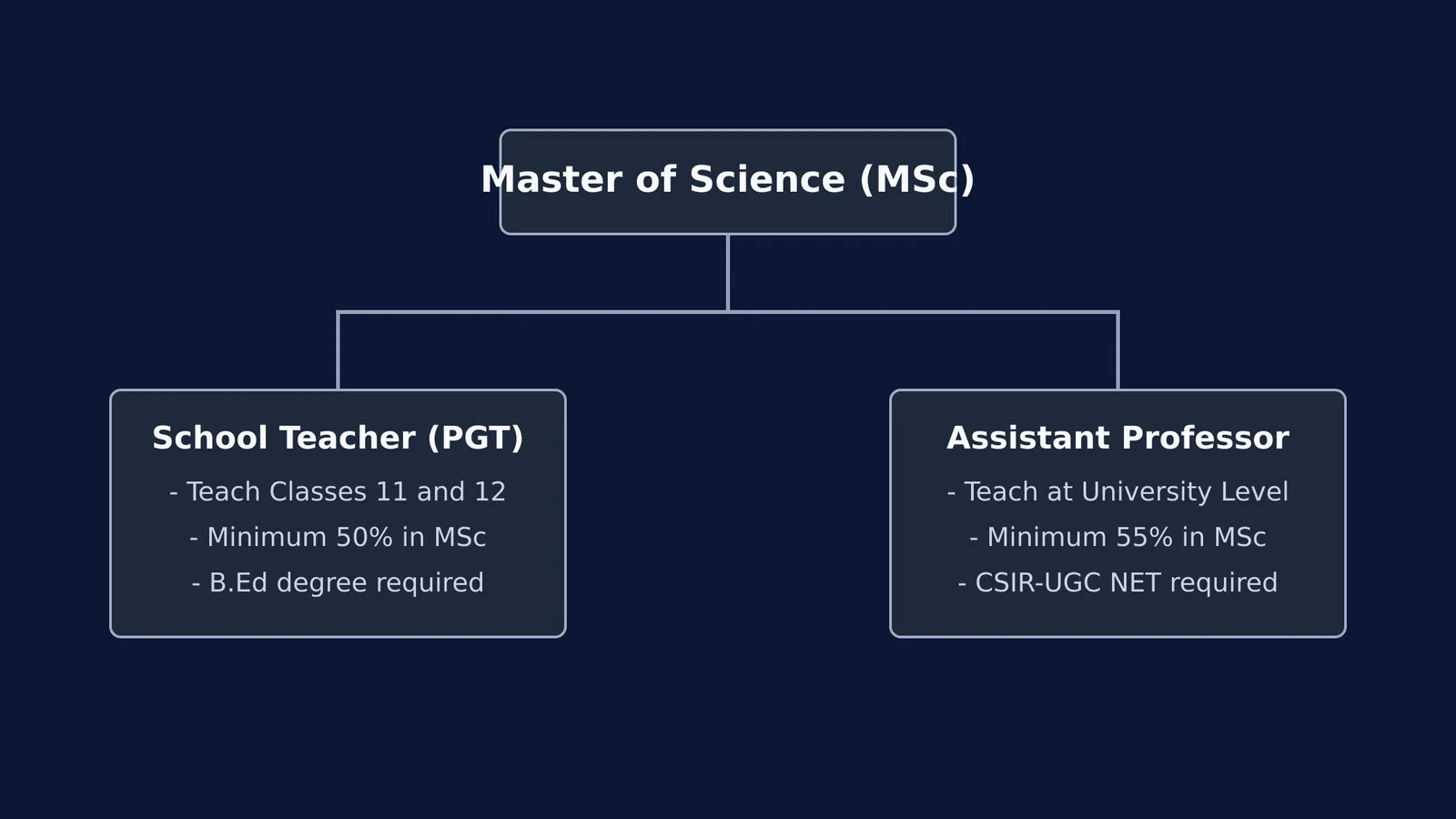
To teach Physics, Chemistry or Biology to Classes 11 and 12, you must qualify as a Post Graduate Teacher (PGT) according to the NCTE. The National Council for Teacher Education (NCTE) defines the minimum qualifications for these school appointments.
A candidate must hold a Master’s degree with at least 50% marks in the relevant subject based on these rules. You must also complete a Bachelor of Education (B.Ed) from an NCTE-recognised institution. While the Central Teacher Eligibility Test (CTET) is mandatory for primary and middle school teachers, it is not yet a strict national requirement for PGTs, though some private schools prefer it.
State boards, central government schools and private schools often have their own age limits for PGT applicants, so you should check the specific notifications when applying.
What do you learn in a B.Ed program?
Instead of teaching you more science, a B.Ed program focuses entirely on the science of teaching. You will study educational psychology, classroom management, and assessment techniques. You will also complete practical teaching practice in a real school. This hands-on training ensures you know how to break down complex topics like electromagnetism or organic chemistry for teenagers who are seeing them for the first time. As a PGT, your primary job is to prepare students for their board exams and competitive entrance tests, requiring excellent communication and patience.
How to become a college lecturer after MSc?
If you prefer teaching at the university level, a B.Ed is not required. Instead, you must clear a national qualifying exam to become an Assistant Professor.
The University Grants Commission (UGC) mandates that general category candidates must secure at least 55% marks without rounding off in their Master's degree as per UGC NET guidelines. Candidates from reserved categories (SC, ST, OBC, PwD) require at least 50% marks.
Unlike school teaching roles, there is no upper age limit for applying for Assistant Professor eligibility through the UGC NET. If you are in the final year of your MSc, you can take the exam provisionally, provided you complete your degree.
What does the CSIR-UGC NET involve?
For science postgraduates, the CSIR conducts the NET in subjects including Chemical Sciences, Earth Sciences, Life Sciences, Mathematical Sciences, and Physical Sciences. The exam tests both your deep subject knowledge and your general aptitude for research and analysis. It is a computer-based, multiple-choice test. Clearing the exam gives you the formal eligibility to apply for Assistant Professor vacancies in colleges across the country. In a college setting, you have more academic freedom and will often balance teaching with your own research projects.
Preparing for the NET requires deep conceptual clarity across your entire MSc syllabus. If you find gaps in your understanding while revising, the Fermi Concept Library maps every concept in physics, chemistry, biology, mathematics and computing, each with its own lesson.
A practical checklist for your final year
If you are nearing the end of your MSc and want to teach, taking the right steps now will save you a gap year.
Aim for high marks: Keep your aggregate marks strong to ensure you remain eligible for both school and college teaching paths.
Pick your track: Decide whether you prefer the structured curriculum of school teaching or the advanced academics of a university.
Register for your qualification: If you choose schools, apply for a B.Ed program immediately after your MSc. If you choose colleges, download the CSIR-UGC NET syllabus and start solving past papers.
Build a revision routine: Block out time every week to review fundamental concepts from your bachelor's and master's courses.
Stay updated: Research scholarships for science students in India to help fund your higher education. You might also find it helpful to read about talking about STEM careers beyond engineering and medicine if you are discussing this choice with family.


