On this page
Many exhibition halls have the same familiar models: a volcano, a solar system and a sensor kit that beeps. Judges see them often. A model they remember does something simpler. It asks one question, shows a working answer, and the student who built it can explain every part of it.
What do judges look for in a school science exhibition model?
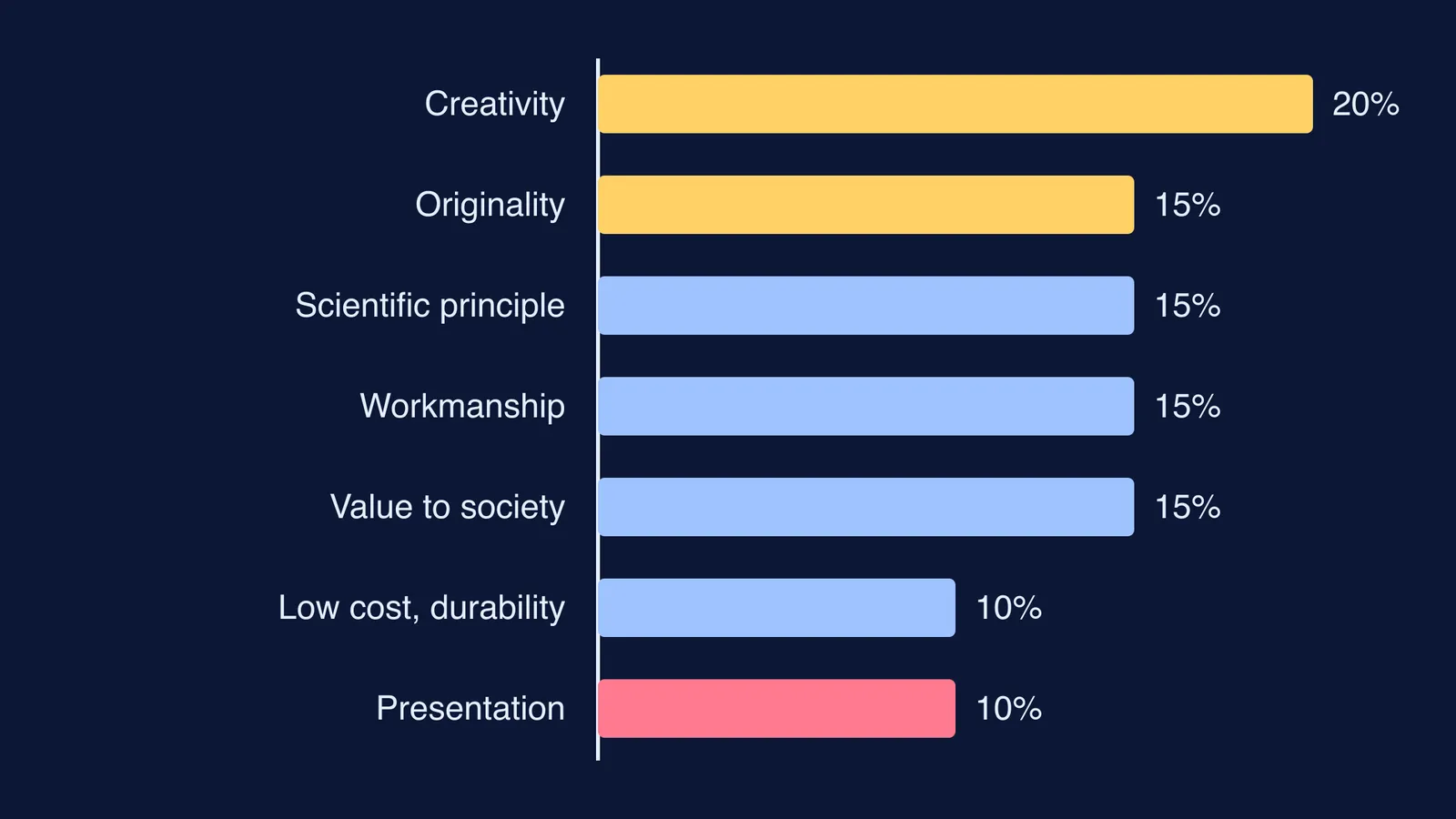
CBSE's circular for the 2025-26 Science Exhibition lists seven judging criteria, each with a weight.
Creativity and imagination: 20%
Originality and innovativeness: 15%
Scientific thought, principle or approach: 15%
Technical skill, workmanship and craftsmanship: 15%
Educational value, scalability and use to society: 15%
Low cost, portability and durability: 10%
Presentation, meaning the display and your explanation: 10%
Creativity and originality together make up 35% of the score in that CBSE circular. The same circular allows three kinds of project: an investigation-based study, an application of basic principles of science and technology, or a new solution or indigenous design for a real problem. CBSE forwards the names of its national winners to NCERT for consideration as entries in the Rashtriya Bal Vaigyanik Pradarshani 2026. Other boards and school fairs may use different rules, so ask your teacher which criteria your exhibition follows.
How do you choose a working model with a clear question?
A working model earns marks when it answers a question you can say in one sentence ending with a question mark. Run your idea through four checks:
One line: can you state the question without using the word "and"?
One change: can you change one thing and measure what happens?
One principle: can you name the science behind it, such as pressure, friction or evaporation?
Your own spark: did the idea start with something you noticed at home, at school or on the way there?
The Department of Science and Technology's INSPIRE-MANAK scheme asks for the same kind of start. Its official FAQ says children "may be urged to look around for common problems and come up with solutions on their own". It also asks for a specific title, such as "A device to climb Areca nut trees", rather than a broad theme like Agriculture.
What does a testable exhibition question look like?
Weak start: "Model of a desert cooler." It shows something that already exists. Stronger: "Does a wet cotton cloth around a steel tumbler cool the water inside more in front of a fan than in still air?"
What you change: the airflow, with the fan on or off.
What you keep the same: the amount of water, its starting temperature, the cloth and the room.
What you measure: water temperature every five minutes for half an hour, recorded in a table and drawn as a graph.
The principle: evaporating water takes heat from the surface it leaves.
Why it matters: cheap cooling for homes without a fridge.
We have not run this test. Your own readings are the result, including any surprises.
Why do copied kit projects score badly?
The INSPIRE-MANAK FAQ lists common textbook ideas it does not encourage. The list includes rainwater harvesting, converting solar energy to electricity, hydraulic lifts, automatic street lights, volcano demonstrations, solar system models and "RFID and sensor based readymade projects". The same FAQ says parents or teachers may suggest a problem or help turn a child's idea into a model, but should not suggest the idea itself.
A kit gives you the idea, the parts and the build steps. That leaves little for the creativity and originality marks in the CBSE list above. Sensors are fine as measuring tools. Start from your question, then pick the sensor that answers it.
How should you explain your model to judges?
Practise a 60-second explanation in this order, out loud, until you can give it without notes:
The question: "We wanted to find out whether moving air makes a wet cloth cool water faster."
Why you asked it: "In summer our steel bottle gets warm, and not every home has a fridge."
The principle: "When water evaporates, it takes heat away from the cloth and the tumbler."
What you did: say what you changed, what you kept the same and what you measured.
What you found: point to your graph, and mention anything that did not go to plan.
Expect follow-up questions like "Why did you choose this?", "What happens if you change this part?" and "How much did it cost?" (low cost is one of the scored criteria). "I don't know yet, but I would test it by..." is an honest answer and shows how a scientist thinks.
The Fermi Concept Library has a lesson on every concept in physics, chemistry, biology, mathematics and computing, so you can check that you can explain the principle behind your model in your own words. To rehearse the follow-up questions, Fermi's AI tutor can ask you questions and check your understanding as it goes.
Write your question in one sentence today, show it to someone at home, and ask them what they would want to know next.