

On this page
It is late October and your teacher is still on chapter 8. Board exams don't move because a school ran behind, so the gap is now yours to close. Here is a plan, with a worked example from Class 12 Physics.
What should you do if your school has not finished the syllabus?
Start with the official list, not your memory. CBSE publishes the curriculum for every subject on its academic website, and the current page covers the 2026-27 session. Download your subject's PDF and mark each chapter as one of three things:
Done and understood: taught in class, and you can solve the exercises.
Done but shaky: taught, but you couldn't do the back exercises without help.
Not taught: your school hasn't reached it.
Read the note at the end of each syllabus too. The 2026-27 Physics curriculum says content marked in NCERT textbooks as excluded for 2026-27 is not to be tested by schools and will not be assessed in the 2026-27 board exams, so don't spend evenings on parts that are out.
Which chapters should you study first?
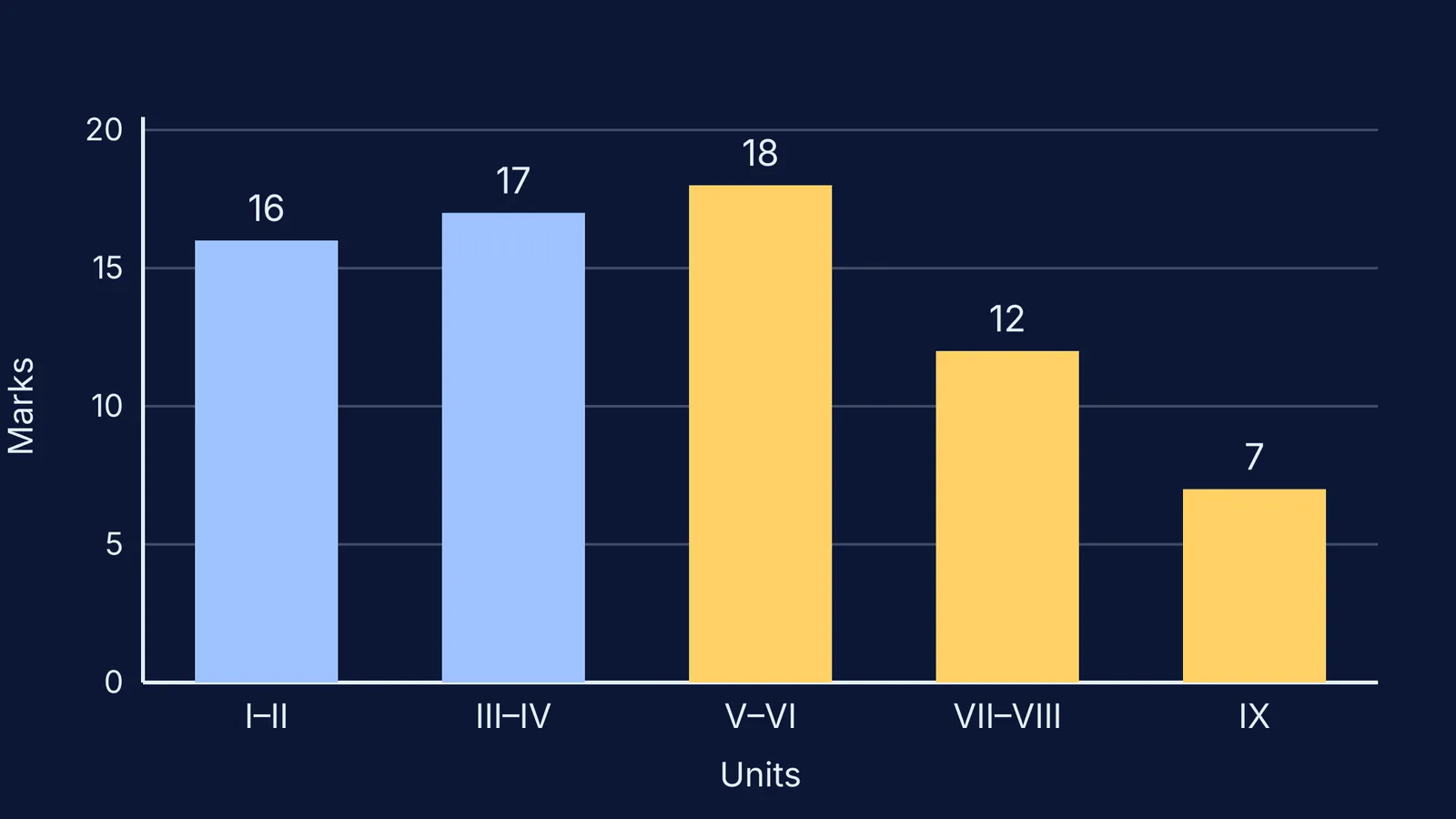
Order by marks, not by chapter number. The same Physics curriculum gives the Class XII theory paper 70 marks, split unevenly: 16 for electrostatics and current electricity, 17 for magnetism, induction and alternating current, 18 for electromagnetic waves and optics, 12 for dual nature, atoms and nuclei, and 7 for semiconductor electronics.
Worked example. Say your school has finished chapters 1 to 8 and six are left: ray optics, wave optics, dual nature, atoms, nuclei and semiconductors. Those six sit inside unit groups worth 37 of the 70 theory marks (18 + 12 + 7, though the 18 also covers electromagnetic waves, which you've done). A sensible order:
Ray optics and wave optics first: the heaviest group, and ray diagrams need practice.
Dual nature, atoms and nuclei next: shorter chapters, mostly formula-based numericals.
Semiconductors last: the lightest unit, and your school may still reach it.
If your school does cover a chapter later, that class becomes your revision instead of your first contact.
Which resources should you use to self-study?
For CBSE, three are enough:
The NCERT textbook for the chapter, which the curriculum lists as the prescribed book.
CBSE's sample papers and marking schemes. The board has posted sample question papers and marking schemes for exam 2026-27; the marking scheme shows what an answer needs to earn its marks.
DIKSHA, the learning platform from the Ministry of Education and NCERT, which has textbooks and explanation videos, and links to material through QR codes printed in textbooks.
When a chapter rests on an idea you never properly learned (say, refraction at a curved surface before lenses), look up that one idea in the Fermi Concept Library, which gives every concept in physics, chemistry, biology, mathematics and computing its own lesson, then go back to the textbook. For the first sitting with a tough chapter, see our guide to learning a hard chapter from scratch.
How do you set a pace you can keep?
Count sessions, not hours. A budget we suggest is five 45-minute sessions per chapter: two to read and make notes, two for the NCERT exercises, one for sample-paper questions on that chapter. Six chapters is 30 sessions; at four a week alongside school, that is about eight weeks. Put the sessions in your calendar now, with one spare evening a week for slippage.
Don't finish a chapter and drop it. A 2013 review of ten study techniques by Dunlosky and colleagues rated practice testing and distributed practice as high utility, because they helped learners of different ages and abilities across many kinds of tests. In practice: each week, answer a few questions from chapters you finished earlier. Our spaced revision schedule shows how to time those returns.
How do you get your teacher's help with doubts?
Self-study doesn't mean studying alone. Collect doubts in one notebook as you go, write each one precisely, and bring two or three at a time. A script that works:
"Ma'am, I've started ray optics on my own because we may not reach it before the pre-boards. I'm stuck on the sign convention in question 4 of the exercises. I got minus 20 cm and the answer is plus 20 cm. Could you check where my method goes wrong?"
That shows effort and names the exact step. More in how to ask better questions in class. If a numerical goes wrong between meetings and you can't see why, the Fermi Problem Library has a step-by-step solver that explains the reasoning, so you can compare its method with yours line by line.
Start today with the syllabus PDF and a pencil: the list is the plan.


