

On this page
Pursuing an MBBS in India spans 54 months of academic coursework across three phases and a 12-month compulsory rotating medical internship (CRMI) regulated by the National Medical Commission. Unlike three-year degrees, medical students must fund five and a half years of tuition, hostel charges, expensive textbooks, and clinical tools. Whether entering through state counselling or exploring the AFMC Pune MBBS admission path, planning your scholarship applications early makes this long journey financially predictable.
Which government scholarships support MBBS students in India?
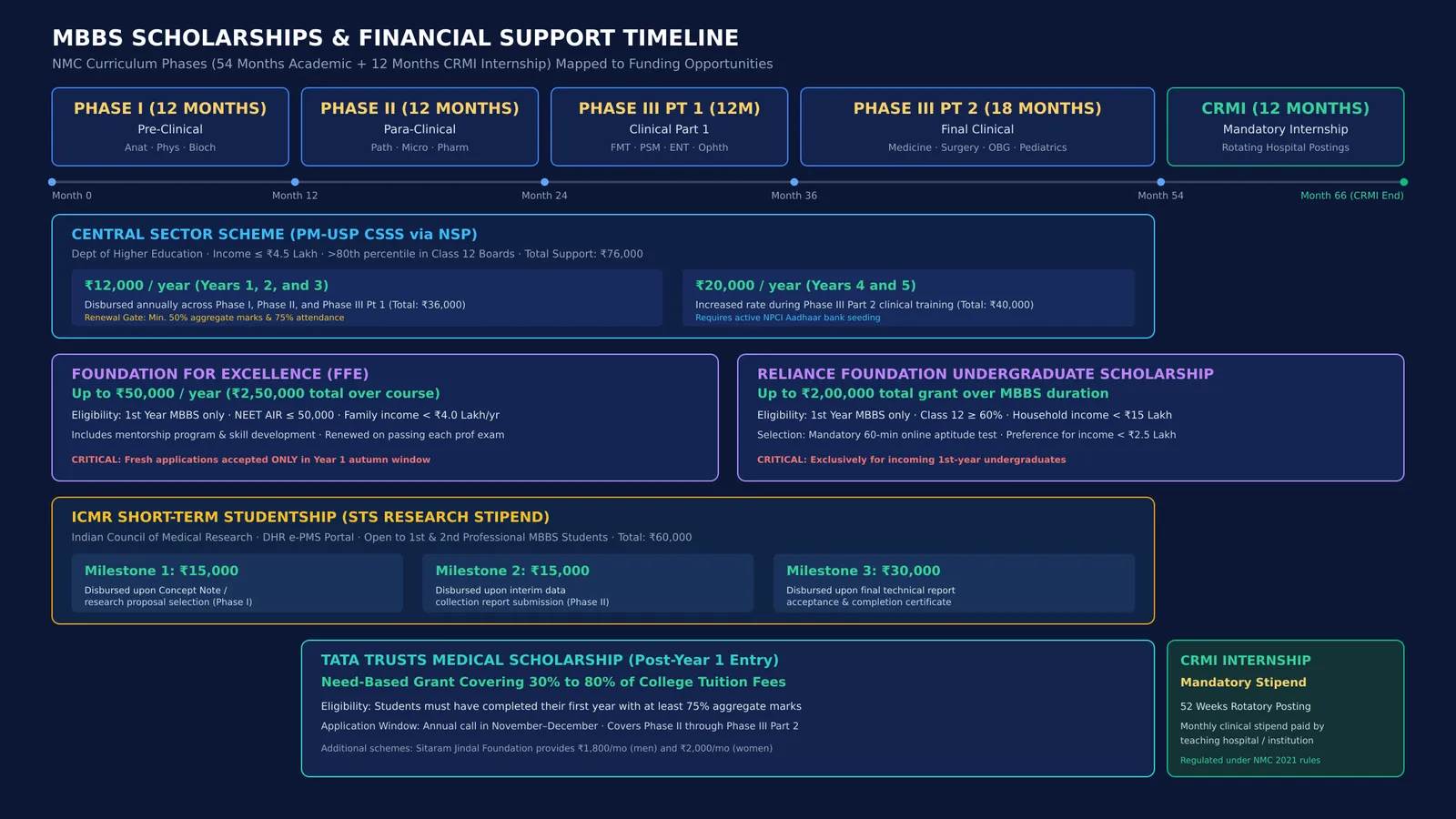
Central and state programs provide merit-cum-means funding through the National Scholarship Portal. The Central Sector Scheme of Scholarship for College and University Students (PM-USP CSSS), run by the Department of Higher Education, supports students above the 80th percentile in their Class 12 boards with family income up to ₹4.5 lakh. It pays ₹12,000 per annum for the first three years and ₹20,000 per annum in the fourth and fifth years, delivering ₹76,000 across the degree. Renewal requires at least 50% marks in annual exams and 75% attendance.
The University Grants Commission runs the Ishan Uday scheme for students from the North Eastern states, providing ₹7,800 per month for professional courses to families earning under ₹4.5 lakh. State portals also run Post-Matric Scholarships for SC, ST, and OBC students, covering tuition and monthly maintenance allowances. Our guide to scholarships for science students in India details broader eligibility criteria.
What private trusts and foundation grants fund medical college?
Private philanthropic trusts offer critical aid for living and equipment expenses. The Foundation for Excellence Scholarships supports first-year MBBS students who secured a NEET All India Common Merit Rank up to 50,000 with gross family income below ₹4.0 lakh per annum. It awards up to ₹50,000 annually across the entire course alongside mentorship programs.
The Reliance Foundation Undergraduate Scholarships program provides up to ₹2,00,000 over the degree. First-year MBBS students with at least 60% in Class 12 and household income under ₹15.0 lakh (preference under ₹2.5 lakh) qualify through an online aptitude test. Later in your course, Tata Trusts provides grants covering 30% to 80% of tuition fees for students who completed their first year with at least 75% aggregate marks. The Sitaram Jindal Foundation offers monthly stipends of ₹2,000 for female students and ₹1,800 for male students.
How can MBBS students earn stipends through ICMR research?
Medical students can earn research income during their degree through the Indian Council of Medical Research Short-Term Studentship (STS) via the Department of Health Research e-PMS portal. Open to first- and second-professional-year MBBS and BDS students, the scheme awards a total stipend of ₹60,000.
The stipend is paid in three milestone instalments: ₹15,000 upon proposal approval, ₹15,000 on interim data submission, and ₹30,000 upon final report acceptance. Around 2,000 students receive awards each year under a faculty guide. When preclinical students transition into medical school, managing dense coursework in biochemistry and cellular physiology demands solid foundational concepts. The Fermi Concept Library maps every concept across biology and chemistry to help students review foundational pathways and molecular mechanisms when starting their preclinical terms.
How should families plan financially for the 5.5-year course?
Under National Medical Commission regulations, MBBS comprises 54 months of coursework divided into Phase I (12 months), Phase II (12 months), Phase III Part 1 (12 months), and Phase III Part 2 (18 months), followed by 12 months of mandatory rotatory internship. Budgeting across this duration requires accounting for hidden costs:
Diagnostic instruments: Stethoscopes, blood pressure cuffs, tendon hammers, and bone sets require an initial outlay of ₹10,000 to ₹25,000.
Textbooks: Standard clinical volumes cost ₹15,000 to ₹30,000 annually if bought new; library copies and second-hand editions reduce this.
Mess charges: Hostel mess bills in government colleges add ₹40,000 to ₹60,000 per year.
Internship income: The final 52 weeks of compulsory internship provide a monthly hospital stipend.
Immediately after the NEET UG counselling process, apply for trust grants in your first year, set up Aadhaar bank seeding for government schemes, and submit an ICMR STS research proposal. Balancing clinic postings, lab assignments, and scholarship renewal benchmarks requires disciplined time management. Fermi's AI tutor works out what a student already knows and builds a plan for the session, helping learners structure demanding study blocks alongside intense academic schedules.


