

On this page
When time is short before a board exam or competitive test like JEE or NEET, the standard advice is to solve more numericals. But if you fully solve every problem in your question bank, carrying out the algebra and calculating the final decimal, you will quickly run out of hours.
The hardest part of a physics or maths exam is rarely the arithmetic. It is looking at a new, unseen problem and knowing exactly where to start.
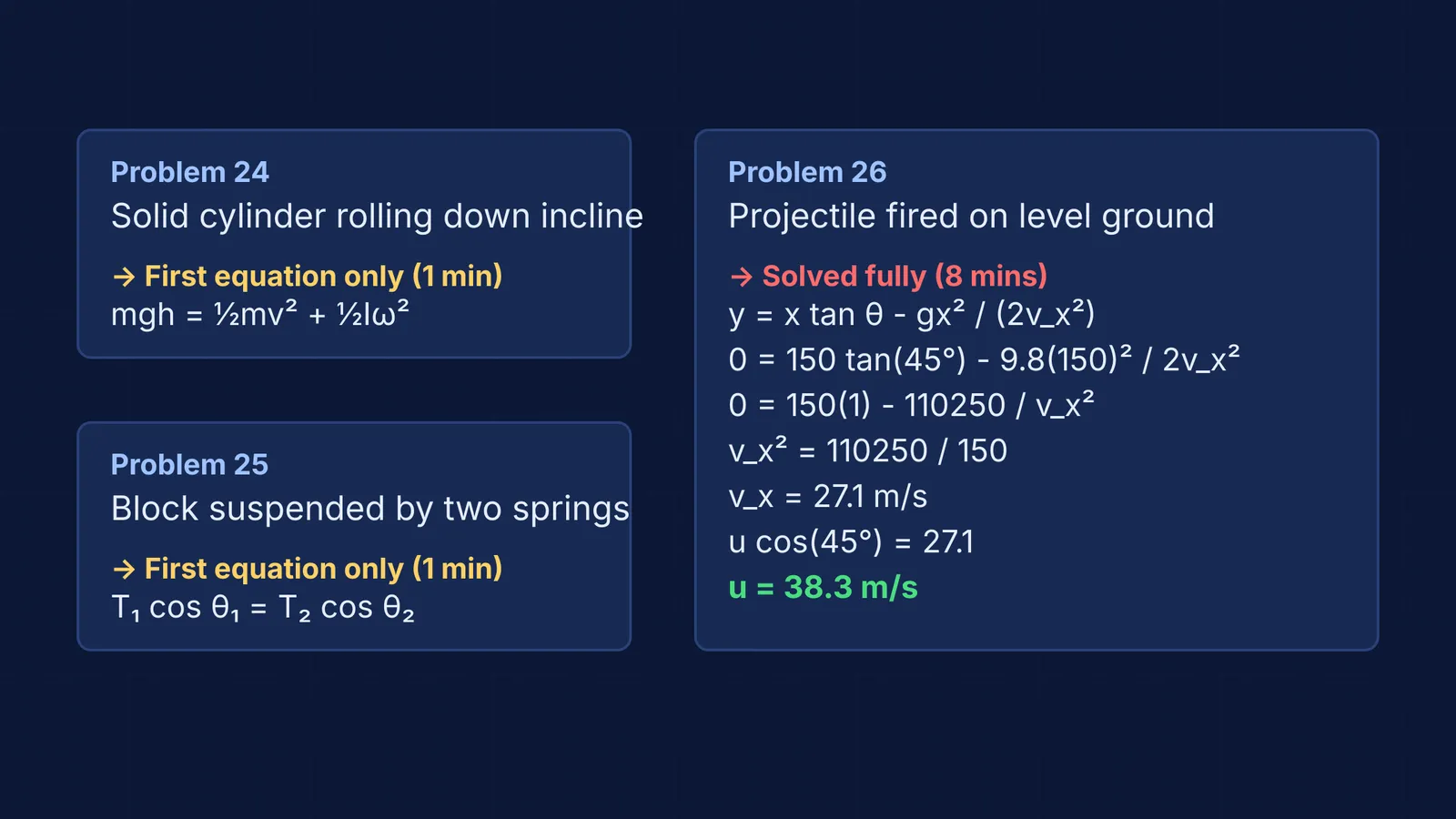
Here is how to revise numericals quickly before an exam: write down the method and the first equation for problems, but only solve a fraction of them fully.
Why does writing the first equation work?
In a classic 1981 study published in *Cognitive Science*, researchers asked students and professors to sort physics problems into groups. They found that novices and experts look at problems very differently. A novice sees "a block on a ramp" and tries to group it with other ramp problems, searching for a ramp formula. An expert sees the same problem and immediately thinks of the fundamental physical principle, such as the conservation of energy or Newton's second law (Cognitive Science).
Choosing the correct starting principle is the core skill you are tested on. In a 2007 study published in *Instructional Science*, psychologists tested what happens when students have to constantly choose their strategy. Students who mixed different types of problems—forcing them to identify the right method each time—scored 63% on a delayed test, while students who used traditional "blocked" practice (solving similar problems in a row) scored just 20% (Instructional Science).
When you fully solve a numerical, you spend most of your time executing the algebra rather than choosing the strategy. By stopping after writing the first equation, you strip away the routine execution. This allows you to practice the difficult, expert-level skill of strategy selection repeatedly across dozens of different scenarios in the same amount of time.
How do you use the equation-only method?
Instead of opening a single textbook chapter and solving five problems from start to finish, try this 30-minute revision framework:
Pick ten problems at random: Choose a mix from different chapters or a past paper so that the strategy is not obvious. Using interleaved practice forces your brain to identify the problem type without any clues.
Read and plan: Read the first problem. Decide which physical principle or mathematical theorem applies.
Write the first equation: Write down only the initial setup with the specific variables given. For a collision problem, this might be m₁u₁ + 0 = (m₁ + m₂)v.
Check the solution key immediately: Look at the worked solution. Did they start with the exact same equation? If yes, you understand the concept. Move on immediately to the next question.
Roll the dice: For every five problems you plan out, pick one at random to solve completely to the final numerical answer.
What if you do not know where to start?
When you look at a problem and cannot write the first equation, you have found a genuine conceptual gap. This is exactly where you should spend your valuable study time.
The temptation here is to simply read the full solution and nod along. This creates a false sense of familiarity; you feel like you understand it because the steps make sense when written out by someone else, but you will still struggle to generate the first step on your own during the exam.
Instead of reading the entire answer, try to get just a small hint. If you are using Fermi's AI tutor, the tutor can work out what you already know and build a plan for the session, so you sit down to a clear next step. It will ask you guiding questions to help you uncover the right physical principle yourself, rather than simply printing the answer for you to read.
When must you solve problems completely?
You cannot abandon full calculation entirely. If you only ever write the first equation, you will lose your algebraic stamina and make careless arithmetic errors under exam pressure.
You must still solve a few problems fully during your study sessions. This maintains your calculation speed, forces you to practice unit conversions (like remembering to change grams to kilograms), and ensures you remember how to solve physics problems step by step without skipping intermediate stages. The equation-only method is a high-speed revision tool for the final weeks before an exam, not a substitute for learning the foundational maths in the first place. By balancing the two, you train your brain to both start correctly and finish accurately.


