

On this page
You have one hour and one chapter, say Current Electricity before a unit test. Most students spend that hour rereading and highlighting. It feels productive, but the research points to a better use of the same hour.
Why does rereading feel like revision but not work?
In a 2006 experiment, students who took free-recall tests on a passage remembered more of it a week later than students who simply reread it, even though rereading did better on a test given five minutes later (Roediger and Karpicke, Psychological Science). The rereaders also felt more confident. Rereading makes the page look familiar, and familiar is easy to mistake for known.
A 2013 review of ten common study techniques rated practice testing and distributed practice as “high utility”, and rereading, highlighting and summarisation as “low utility” (Dunlosky and colleagues, Psychological Science in the Public Interest).
So the hour below is built around pulling the chapter out of your head, not pouring it back in.
How do you revise a full chapter in one hour?
Start with a blank page. In a 2011 study, students who practised retrieving what they had read showed more meaningful learning than students who studied the same science texts by building concept maps, and the advantage held across test formats, including questions that asked students to make inferences (Karpicke and Blunt, Science). Put your phone in another room and time each block.
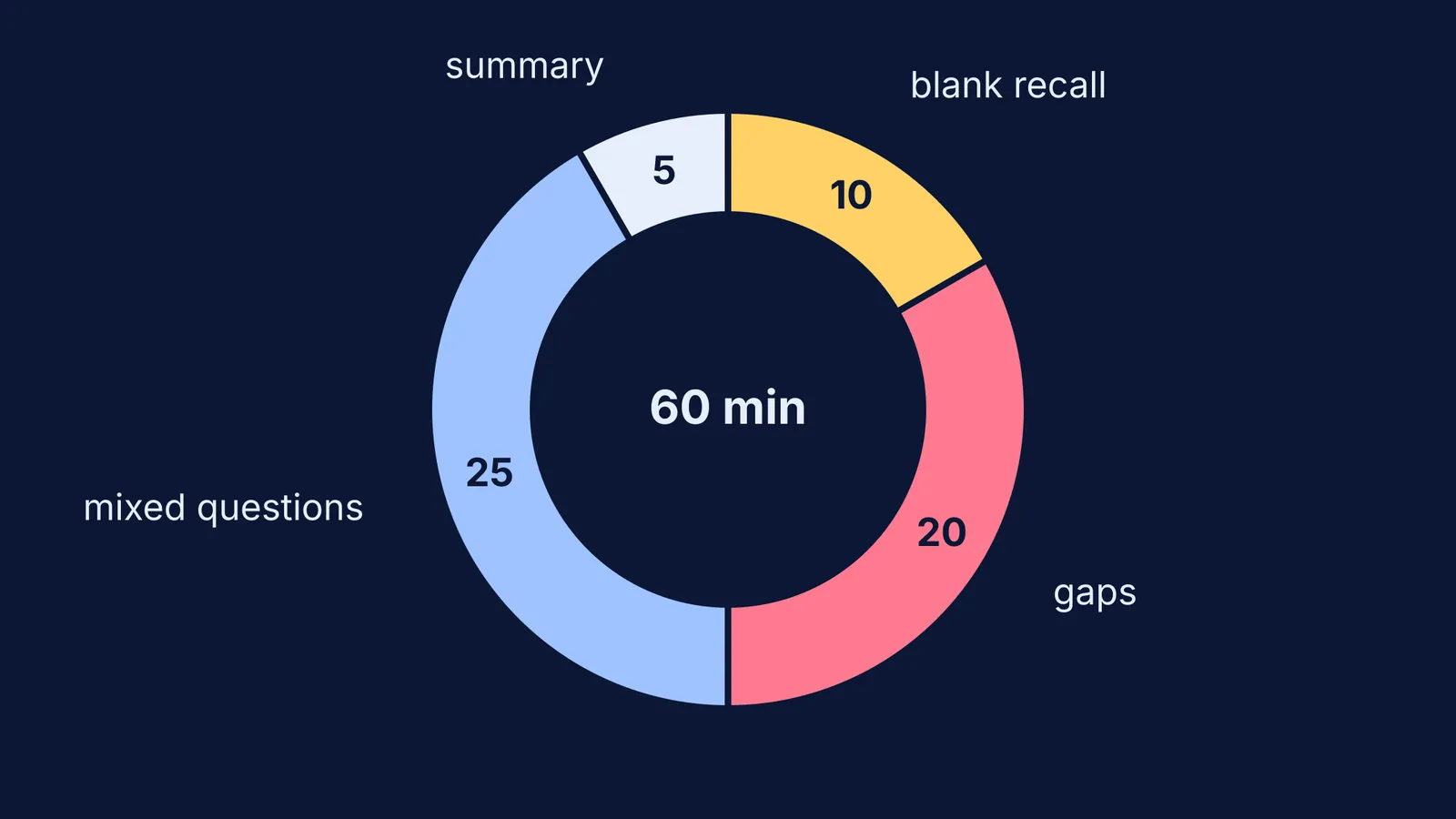
Minutes 0 to 10: blank recall. On a blank sheet, write everything you remember: definitions, formulas, diagrams, derivation steps, units. No book. When you stall, write the headings you remember and try to fill in under each one.
Minutes 10 to 30: fix the gaps. Open the book and compare. Mark what you missed or got wrong in a second colour. Spend these 20 minutes only on those marks: reread that section, redo that derivation, then close the book and write it again from memory.
Minutes 30 to 55: mixed questions. Do 8 to 12 questions from across the whole chapter, shuffled, not in the order the textbook teaches them. Check each answer as soon as you finish it.
Minutes 55 to 60: summary from memory. Book still closed, write the chapter on half a page: the three to five ideas everything else hangs on, plus the mistakes you made today.
If a gap turns out to be a whole idea you never understood, the Fermi Concept Library gives every concept in physics, chemistry, biology, mathematics and computing its own lesson, so you can fill that hole without rereading the whole chapter. If it is bigger than one idea, an hour is not enough; use our guide to learning a chapter you've never understood instead.
Why should the questions be mixed?
In a 2007 experiment, students who practised maths problems randomly mixed by type did vastly better on a test one week later than students who practised them in blocks of one type at a time (Rohrer and Taylor, Instructional Science).
When every question in a set uses the same method, you never have to choose the method. In the exam you do. Mixing forces the choice: is this a Kirchhoff's loop question, a Wheatstone bridge, or plain series and parallel reduction? For more on whether practice questions help on questions you have never seen, read our look at a 2018 meta-analysis on practice tests and transfer.
If you keep picking the wrong method in this block, the Fermi Problem Library has worked problems with a step-by-step solver that explains the reasoning rather than printing an answer, so you can see where your choice went wrong.
What does the hour look like for a real chapter?
Here is one run through Current Electricity. Check the topic list against your current syllabus; this is an illustration.
Blank recall: you write Ohm's law, resistivity, series and parallel resistors and both Kirchhoff's laws without trouble. You blank on how drift velocity connects to current, and you half-remember the Wheatstone bridge condition.
Gaps: ten minutes on drift velocity, ending with I = neAv (v is the drift velocity) written from memory. Ten minutes on the balanced bridge, then one worked example with the book closed.
Mixed questions: ten questions, shuffled: two on drift velocity, three on Kirchhoff's laws, two on bridges, two on cells with internal resistance, one on how resistance changes with temperature.
Summary: half a page with four ideas and two mistakes, such as “sign error on the second loop” and “forgot to convert mm² to m²”.
For parents: the most useful thing during this hour is a quiet room. Afterwards, ask “What was on your gap list?” rather than “Did you finish the chapter?”
What should you do after the hour?
Keep the summary and the mistake list. In a few days, start a fresh blank page; today's mistakes become the first questions next time. Our four-week spaced revision schedule for any chapter shows when to come back.
Tonight, pick one chapter, take a blank sheet and start the timer.


