

On this page
Many students are shocked to see their category seats cancelled during document verification for JoSAA (JEE) or MCC (NEET). A single formatting error on an OBC-NCL, EWS, SC, or ST certificate can move a student into the General (Open) rank list.
Understanding the strict rules for these documents can save you from a last-minute panic. Here is exactly why certificates get rejected and how to secure the correct format.
Why was my caste certificate rejected in counselling?
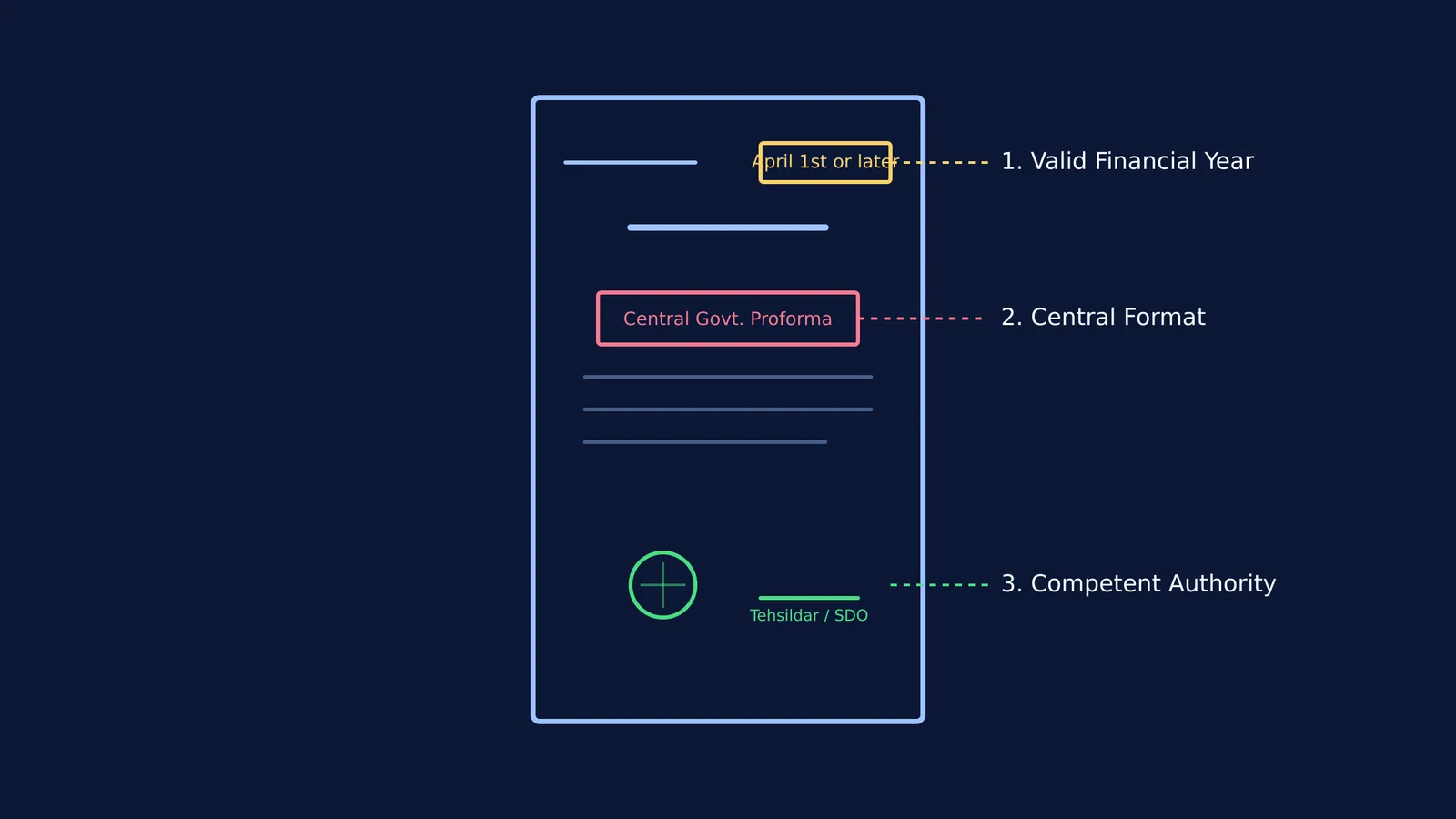
When a verifying officer raises a query or rejects a document, it usually comes down to one of three strict rules that candidates overlook.
1. The April 1st financial year rule For OBC-NCL (Non-Creamy Layer) and GEN-EWS categories, your financial status must be assessed for the current financial year. According to the official JoSAA guidelines, your certificate must be issued on or after April 1st of the year of admission. For example, if you are applying for 2025 admissions, an OBC-NCL or EWS certificate issued in March 2025 or earlier will be rejected outright because it belongs to the previous financial year.
2. State format instead of Central format This is the most common mistake. State governments issue caste certificates for local jobs and scholarships, but these often lack specific clauses required by the Central Government. All India Quota seats in NEET and seats in IITs, NITs, and IIITs require the exact Central Government proforma. For OBC candidates, this proforma must explicitly state that the candidate does not belong to the "Creamy Layer."
3. Issued by the wrong authority The certificate must bear the signature and seal of a Competent Authority. A document signed by a notary, a gazetted officer, or a village officer will not be accepted. The lowest rank accepted is a Tehsildar or a Sub-Divisional Officer (SDO).
What about SC and ST certificates?
While OBC-NCL and GEN-EWS certificates are tied to annual family income and must be renewed every financial year, SC and ST certificates operate differently. In most cases, SC and ST certificates have lifetime validity.
Once issued by the Competent Authority in the Central format, you do not need to obtain a new one every year. However, if your certificate is very old and illegible, or if it is only in a local state language without an English or Hindi translation, verifying officers may ask for a recent copy or an officially translated version.
What is the Central List of OBCs?
Another frequent point of confusion is the difference between state lists and the central list.
Your caste might be recognized as an Other Backward Class (OBC) by your state government, granting you reservation in state-level engineering or medical colleges. However, JoSAA and All India Quota NEET counselling only recognize castes listed in the Central List of OBCs.
Before applying for an OBC-NCL certificate, you should verify that your specific caste and sub-caste are included in the Central List for your state. If your caste is missing from this central registry, you must apply as a General category candidate for central institutions, even if you hold a valid state-level OBC certificate.
The document verification checklist
Do not rely on the standard template your local Tehsildar's office prints by default. Instead, take the exact format to them and use this checklist before uploading anything to the counselling portal:
Download the exact proforma. The official formats are published as annexures in the JoSAA Business Rules and the NTA NEET Information Bulletin. Do not use random templates found on unofficial websites.
Visit the correct authority. Take this printed proforma to your District Magistrate, Collector, or Tehsildar. A notary public or a school principal cannot sign a valid caste or EWS certificate.
Verify the language. If the certificate is issued in a regional language, you must usually provide a translated and notarised English or Hindi version alongside the original document.
Check the spelling. Ensure your name, your parents' names, and your date of birth exactly match your Class 10 mark sheet and your JEE or NEET application. A missing middle name or a slight spelling difference can trigger a query.
Scan it clearly. When scanning the document for online reporting, ensure all four corners are visible, the text is perfectly legible, and the authority's seal is completely captured. Blurry uploads are a common reason for sudden rejection.
Sorting out paperwork early leaves your mind clear for the actual admission process. If you find yourself equally lost when revising and not knowing where to start, Fermi's AI tutor builds a plan for the session, so you sit down to a clear next step.
What happens if my certificate is rejected?
If your document is invalid, the verifying officer will raise a query on the counselling portal. You are typically given a tight deadline to respond and upload the correct document.
If you cannot provide a valid certificate before the deadline:
Your category-specific seat allocation is cancelled.
Your profile is converted to the General (Open) category.
You will only be considered for seats in subsequent rounds if your Common Rank List (CRL) score meets the General cutoff.
If you realise your certificate is outdated *before* counselling begins, apply for a fresh one immediately. Many local offices can expedite the process if you show them your JEE or NEET rank card and the counselling schedule.
Read next:


