

On this page
The shift away from fossil fuels is creating an enormous demand for skilled professionals. Globally, renewable energy employment reached 13.7 million in 2022, according to the International Renewable Energy Agency (IRENA). As nations race to meet their climate goals, this sector has become one of the fastest-growing areas for engineering graduates.
In India, the growth is accelerating rapidly. A June 2026 study by the Council on Energy, Environment and Water (CEEW) and the Natural Resources Defense Council (NRDC) estimates that meeting the country's 500 GW non-fossil fuel target will generate over 4.4 million full-time equivalent jobs. Decentralized systems like rooftop solar are major drivers, accounting for 62% of new clean energy workforce additions between 2023 and 2026. Because rooftop panels require site assessments and custom local grids, they generate 44 times more jobs per megawatt than massive utility-scale solar parks. The National Green Hydrogen Mission is also projected to add thousands of highly specialised roles in the coming years.
Which engineering branches are best for renewable energy?
You do not need a specialised "Renewable Energy Engineering" degree to enter the field. In fact, most industry experts recommend starting with a core engineering discipline after your 12th standard (PCM). This builds a versatile foundation that keeps your options open, allowing you to specialise later through electives or a master's degree.
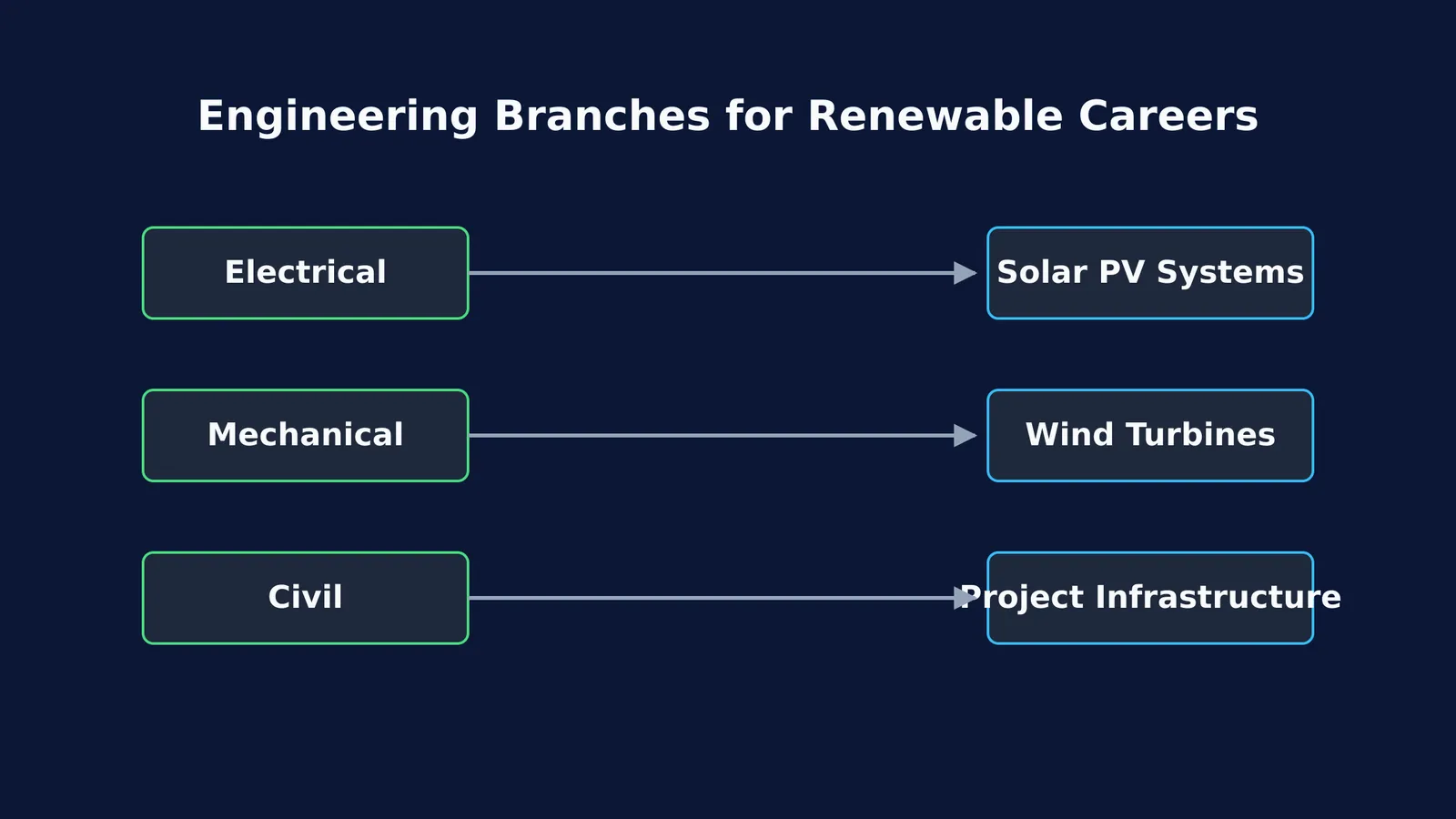
Electrical Engineering: This is the most direct route into the solar industry. Electrical engineers design photovoltaic (PV) systems, manage grid integration, and develop battery storage solutions. They focus heavily on power electronics and smart grids.
Mechanical Engineering: This branch is the backbone of the wind energy sector, as well as hydro and thermal power. Mechanical engineers work on the aerodynamics of turbine blades, complex gearbox mechanics, and fluid dynamics.
Civil Engineering: This field is essential for the infrastructure of large-scale renewable projects. Civil engineers are responsible for surveying the land for a 100-acre solar park, designing the structural supports, and anchoring offshore wind turbines safely in the sea bed.
If you are fascinated by the history of how these technologies began, reading about Chapin, Fuller, Pearson and the first practical silicon solar cell is a great place to start.
What skills do you need for solar and wind?
A degree gets you an interview, but practical skills get you the job. The CEEW report notes that 60% of jobs in solar and wind deployment require semi-skilled or highly skilled workers, and this jumps to 80–90% in the manufacturing side of the industry.
In the solar sector, you will need to understand PV cell physics, string sizing, inverter technology, and net-metering protocols. Familiarity with design and energy yield simulation software like AutoCAD, PVSyst, or HelioScope is highly valued by employers. If you are preparing for entrance exams now, mastering the physics behind these devices—such as the Photodiode, LED and solar cell I-V curves for JEE Main—will give you a significant head start in your first year of college.
In the wind sector, the focus shifts to aerodynamics, structural health monitoring, and mechanical stress analysis. Engineers here frequently use tools like WAsP (Wind Atlas Analysis and Application Program) for wind resource assessment, alongside MATLAB or Python for heavy data analysis.
Beyond technical abilities, environmental compliance and project management are crucial. Engineers must often navigate local regulations, manage supply chains, and ensure that massive installations do not disrupt local ecosystems.
How can students prepare today?
If you are in school and aiming for a career in renewables, your immediate focus should be on building a strong understanding of physics and mathematics. The green energy transition is built on fundamental scientific principles, not just software tools.
Solar energy requires a deep, intuitive understanding of semiconductors and electromagnetism, while wind turbine design relies entirely on aerodynamics and classical mechanics. If you find it hard to bridge the gap between textbook equations and these real-world applications, Fermi's AI tutor can work out what you already know and build a plan for the session, so you sit down to a clear next step.


