

On this page
Some students join a BSc or BTech while they prepare for another JEE or NEET attempt. You keep a seat and a year of credits, and you still get a second shot. It works only if you settle a few questions on day one and give every week the same fixed shape.
Can you take JEE or NEET again while studying in college?
Being in college does not by itself stop you. The rules are about your Class 12 year, attempts and age, and they change yearly, so read the current documents.
JEE Main 2027 has no age limit and is open to candidates who passed Class 12 in 2025 or 2026 or are appearing in 2027, according to the JEE (Main) 2027 Information Bulletin.
JEE Main 2027 runs in two sessions, January and April 2027, and regular Session 1 applications close on 22 November 2026 (late fee to 26 November), per NTA's public notice of 24 October 2026.
JEE Advanced can be attempted at most two times in two consecutive years, and the 2026 rules exclude anyone already admitted to an IIT, per the JEE (Advanced) 2026 eligibility page.
The NEET (UG) 2026 Information Bulletin states that there is no upper age limit, citing a National Medical Commission letter.
The IIT rule matters most. If JEE Advanced is your goal, do not take an IIT seat now and plan to switch later.
What trade-offs should you decide before the semester starts?
Write your answers down and share them with your family:
What is the college for? If it is your fallback, you must pass semester exams and meet the attendance rule. Read your college's rules on attendance and on refunds if you leave mid-year.
Which exam window are you aiming at? For JEE, decide whether January or April is your main attempt.
How many hours can the exam really get? Block your college timetable first, then count what is left.
What will you drop? Something has to give: clubs, a long commute, phone time. Not sleep.
What is your checkpoint? Pick a date and a mock-score range at which you will keep going, scale down, or commit to the degree. For JEE, the January session result is a natural checkpoint.
What does a weekly schedule look like?
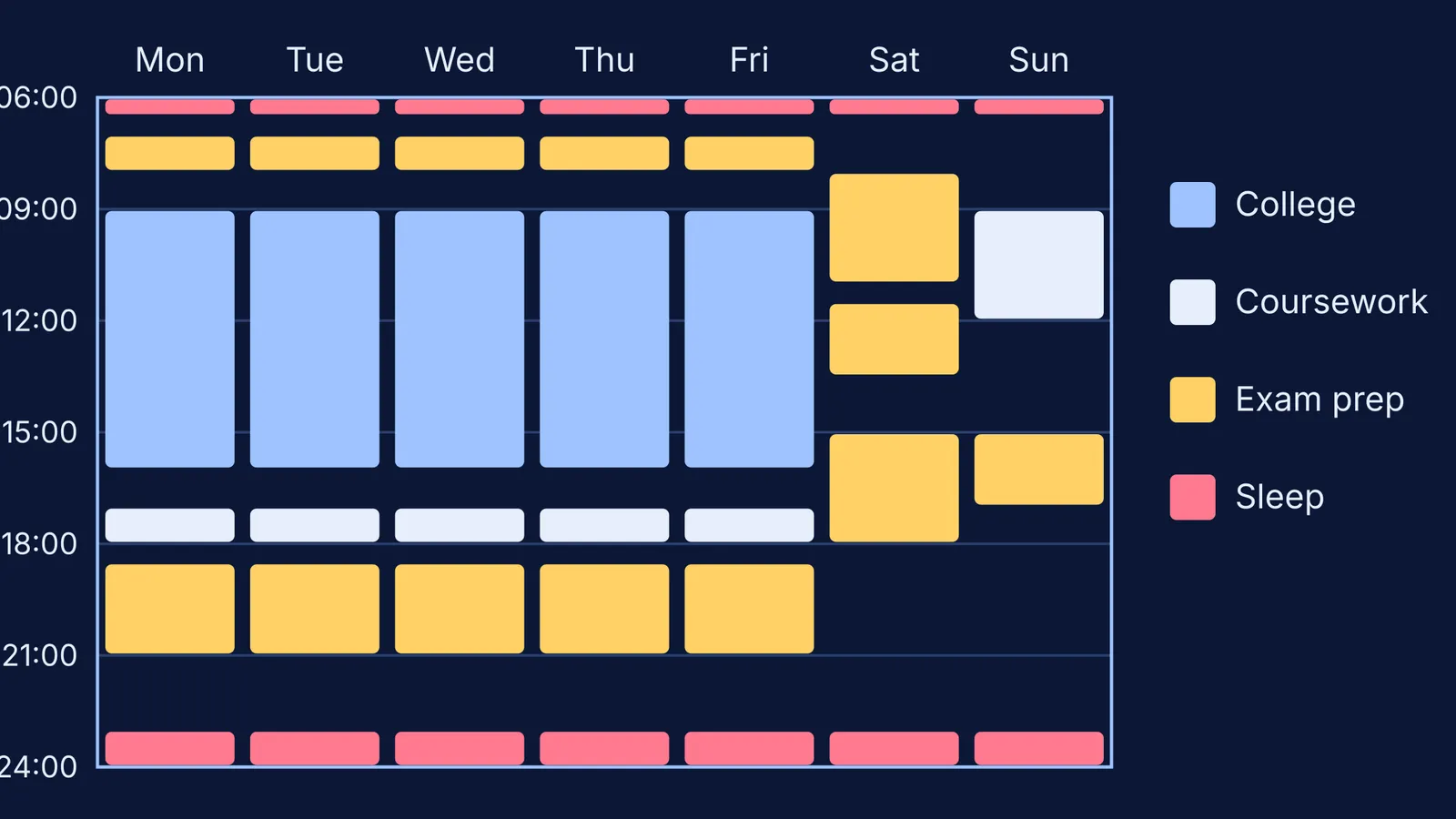
This sample assumes weekday classes from 9 am to 4 pm. Fix sleep first: adults aged 18 to 60 should sleep 7 or more hours a night, according to an American Academy of Sleep Medicine and Sleep Research Society consensus statement. Teenagers aged 13 to 18 need 8 to 10 hours, per the academy's paediatric statement, so if you are 17, move bedtime earlier.
Monday to Friday:
7:00 to 8:00 am: write formulae, reactions or NCERT lines from memory, then check.
9:00 am to 4:00 pm: college.
5:00 to 6:00 pm: coursework, notes and lab records.
6:30 to 9:00 pm: main prep block, one chapter then timed problems.
11:00 pm to 6:30 am: sleep (weekends too).
Saturday:
8:00 to 11:00 am: full-length timed mock.
11:30 am to 1:30 pm: mock analysis.
3:00 to 6:00 pm: your weakest chapter.
Sunday:
9:00 am to noon: college catch-up for the week.
3:00 to 5:00 pm: spaced revision of last week's and last month's chapters.
That is about 27.5 hours of exam prep and 8 hours of coursework outside class, with Saturday and Sunday evenings free. The morning and Sunday blocks use recall and spacing, not rereading: the Dunlosky review of learning techniques rated practice testing and distributed practice as the two high-utility methods. For Saturday, use our 60-minute routine for analysing a mock test.
When a mock shows you used the wrong method, the Fermi Problem Library has worked problems with a step-by-step solver that explains the reasoning. For a chapter you have never understood, Fermi's AI tutor can work out what you already know and build a plan for the session.
What if college exams and mock season collide?
In mid-semester and end-semester weeks, flip the balance for one or two weeks. Keep the morning recall hour and the Saturday mock, and give the evening block to college. If college pace is new to you, read what changes in your first semester. If you fall behind in college, cut prep hours for a week before you cut classes.
How can parents help without adding pressure?
Agree the checkpoint together, then stop asking about marks every day. One sentence helps: "We will back this until the date we agreed, and whatever happens, the degree is a real option we will decide on together." Our guide to supporting a child through a JEE drop year covers more of the family side.
If stress affects sleep, eating or mood for weeks, talk to a college counsellor or doctor. Tele MANAS offers 24/7 tele-mental health support on the toll-free number 14416, according to the Ministry of Health and Family Welfare.
This week: write down your checkpoint and put the first Saturday mock on the calendar.


