On this page
India is spending real money on quantum technology. The Union Cabinet approved the National Quantum Mission on 19 April 2023, with a budget of ₹6,003.65 crore running from 2023–24 to 2030–31, according to a Press Information Bureau backgrounder. One of its goals is to build intermediate-scale quantum computers with 50 to 1,000 physical qubits within eight years. Someone has to build, program and test those machines. Here is how to get ready.
What jobs exist in quantum computing?
The most useful evidence comes from a survey of 57 companies in the quantum industry, published by Ciaran Hughes and colleagues in IEEE Transactions on Education (free version on arXiv). They found a range of roles, from highly specific jobs such as quantum algorithm developer and error correction scientist to broader jobs in software, hardware and business. Most skills those broader jobs need are not quantum skills, and apart from the highly specific roles, companies were looking for bachelor's, master's and PhD graduates.
A Physics Today report cites a Chicago Quantum Exchange analysis that found more than half of 5,000 quantum job postings from 2022–23 required no more than a bachelor's degree. Those were global postings, not Indian ones, but the lesson travels: a solid degree plus some quantum knowledge can get you in the door.
Which subjects do you need for quantum computing?
Quantum computing sits where three subjects meet:
Maths: linear algebra (vectors, matrices), complex numbers and probability. This is the language of the field.
Physics: quantum mechanics, and for hardware roles, electronics, superconductivity and optics.
Computer science: programming (Python is a common place to start), algorithms and logic gates.
You do not need all three on day one. IBM's introductory course says it recommends familiarity with basic linear algebra, complex numbers, and elementary mathematical notions including sets and functions. Much of that is class 11–12 maths plus first-year matrices.
What does a qubit look like in maths?
A qubit's state is a vector. The state 0 is the column (1, 0). The Hadamard gate is a 2×2 matrix with rows (1, 1) and (1, −1), multiplied by 1/√2.
Multiply: H times (1, 0) gives (1/√2, 1/√2).
Square each entry to get the measurement probabilities: 1/2 for 0 and 1/2 for 1.
Apply H again: (1/√2)(1/√2 + 1/√2, 1/√2 − 1/√2) = (1, 0). You are back to 0 with certainty.
That third step is interference, a core trick of quantum algorithms. If matrix multiplication or complex numbers feel shaky, the Fermi Concept Library has a lesson for every concept in mathematics and physics, so you can fill one gap at a time.
Which free quantum computing courses should you start with?
IBM's Understanding Quantum Information and Computation. Four courses of four lessons each, hosted by John Watrous, IBM Quantum's technical director for education; each lesson is a 30–90 minute video and the series is free.
NPTEL's Quantum Information and Computing from IIT Bombay, taught by Prof. Dipan Ghosh. The course outline runs across eight weeks, from qubits and quantum gates through Grover's and Shor's algorithms and error correction to information theory and cryptography.
Quantum Country by Andy Matuschak and Michael Nielsen, a free online essay that assumes complex numbers, linear algebra and basic logic gates and builds in review questions spaced over weeks and then months.
Where is quantum research happening in India?
The mission is run through four thematic hubs, according to the same PIB backgrounder: quantum computing at IISc Bengaluru, communication at IIT Madras with C-DOT, sensing and metrology at IIT Bombay, and materials and devices at IIT Delhi. Together they bring in 14 technical groups across 17 states and 2 union territories, so relevant labs exist well beyond these four campuses.
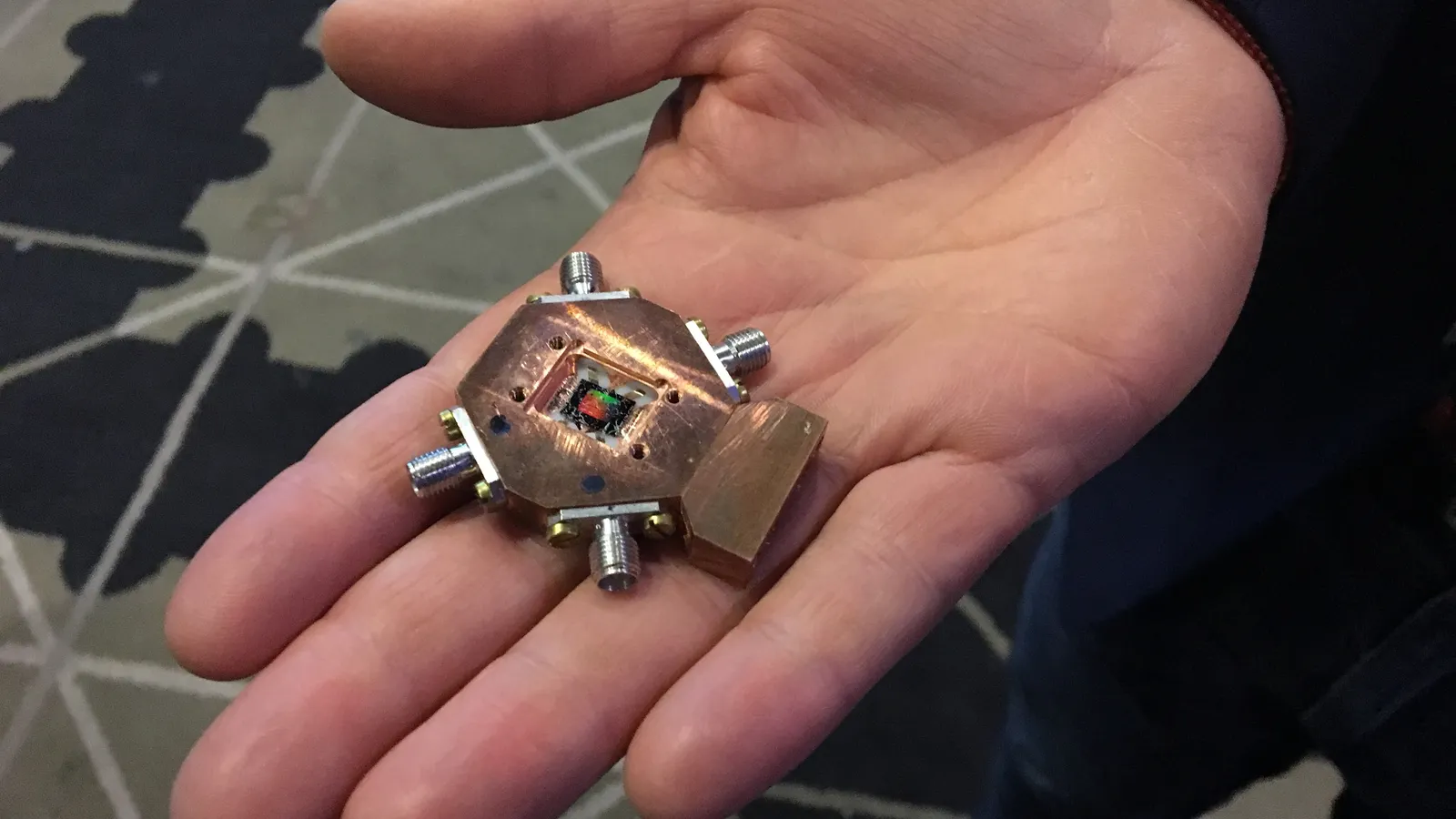
Hardware work happens in India too. At TIFR Mumbai, Rajamani Vijayaraghavan's group works on qubits made from superconducting circuits operated at millikelvin temperatures and controlled with microwave signals, as his 2016 ICTS colloquium abstract describes.
Students usually get into a lab through a summer project. Our guide to research internships for science undergraduates in India is the place to start.
How to build a quantum computing career: a four-stage plan
Class 11–12: Get strong at complex numbers, vectors and probability. Learn basic Python.
First and second year of college: Study physics, maths, computer science or electronics. Finish one free course above.
Third year: Do a summer project in a quantum lab and learn whether you prefer theory, software or hardware.
Final year and after: For research, aim for an MSc or PhD. For industry, show a project you have built.
Hardware overlaps with solid-state physics, covered in our guide to condensed matter physics careers. If you love the maths of codes, see cryptography careers for maths students.
If you don't know where to begin, Fermi's AI tutor can work out what you already know and build a plan for the session, so you start with the gap that matters. This week, work the Hadamard example on paper.