

On this page
Many engineering graduates believe that a top GATE score is the only way into a Public Sector Undertaking (PSU). While GATE is the most common route, several premier organisations—such as the Indian Space Research Organisation (ISRO), Bhabha Atomic Research Centre (BARC), and Hindustan Aeronautics Limited (HAL)—conduct their own independent entrance exams.
If you are planning your career and want to look beyond the GATE competition, these independent exams offer a parallel path to a stable, high-level engineering job. This is especially useful when Talking about STEM careers beyond engineering and medicine and exploring all available government options.
Which PSUs recruit engineers without GATE?
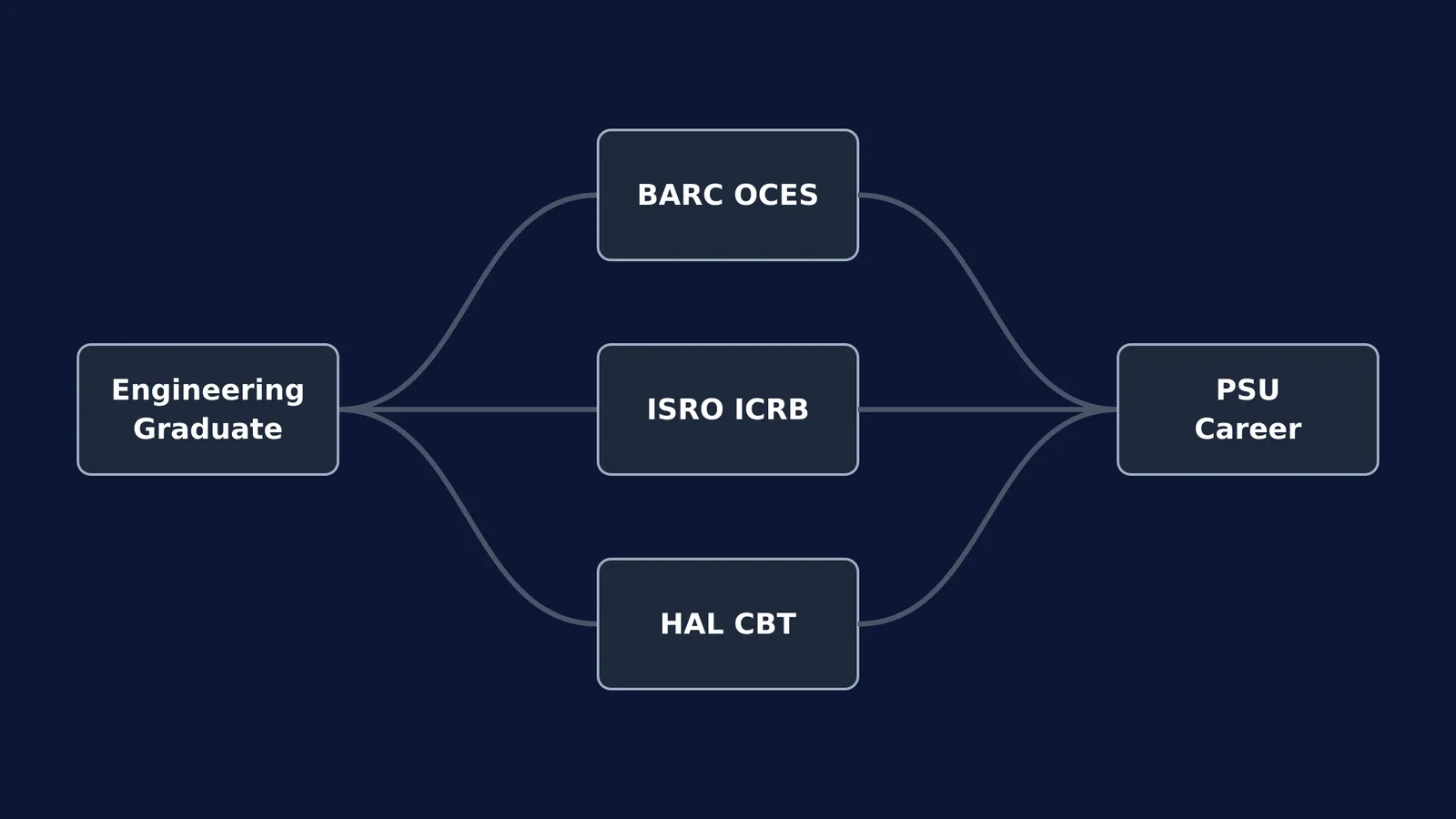
Several top-tier government organisations prefer to test candidates through their own tailored assessments. The most prominent examples include:
BARC: The Bhabha Atomic Research Centre recruits Scientific Officers through the OCES/DGFS programmes, allowing candidates to apply via a valid GATE score or through its own online exam. For example, the BARC OCES/DGFS online examination is typically held in March or April.
ISRO: The ISRO Centralised Recruitment Board (ICRB) conducts an independent written test followed by an interview for the Scientist/Engineer 'SC' post.
HAL: Hindustan Aeronautics Limited recruits Management Trainees (MT) and Design Trainees (DT) via an all-India Computer-Based Test (CBT).
State Engineering Services (SES): Various state public service commissions (like UPPSC and MPSC) recruit Assistant Engineers through their own independent written exams, independent of the central GATE system.
What is the selection process for PSU exams?
Unlike GATE, which is highly numerical and deeply conceptual, direct PSU exams are designed to test both your theoretical foundation and your speed. They often include a significant general aptitude section.
For the HAL Management Trainee exam, candidates must answer 160 multiple-choice questions in 150 minutes, comprising 100 technical questions, 40 on English and reasoning, and 20 on general awareness. This gives you less than a minute per question, making speed crucial.
The ISRO ICRB exam follows a similar high-speed format. Candidates face 95 questions in 120 minutes: 80 discipline-specific technical questions and 15 general aptitude questions. To qualify for the interview shortlist, you must score a minimum of 50% in both parts.
Since PSU exams rely heavily on theoretical concepts and speed, practicing similar problems is key. The Fermi Problem Library has worked problems with a step-by-step solver that explains the reasoning rather than printing an answer.
What are the general eligibility criteria?
Before you start preparing, you must ensure you meet the strict eligibility rules these organisations set. While GATE has very relaxed age and percentage criteria, independent PSU exams are much stricter.
Age limit: Central organisations typically set the upper age limit at 26 to 28 years for general category candidates. For instance, the maximum age limit for the BARC OCES exam is typically 26 years for the unreserved category.
Academic aggregate: Most PSUs require a full-time B.E. or B.Tech degree with a minimum of 60% to 65% aggregate marks across all semesters.
How to track PSU notifications?
Unlike the centralized GATE process, independent PSU exams happen on their own schedules. If you miss a notification window, you miss the year.
Bookmark official career pages: Set a weekly reminder to check the 'Careers' or 'HR' sections of the ISRO, BARC, HAL, and BEL websites.
Use employment news: The government's weekly *Employment News* (Rozgar Samachar) remains the most reliable source for official recruitment advertisements.
Watch for dual-entry options: Read notifications carefully. Exams like BARC OCES allow you to apply through both the online exam and your GATE score, giving you two paths to clear the screening stage. (For those considering GATE as well, it helps to understand how the exam is structured, such as GATE for science graduates: papers, pattern and how it fits).
A study framework for direct PSU exams
Because you have less time per question compared to GATE, your preparation strategy must shift from solving complex, multi-step numericals to rapid recall and theoretical clarity. Here is a practical framework to adjust your study habits:
Focus on theory: Review standard textbooks for factual data, definitions, and direct formulas. With strict time limits, you will not have time to derive equations from scratch. Memorise standard constants and empirical relations.
Daily aptitude practice: Dedicate a portion of your study session every day to general aptitude, logical reasoning, and basic English grammar. In exams like HAL's, this non-technical section makes up a significant part of the paper. Do not leave this until the last month.
Solve previous papers: Organisations like ISRO heavily repeat concepts from their past papers. Sourcing previous years' ICRB question papers is the best way to understand which specific topics they favour (for example, satellite communication for electronics engineers or fluid machinery for mechanical engineers).
Securing a PSU job without GATE requires vigilance to catch the notifications and a focused, speed-oriented study plan. However, with the right strategy, it remains one of the most rewarding career routes for an engineer.


