

On this page
A science fair abstract condenses months of work into a single page. It is often the first—and sometimes the only—thing a judge reads before walking up to your display board.
If your abstract is vague or padded with technical jargon, readers will walk past. If it is clear and precise, they will stop to ask questions. Writing concisely is often harder than writing a long report, but it forces you to understand exactly what your research achieved.
What should a science project abstract include?
An abstract is a high-level summary of your entire project. The Regeneron ISEF rules cap this write-up at a strict 250-word maximum, while the CBSE Science Exhibition requires a brief project description for online submission.
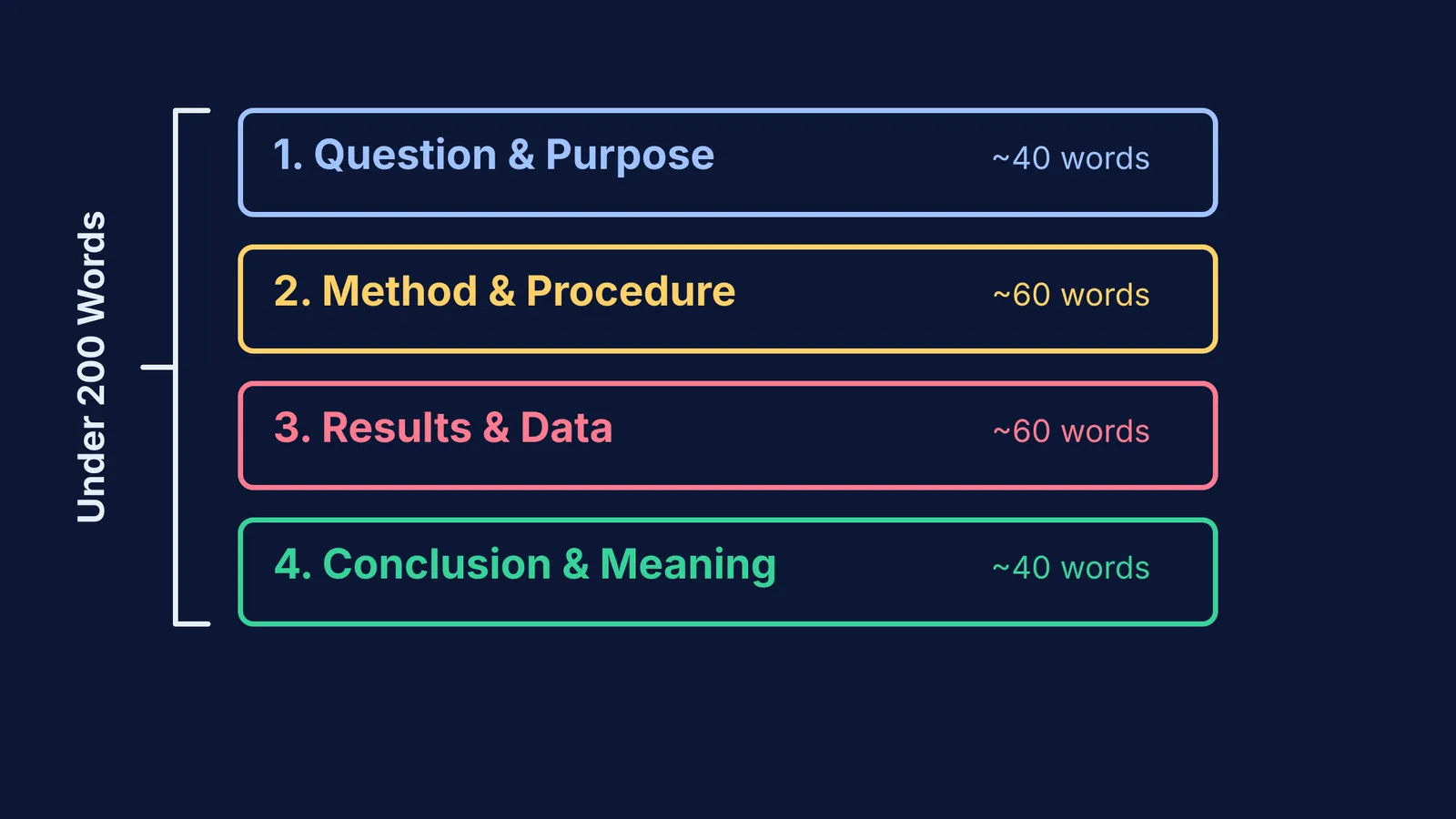
To ensure your summary stays punchy and covers everything judges are looking for, aim for under 200 words. You can break it down into four distinct sections:
Question and purpose: Why did you do this project? Hook the reader by explaining the specific problem you were trying to solve or the hypothesis you were testing. If you had multiple questions, highlight only the primary one.
Method and procedure: How did you test your hypothesis? Briefly mention your experimental design and the core approach. Focus on the overall method rather than listing every piece of equipment or minor procedural step.
Results and data: What did you find? Include the most important numbers or trends. Do not simply say the data supported the hypothesis; give the actual percentage change or the final calculated value.
Conclusion and meaning: What is the big-picture takeaway? State whether the results supported your original idea. Briefly mention how this research could be applied in the real world or what future work could build upon it.
If you are stuck on how to summarise your physics or chemistry calculations for the method section, Fermi's AI tutor can work out what you already know and build a plan for the session, so you sit down to a clear next step instead of a blank page.
How do you write an abstract under 200 words?
The easiest way to draft your abstract is to use a proportional framework. By giving yourself a strict word limit for each of the four sections, you prevent the procedure from taking over the whole page. Students often make the mistake of spending 150 words describing their setup, leaving no room for their actual findings.
You can use this rough guide to structure your writing:
Purpose (approx. 40 words): "This project investigated..."
Method (approx. 60 words): "To test this, we compared..."
Results (approx. 60 words): "The experiments showed that..."
Conclusion (approx. 40 words): "These findings suggest..."
For example, if you are doing a science project from a good question to a fair experiment, your results section might say: "Plants exposed to blue light grew 15% taller than the control group over 14 days, while red light resulted in no significant difference." This is much stronger than simply stating that the blue light was better.
Before submitting, you can double-check the mathematical results of your experiment using the Fermi Problem Library, which provides worked problems with a step-by-step solver that explains the reasoning rather than printing an answer.
What should you leave out of the abstract?
When you only have 250 words, every single sentence must earn its place. There are several elements you should actively remove before submitting your final draft to the judges.
First, do not include any citations or a bibliography. Your abstract is a summary of your own findings, not a literature review. You can include your references in the main project file or when presenting at an event like the IRIS National Fair.
Second, remove all acknowledgements. Thanking your parents, mentors or school takes up valuable space. Most official abstract forms, including the ISEF paperwork, explicitly prohibit self-promotional language or mentor shout-outs.
Finally, cut out unnecessary jargon and vague language. Instead of saying "most of the samples," give the exact fraction or percentage. Do not use acronyms without defining them first. If your grandmother can read your abstract and understand what you discovered, you have pitched it at the right level.


