

On this page
Standing in front of your class for a five-minute seminar or science exhibition can feel unnerving. Most students cope with presentation nerves by pasting paragraphs from their textbook onto slides and reading every bullet point word for word off the screen. While this feels safe, it loses the room. Delivering an engaging, high-scoring presentation comes down to three practical habits: replacing bulleted lists with visual evidence, timing your delivery through out-loud rehearsal, and handling classroom questions with steady composure.
Why do text-heavy presentation slides fail in class?
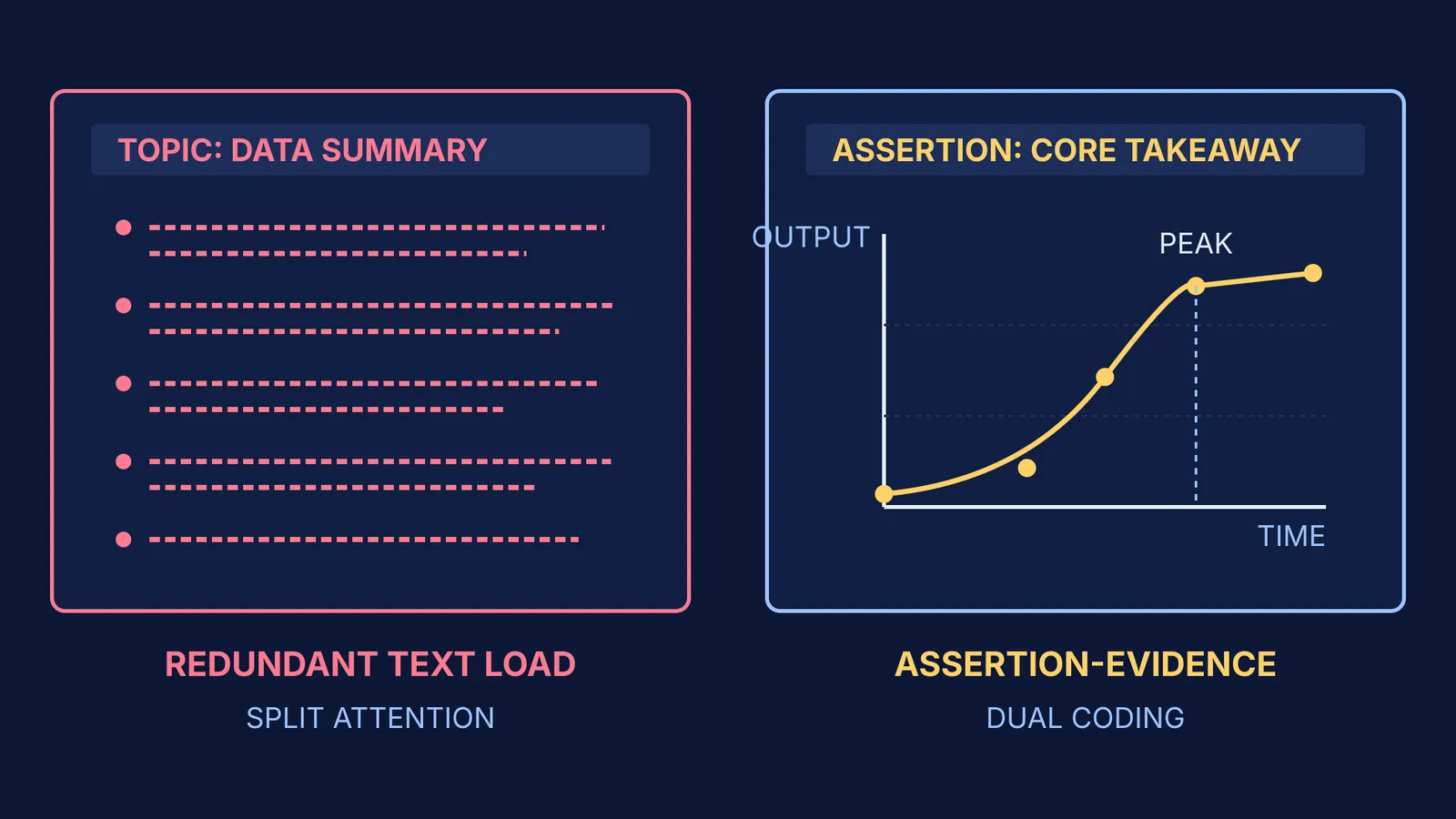
When you display complete sentences on a slide while speaking, you place your classmates in cognitive conflict. Across experiments published in the *Journal of Educational Psychology*, researchers Richard E. Mayer, Julie Heiser, and Steve Lonn (Mayer et al., 2001) documented the redundancy effect in multimedia learning. Students who learned from animated graphics and spoken narration scored significantly higher on problem-solving transfer tests than students who were also presented with duplicate on-screen text.
The human brain processes visual diagrams and auditory speech through separate, capacity-limited channels, a principle examined in our guide to dual coding notes. When a slide contains printed prose, your classmates read ahead. Because silent reading is faster than speaking, the audience finishes reading within seconds and tunes out your voice while waiting for you to catch up.
How should you design school presentation slides?
To keep your audience focused on your explanation, use the assertion-evidence slide model developed by engineering communication researchers Joanna Garner and Michael Alley (Garner et al., 2011). Instead of treating a slide as a teleprompter, an assertion-evidence slide consists of two components:
A clear assertion headline: A single, full-sentence statement (under 20 words) at the top of the slide that states the core takeaway.
Direct visual evidence: A diagram, graph, or labelled illustration in the body of the slide that directly supports that takeaway, with text restricted to essential labels.
Consider a Class 10 physics seminar on electromagnetic induction. A weak slide carries the heading "Faraday's Experiment" followed by bullet points defining coils and induced currents. An assertion-evidence slide replaces that wall of text with the headline: "Moving a magnetic field through a coil induces a measurable electric current." The body contains only a schematic diagram of a bar magnet entering a coil connected to a galvanometer, with arrows indicating motion and current. Your slide provides visual proof, while your voice provides the explanation.
When preparing science slides, you can explore interactive models in the Fermi Simulation Lab to see physical phenomena in action, or reference core figures in the Fermi Concept Library, which covers every concept in physics, chemistry, biology, mathematics and computing.
Why must you rehearse your presentation out loud?
Many students prepare for a presentation by clicking through slides and reading notes silently. This creates an illusion of fluency. A meta-analysis of reading rates by Marc Brysbaert (Brysbaert, 2019) found that average adult silent reading runs at 238 words per minute for non-fiction (dropping to 183 words per minute when reading aloud), whereas comfortable spoken presentation pace typically proceeds at 130 to 160 words per minute. If you silently scan a 500-word script in two minutes, speaking those same words aloud in class will take nearly four minutes.
Silent practice also fails to prepare your vocal memory. Research on the production effect by Noah Forrin and Colin MacLeod (Forrin & MacLeod, 2018) demonstrates that speaking text aloud creates distinctive motor and auditory memory traces that produce significantly stronger recall than silent reading. Rehearsing out loud three times to an empty room or a family member reveals awkward transitions and locks in your pacing. This mirrors what educational research shows about learning by teaching: explaining a topic aloud forces you to organise the logical connections in your own mind.
How do you handle questions from teachers and classmates?
The question-and-answer session at the end of a presentation often sparks anxiety, but it is also where you demonstrate genuine mastery. Classic research on classroom communication by Mary Budd Rowe (Rowe, 1986) demonstrated that introducing a deliberate "wait time" of three seconds after a question noticeably improves the logical coherence and quality of spoken responses.
When a teacher or classmate asks a question, follow a three-step structure:
Pause and rephrase: Take a two-second pause, look at the questioner, and restate the question so the entire room hears it ("You are asking how changing the coil material affects the induced voltage").
Answer the core point directly: State your conclusion in your first sentence, followed by one piece of supporting evidence from your slides.
State boundaries with intellectual honesty: If someone asks about a parameter you did not test, never invent data. Say: "We did not test different core materials in this project, but testing soft iron versus steel would be the next experiment." In CBSE and ICSE assessments, evaluators reward scientific honesty and clear experimental boundaries, principles outlined in our guide on doing a science project.
To test whether your explanations hold up under questioning, practising your topic with Fermi's AI tutor can help you spot conceptual gaps before presentation day, as the tutor checks understanding and prompts you to explain your reasoning step by step.


