On this page
The Post-Matric Scholarship for SC and ST students is a centrally sponsored scheme that provides financial assistance to pursue higher education after Class 10. Administered by the Ministry of Social Justice and Empowerment for Scheduled Caste (SC) students and the Ministry of Tribal Affairs for Scheduled Tribe (ST) students, the scheme ensures that financial constraints do not stop students from completing their degrees or diplomas.
Whether you are entering Class 11, pursuing a diploma, or enrolling in a degree programme, this scholarship covers compulsory non-refundable fees, including tuition, and provides a monthly maintenance allowance. The funds are credited directly to the student's bank account through Direct Benefit Transfer (DBT).
Who is eligible for the Post Matric Scholarship?
To qualify for the scholarship, students must meet both academic and financial criteria set by the government. The core requirements focus on category, income, and educational standing.
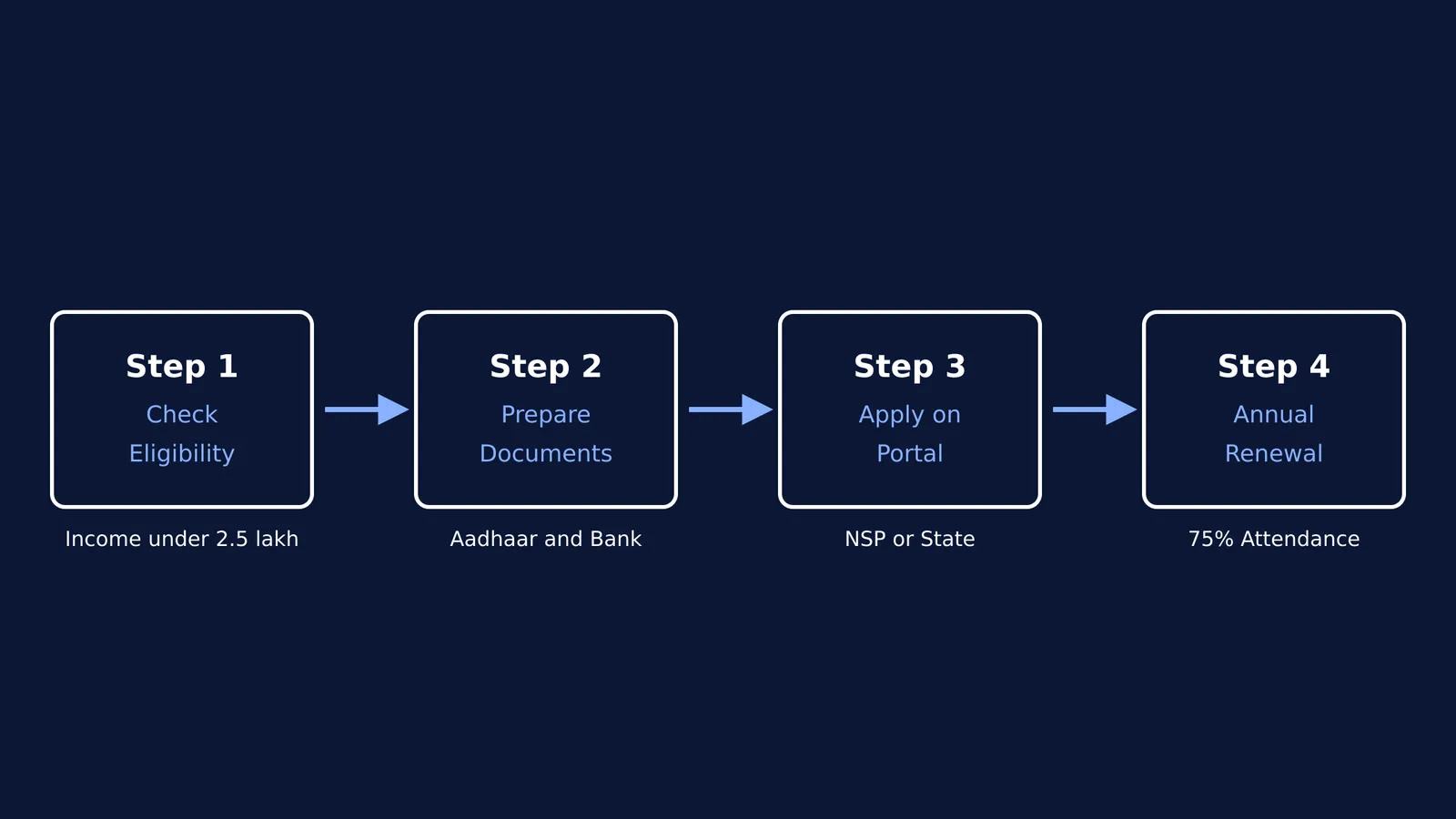
You must belong to the SC or ST category and be an Indian national. The annual family income from all sources must not exceed ₹2,50,000. You must have passed Matriculation (Class 10) or Higher Secondary and be enrolled in a recognised post-matriculation or post-secondary course. Finally, you must be a permanent resident of the state or union territory where you are applying.
Students receiving any other scholarship or stipend are generally not eligible. The scheme also restricts benefits if you change your course of study at the same level, such as pursuing a B.A. after completing a B.Com.
What documents are needed to apply?
Gathering the right documents early prevents delays in your application. Here is a checklist of the paperwork you need to prepare before logging into the portal.
Caste Certificate: A valid certificate issued by a competent authority.
Income Certificate: Proof of family income for the current financial year.
Domicile Certificate: Proof of your permanent residence.
Academic Records: Mark sheets from Class 10 onwards, including the previous qualifying examination.
Institution Documents: A fee receipt for the current academic year and a Bonafide Certificate from your college or school.
Bank Details: An Aadhaar card seeded with your bank account is mandatory for biometric authentication and DBT payments.
If you do not know where to start with your coursework, Fermi's AI tutor can help. It works out what you already know, builds a plan for the session, and teaches through it.
How to apply on state portals or the NSP?
Applications are submitted online, typically opening between July and September each academic year. While many states use the National Scholarship Portal (NSP), others manage applications through their own state-specific portals.
For the 2024-25 academic year onwards, a One-Time Registration (OTR) is mandatory on the National Scholarship Portal. After registering, you use your ID to apply for the Post Matric scheme. States like Uttar Pradesh (UP Scholarship Portal), Maharashtra (MahaDBT), and Bihar (Bihar Post Matric Scholarship Portal) require students to apply directly through their systems.
Check your state's social welfare or tribal welfare department website to confirm the correct platform. For a broader look at funding, you can also explore other Scholarships for science students in India or learn about the NMMS scholarship for Class 8 if you have younger siblings.
What are the rules for keeping the scholarship each year?
Securing the scholarship in your first year is just the beginning; you must renew it annually. The renewal criteria ensure that the funds support active, progressing students.
You must pass the previous year's exams and be promoted to the next class or year of the same course. A minimum of 75% attendance is mandatory, often verified through Aadhaar-based systems at the institution. To renew, log into the portal using your previous Application ID to update your recent marks, current fee receipts, and a new Bonafide Certificate.
Keeping up your grades is essential for renewal. If you need help visualising complex topics to stay on track, the Fermi Simulation Lab provides interactive simulations for the ideas that are easier to see than to read. If you have concept gaps, the Fermi Concept Library contains every concept in physics, chemistry, biology, mathematics and computing, each with its own lesson and its place in the map.