

On this page
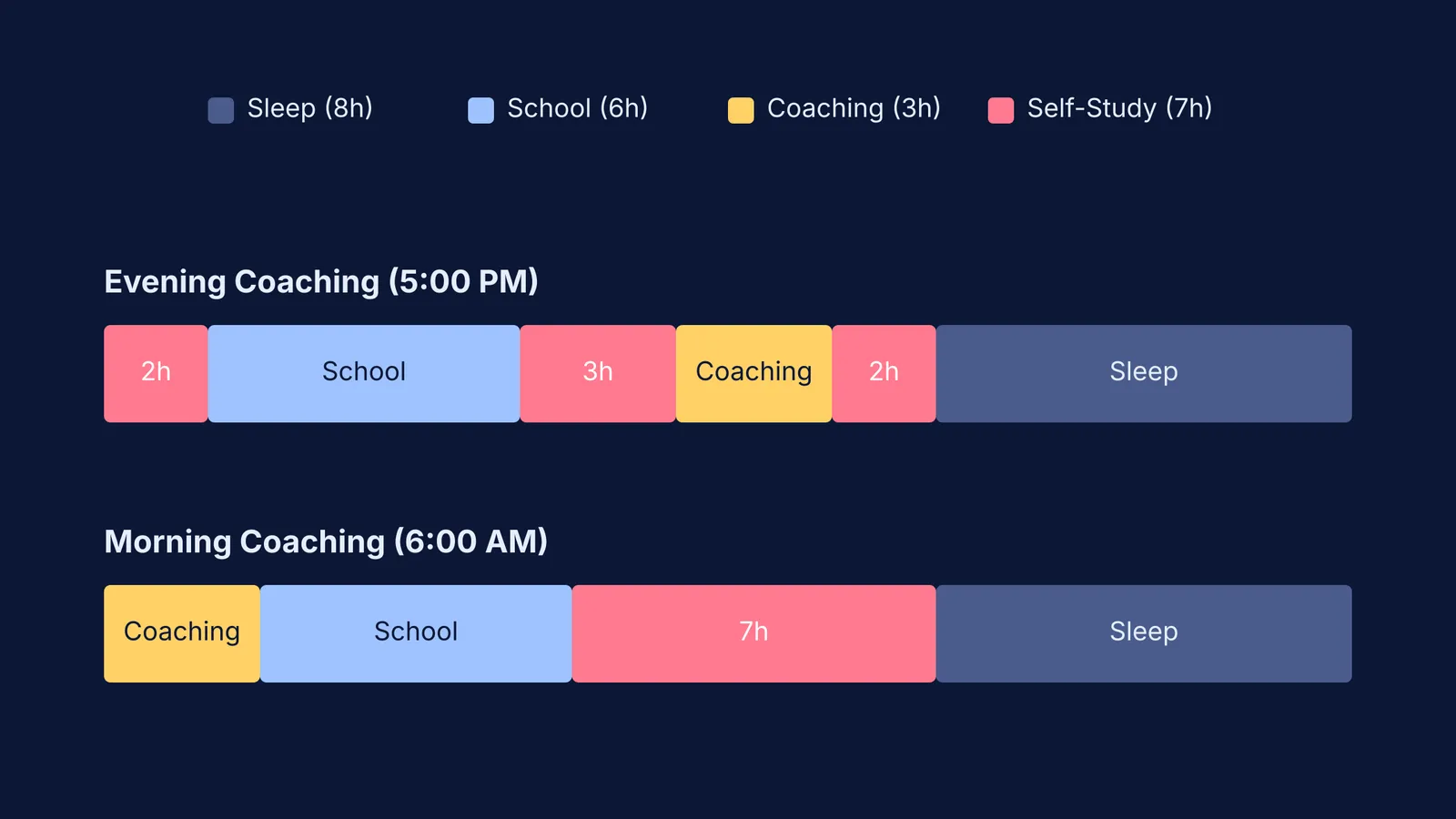
You shift from Class 10 to 11, or your batch is reshuffled, and suddenly your coaching is at 6:00 AM instead of 5:00 PM. A changed timetable does more than just force you to wake up early; it breaks the fragile study routine you spent months building. When school, coaching and travel take up ten to twelve hours of your day, the remaining time feels like a scramble. Here is how to rebuild your week around the new class times without losing sleep or skipping revision.
Why does a timing change break your routine?
When your schedule shifts, the most common trap is trying to force your old habits into the new gaps. If you used to study at midnight, you might try to keep doing that despite a 6:00 AM coaching class. This leads directly to sleep deprivation, which is disastrous for your ability to retain information.
According to the Centers for Disease Control and Prevention (CDC), adolescents aged 13 to 18 need 8 to 10 hours of sleep per 24 hours to maintain cognitive function and physical health. Yet, most students do not get this. A 2026 study of secondary school students found that 68% of adolescents experienced sleep deprivation, defined as sleeping less than 8 hours per night.
The consequences are measurable. The same study found that sleep-deprived adolescents had significantly lower cognitive performance scores (an average of 72.4 compared to 84.7 for those with adequate sleep) and lower academic achievement, seen in a drop in average GPA from 3.45 to 2.89. Memory consolidation—the process where your brain turns short-term learning into long-term retention—happens while you sleep. If you cut sleep to finish a chapter, you are actively preventing your brain from storing what you just read. Your brain physically needs those eight hours to wire the day's lessons into your long-term memory.
Coaching timing changed: how to adjust study plan?
To build a sustainable routine, you have to treat sleep and classes as immovable blocks and fit your self-study into the remaining time. Here is a framework to construct your new week effectively.
1. Map your non-negotiables first Draw a twenty-four-hour timeline on a sheet of paper. Block out your school hours, coaching hours, commute times, and the CDC-recommended 8 hours of sleep. What is left is your actual available time. Be honest about travel and meals. If your commute takes forty-five minutes, write it down. The visual representation will stop you from planning five hours of self-study when you only have three available.
2. Shift from long blocks to targeted sessions When your timing changes, you might lose that continuous three-hour evening block you used to rely on. You have to adapt by using smaller windows. Use a forty-five-minute gap after school to finish daily homework, or use your morning commute to review flashcards. These fragmented slots can be incredibly effective if you enter them with a clear, single goal, such as solving ten physics problems or reviewing one biology diagram.
3. Use active recall instead of rereading With less continuous time, you have to study efficiently. Reading your notes feels productive, but it does not stick. Instead, test yourself. Close the book and write down everything you remember about a concept, or solve a problem from scratch. Spaced repetition and active recall force your brain to work, which means you learn more in a one-hour gap than you would in three hours of passive reading.
4. Build a transition week plan Your body clock takes time to adjust to waking up early or staying focused late. For the first seven days of your new routine, do not plan heavy, complex new chapters. Use this transition week for revision and clearing backlogs. Let your energy levels settle before you ask your brain to tackle the hardest topics. Gradually shift your sleep cycle backward or forward by fifteen minutes a day until you reach your target bedtime.
Where does a smart tool fit in?
When your routine is fragmented, you cannot afford to waste thirty minutes figuring out where to start. Fermi's AI tutor works out what you already know, builds a plan for the session, and teaches through it. It checks your understanding as it goes, so you sit down to a clear next step instead of a blank page.
If you are stuck on a late-night assignment and your teacher is unavailable, the Fermi Problem Library has worked problems with a step-by-step solver that explains the reasoning rather than just printing an answer. It helps you untangle where you went wrong so you can finish the work and get to bed on time.
Building a new routine takes patience. By protecting your rest and using your study hours actively, you can adapt to any coaching schedule without burning out. Read more about how to build a study routine that lasts longer than a week or a four-week spaced revision schedule for any chapter to make the most of your new timetable.


