

On this page
The domestic pharmaceutical market in India is valued at US$ 60 billion (IBEF). It ranks third globally in pharmaceutical production by volume. This large scale makes pharmaceutical chemistry one of the most stable and heavily recruited fields for science graduates.
If you are studying chemistry, moving from the college laboratory to a career in drug development involves understanding what the roles actually look like and what qualifications they demand.
What does a pharmaceutical chemist do?
The pharmaceutical industry divides scientific work into three broad areas.
Research and Development (R&D): This is where new medicines are born. Chemists in R&D focus on drug discovery and synthesis. They test thousands of molecules to find the one that binds selectively to a disease target. Much like Gertrude Elion and rational drug design built on purine chemistry or James Black and the design of beta blocker drugs, the goal is designing compounds that are safe and effective.
Quality Control (QC) and Quality Assurance (QA): Before a batch of medicine ships, it must be tested against strict standards. QC chemists use analytical instruments like high-performance liquid chromatography (HPLC), UV-Vis spectroscopy, and gas chromatography to measure purity and detect any trace impurities. QA professionals then review this data to ensure the entire manufacturing process complies with stringent global regulations and safety guidelines.
Production: These chemists scale up reactions from the test tube to large industrial bioreactors and vats. They must ensure that the chemical yield remains high and the reaction stays safe when running at large industrial scales, managing factors like heat transfer and solvent recovery.
What are the career options after a BSc in chemistry?
A BSc in Chemistry offers a direct and immediate entry into the pharmaceutical industry, providing a strong foundation for laboratory roles (Sharda University).
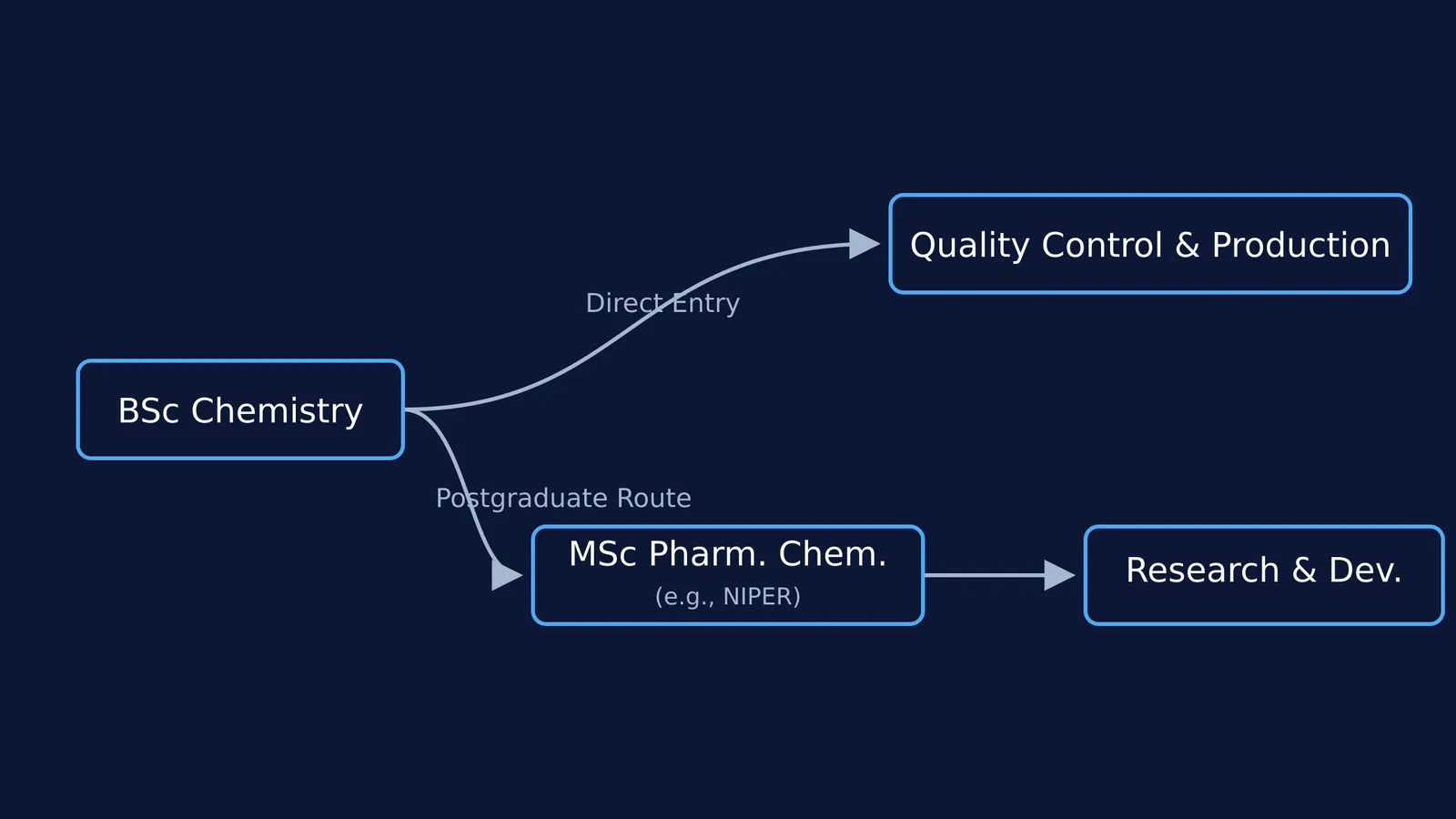
Most BSc graduates start in Quality Control, Production, or as Chemical Technicians. You will spend your days running routine analytical tests, maintaining documentation, and ensuring raw materials are safe. These roles provide a steady income and hands-on experience with industrial standards.
However, growth on this path eventually hits a ceiling. R&D departments, which drive higher salaries and more intellectually challenging work, almost exclusively hire candidates with postgraduate degrees.
Why pursue an MSc in pharmaceutical chemistry?
If your goal is to invent new drugs or manage a laboratory, you will need an MSc in Pharmaceutical Chemistry or Medicinal Chemistry.
In India, the prominent institutions for this route are the National Institutes of Pharmaceutical Education and Research. Declared "Institutes of National Importance", campuses like NIPER Mohali offer master's and doctoral degrees across various disciplines (NIPER).
Admission is highly competitive and is conducted through the joint NIPER JEE. Candidates typically need a valid score in national-level exams like the Graduate Pharmacy Aptitude Test (GPAT), GATE, or the CSIR-UGC NET to qualify for these master's programmes.
An MSc opens doors to roles such as Research Scientist or Formulation Scientist. While a fresher with a BSc might expect an entry-level salary, an MSc combined with specialized skills in organic synthesis or instrumentation leads to significantly faster career progression and higher pay.
How do you build the skills for a career in R&D?
To thrive in pharmaceutical chemistry, you must move beyond rote memorization of reactions. You need to understand the mechanism behind the synthesis, just as you learn in topics like Williamson ether synthesis: choosing the right halide and alkoxide.
If you struggle to picture how molecules interact in three dimensions or why a reaction favours a particular product, the Fermi Concept Library has every concept in chemistry, each with its own lesson. When you get stuck on a difficult synthesis problem or physical chemistry numerical, Fermi's AI tutor works out what you already know and teaches through it—drawing the figure and checking your understanding as you go.
Pharmaceutical chemistry is a demanding field, but it offers the rare chance to do science that directly improves human health. Whether you choose to test the purity of the medicines people rely on today, or stay in academia to design the cures of tomorrow, the path begins with a strong grip on chemical principles.


