

On this page
When deciding on a career in pharmacy, students often face a choice between two main paths: the Bachelor of Pharmacy (B.Pharm) and the Doctor of Pharmacy (Pharm.D). Both degrees are regulated by the Pharmacy Council of India and require a background in physics, chemistry, and biology or mathematics, but they lead to very different careers. One prepares you for the pharmaceutical industry, while the other puts you directly in a hospital setting working with doctors and patients.
What is the difference in course duration?
The most immediate difference is the time it takes to complete each degree.
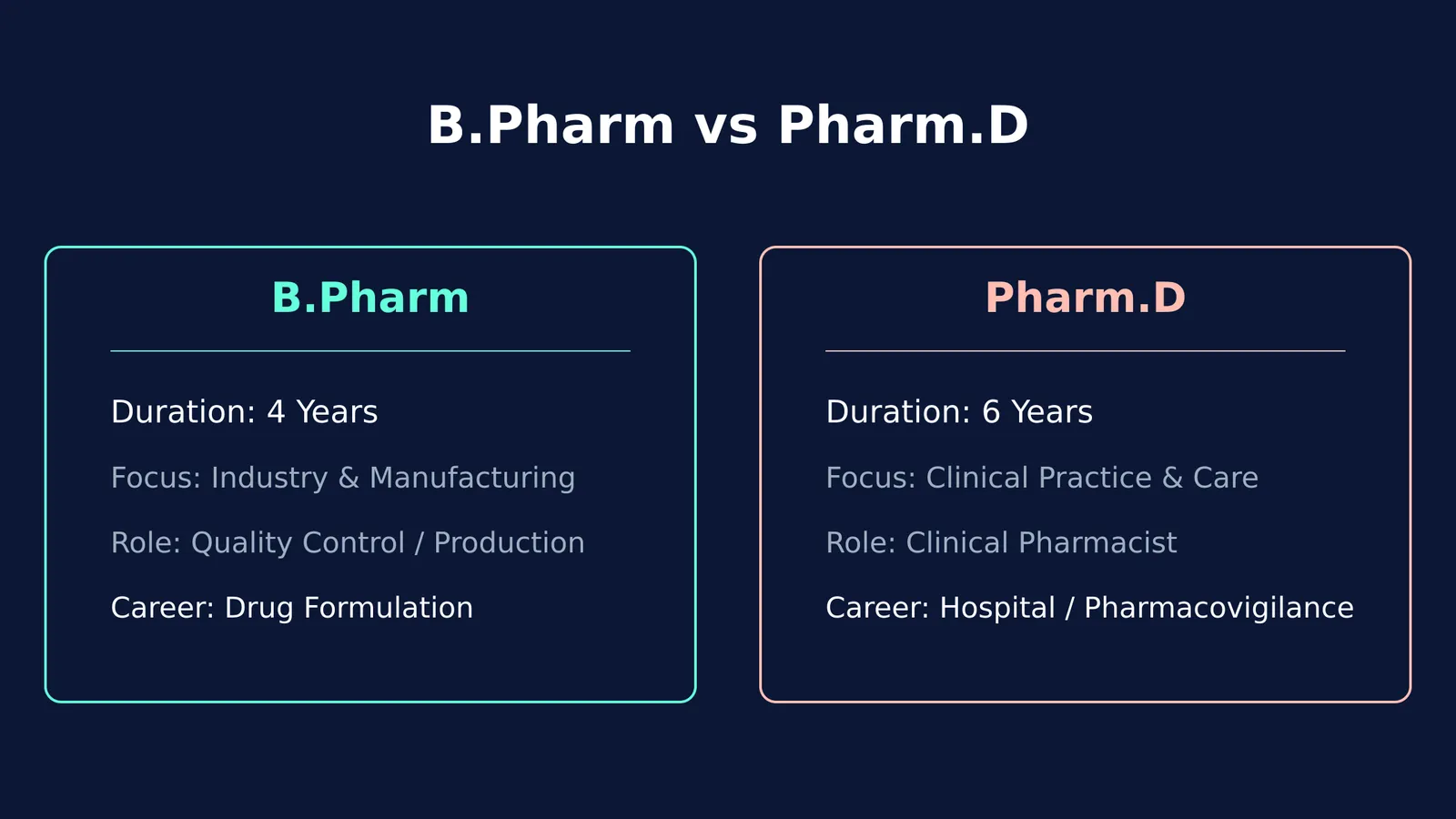
A B.Pharm is a 4-year undergraduate program divided into 8 semesters vidyasiricop.edu.in. The curriculum covers pharmaceutics, pharmacology, pharmaceutical chemistry, and the technical aspects of drug formulation. The final year includes industry-relevant training, preparing students to enter the workforce quickly vidyasiricop.edu.in.
A Pharm.D, on the other hand, is a 6-year professional doctorate pci.nic.in. It includes 5 years of academic study and a mandatory 1-year internship or rotational residency pci.nic.in. During this final year, students must complete clinical postings in hospital departments, such as general medicine for 6 months and paediatrics for 2 months, maintaining a daily logbook of ward rounds and patient counseling sumandeepvidyapeethdu.edu.in. If you already hold a B.Pharm degree, you can pursue a Pharm.D (Post Baccalaureate), which takes 3 years to complete pci.nic.in.
When preparing for pharmacy school or tackling difficult chemistry concepts in your first year, you can explore the Fermi Concept Library, where you can find every concept in physics, chemistry, biology, mathematics and computing, each with its own lesson and its place in the map.
Clinical practice or pharmaceutical industry?
The two degrees have fundamentally different focuses.
B.Pharm is primarily an industry-oriented degree. The coursework is heavy on the science of making medicines. You learn how drugs are manufactured, formulated, and tested for quality. It is designed for students who want to work in laboratories, manufacturing plants, or the business side of healthcare.
Pharm.D is a clinically-oriented degree focused on patient care. The curriculum emphasises drug therapy monitoring, clinical toxicology, and identifying drug-drug interactions. Pharm.D students are trained to work alongside physicians in hospitals, suggesting dosage adjustments and counseling patients on how to take their medications safely. Because it is a professional doctorate, the Pharmacy Council of India allows Pharm.D graduates to use the "Dr." prefix before their names.
What are the career options in India?
Your career path will depend heavily on which degree you choose.
Careers after a B.Pharm:
Pharmaceutical manufacturing: Roles in production, Quality Control (QC), and Quality Assurance (QA).
Sales and marketing: Working as a Medical Representative (MR) or in product management.
Regulatory affairs: Handling the legal documentation required for drug approvals.
Government roles: Positions such as Drug Inspector or government pharmacist.
Fresh B.Pharm graduates can often find starting roles in major multinational companies, with salaries rising significantly as they gain experience or move into government roles like Drug Inspector puranmurti.com.
Careers after a Pharm.D:
Clinical pharmacist: Managing patient medication charts in hospitals.
Pharmacovigilance: Monitoring and reporting the safety and side effects of drugs.
Medical affairs: Acting as a technical expert or Medical Science Liaison (MSL) for pharmaceutical companies.
Medical writer: Creating clinical trial documents and scientific literature.
Pharm.D graduates generally start their careers in hospitals or contract research organizations, with higher earning potential emerging as they specialize in clinical research or pharmacovigilance.
How to make your decision?
Choosing between the two depends on your career goals and how long you want to study.
Choose a B.Pharm if you want to enter the workforce in 4 years vidyasiricop.edu.in, are fascinated by the chemistry of how medicines are made, or want to build a career in India's massive pharmaceutical manufacturing sector. If your child is weighing these options, you might find it helpful to read our guide on when your child's career choice differs from yours or explore talking about STEM careers beyond engineering and medicine.
Choose a Pharm.D if you are passionate about healthcare, want to interact directly with patients, prefer working in a hospital or clinical setting, and are prepared to commit to 6 years of rigorous study and training pci.nic.in.
Both degrees offer stable and rewarding paths in the healthcare sector, so your decision should come down to whether you prefer the laboratory or the hospital ward.


