

On this page
A petroleum engineering degree is highly specialised, training you to find, extract, and manage hydrocarbon resources deep underground. For decades, the path was straightforward: you studied reservoir dynamics, got hired by an oil and gas firm, and rode the industry's highs and lows.
Today, the energy landscape is shifting. While traditional extraction remains a massive global industry, the rise of renewable energy and carbon management has changed how students must plan their futures.
What are the petroleum engineering career options?
The industry is divided into upstream, midstream, and downstream sectors. Petroleum engineers overwhelmingly work in upstream roles, which involve finding and extracting resources. This lifecycle has distinct phases, each offering different career paths:
Exploration and Appraisal: You work alongside geoscientists to evaluate seismic data and drill exploratory wells to determine if a reservoir is commercially viable.
Drilling and Development: Drilling engineers design the wellbore and casing to safely penetrate high-pressure rock formations without collapsing or leaking.
Production and Reservoir Management: Reservoir engineers build mathematical models to estimate how much oil or gas exists and how to push it to the surface. Production engineers manage the active extraction over the lifespan of the well.
While chemical engineers dominate the downstream sector (refining raw crude into plastics and fuels), petroleum engineers are the architects of the subsurface.
Is hiring cyclical in petroleum engineering?
Yes, hiring is famously "boom and bust." When global oil prices are high, energy companies invest in new exploratory wells, leading to aggressive hiring and lucrative field bonuses. When prices drop, projects are paused, and the job market contracts.
According to the U.S. Bureau of Labor Statistics, the job outlook for petroleum engineers projects just a 2% growth from 2025 to 2035, which is slower than average. However, the BLS also notes that roughly 1,000 openings are projected each year over the decade, largely driven by a wave of retirements as older engineers exit the labour force.
What are the transferable skills for the energy transition?
Because traditional oil and gas hiring is cyclical and growing slowly, your greatest asset is the versatility of your degree. The physics and mathematics of pushing fluids through porous rock are entirely transferable to the "New Energy" economy.
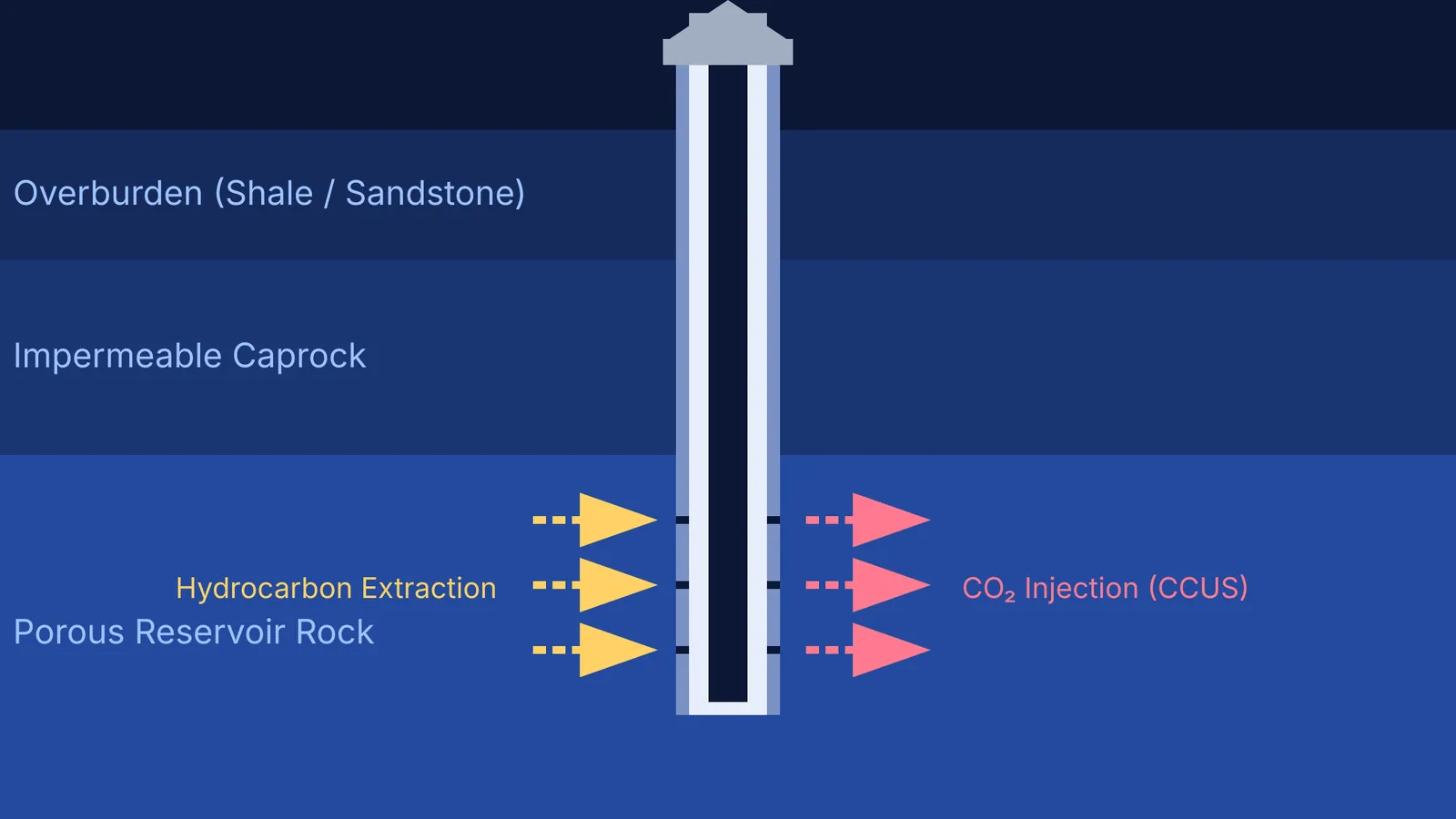
Carbon Capture, Utilisation, and Storage (CCUS): Instead of pulling hydrocarbons out, CCUS involves injecting carbon dioxide back into depleted reservoirs or saline aquifers. Reservoir engineers use the exact same fluid dynamics and permeability modelling to ensure the CO₂ remains safely trapped underground.
Geothermal Energy: Tapping into the Earth's natural heat requires drilling deep into high-pressure, high-temperature (HPHT) environments. The directional drilling techniques developed by the oil industry are now essential for creating Enhanced Geothermal Systems (EGS).
Data Science and Predictive Modelling: Managing a reservoir requires massive datasets and complex simulations. The mathematical rigour needed to handle these models translates seamlessly to tech, finance, and heavy infrastructure. (For instance, you will frequently rely on calculus; brush up on topics like acceleration given as a function of v or x: how to integrate it to keep your foundational maths sharp).
How can you future-proof your engineering degree?
To succeed in this evolving field, you must build a broad technical foundation rather than just memorising oilfield terminology.
Focus on first principles: Mastery of thermodynamics, fluid mechanics, and material science will never become obsolete. If you are struggling to picture how pressure, volume, and temperature interact—such as the free expansion of an ideal gas: why work and ΔU are both zero—these concepts are the bedrock of subsurface engineering. When you need to understand how phase changes happen, the Fermi Simulation Lab provides interactive simulations for the ideas that are easier to see than to read.
Learn industry software: Get hands-on experience with simulation tools like Eclipse or Petrel, which are standard for both oil extraction and CO₂ modelling.
Embrace the complex mathematics: Reservoir modelling is computationally heavy. If you find yourself stuck on a difficult differential equation or integral, the Fermi Problem Library has worked problems with a step-by-step solver that explains the reasoning rather than printing an answer.
The scope of petroleum engineering is no longer limited to fossil fuels. By treating your degree as an advanced toolkit for managing the Earth's subsurface, you can position yourself at the forefront of the energy transition.


