

On this page
It is a common belief that choosing Physics, Chemistry, and Mathematics (PCM) in Class 12 closes the door to the medical field forever. But healthcare runs on more than just biology. Hospitals and medical device companies need engineers to design prosthetics, physicists to plan radiation treatments, and developers to build diagnostic algorithms.
If you are a PCM student who has developed an interest in healthcare, the pathways are wider than ever. Here is how you can build a medical career.
What are the new NEET eligibility rules for PCM students?
Until recently, the rules were rigid: you had to study Biology or Biotechnology continuously for two years in Classes 11 and 12 to sit the NEET-UG exam. That changed with a public notice from the National Medical Commission (NMC) on November 22, 2023.
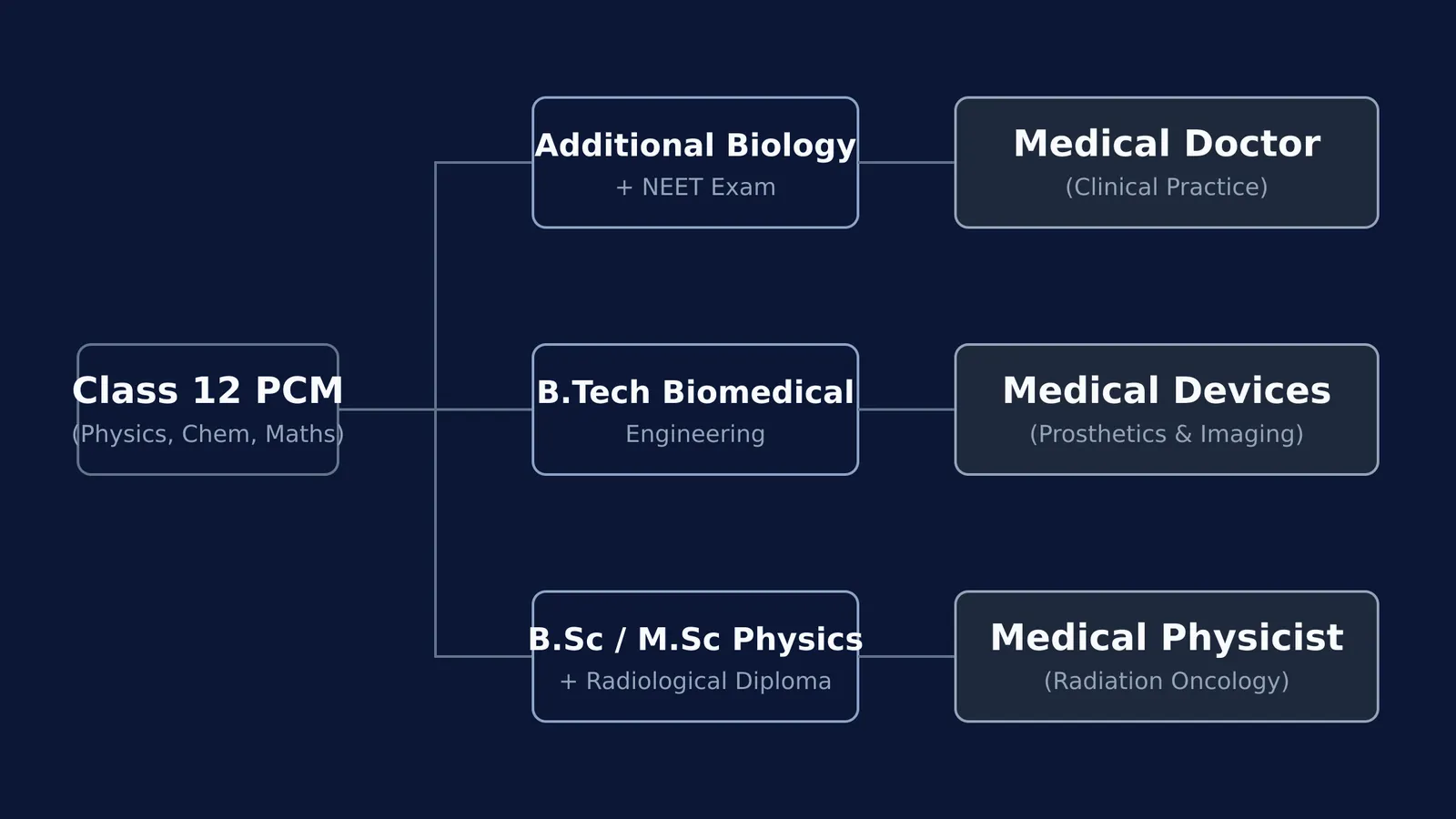
Under the new guidelines, students who have passed Class 12 with PCM as core subjects are eligible to appear for NEET, provided they pass a Biology or Biotechnology exam as an additional subject at the 10+2 level from any recognized board.
This is a major shift. It means you can clear your Class 12 board exams, take Biology through the National Institute of Open Schooling (NIOS) or as a private candidate, and still become a doctor. The rule applies retrospectively, bringing medical education in line with the flexible approach of the National Education Policy 2020. If you are lacking the fundamental biology concepts, a structured review using the Concept Library can help bridge the gap before you start full NEET preparation.
What is biomedical engineering?
If you prefer to stick with engineering but want to work in healthcare, biomedical engineering is the most direct route. Biomedical engineers bridge the gap between engineering and medicine, designing the tools doctors use to diagnose and treat patients.
The Indian medical device market is currently valued at 11 billion USD, and is projected to reach 50 billion USD by 2030, according to Invest India. This growth is driving demand for engineers who can develop:
Medical devices: From affordable pacemakers to advanced robotic surgical arms.
Imaging systems: Improving the software and hardware of MRI and CT scanners.
Wearable tech: Designing sensors that monitor a patient's vitals remotely.
Prosthetics and implants: Using 3D printing and materials science to create better artificial joints and limbs.
Most engineering colleges accept PCM students for B.Tech in Biomedical Engineering, typically bridging the biology gap with anatomy and physiology courses in your first semester at college. It is a highly practical career where your mathematics and physics skills translate directly into saving lives.
What does a medical physicist do?
For students pursuing a pure physics degree, working in a hospital as a medical physicist is a highly specialized and rewarding career path. If you are weighing up BSc physics career options, this is one of the most clinical roles available to non-doctors.
Medical physicists are essential in radiation oncology. When a patient needs radiation therapy for cancer, the medical physicist works with the oncologist to design a customized 3D treatment plan. They use CT or MRI scans to calculate the exact radiation dose required to destroy the tumor while sparing the surrounding healthy tissue.
They are also responsible for calibrating the complex linear accelerators (LINACs) that deliver the radiation, ensuring absolute precision and safety for every patient.
In India, becoming a clinical medical physicist typically involves completing a B.Sc. in Physics, an M.Sc. in Physics, and a Post-M.Sc. Diploma in Radiological Physics (such as the one conducted by BARC), followed by a mandatory clinical internship. This allows you to register with the Atomic Energy Regulatory Board (AERB) and work in radiotherapy departments across the country.
How can you plan your transition to the medical field?
If you are a PCM student considering a move into the medical field, here is a practical checklist to help you decide:
Identify your goal: Do you want to treat patients directly (MBBS), design the equipment (Biomedical Engineering), or manage the physics of treatments (Medical Physics)?
Check the prerequisites: If you are aiming for NEET, register for a Biology exam through a recognized board. If you want to pursue biomedical engineering, check which entrance exams (like JEE) your target colleges accept.
Talk to professionals: Talking about STEM careers with people already working in these fields can clarify what the day-to-day job looks like. Reach out to a medical physicist or a biomedical engineer to understand their career path.
The boundary between engineering, physics, and medicine is blurring. Whether you choose to take the extra Biology exam for NEET or apply your maths and physics skills to medical technology, the healthcare sector needs your expertise.


