On this page
When you enter a student paper contest at a college tech fest, you are tasked with breaking down a complex project into a short, compelling technical argument. It is a vital career skill, but it is rarely taught directly in the classroom.
If the thought of standing in front of a panel of judges makes your heart race, you are not alone. A 2022 study in the Asian Journal of University Education found that 50.8% of engineering diploma students experienced moderate public speaking anxiety, with the mere thought of presenting and answering questions acting as the primary triggers. Another 12.3% reported high levels of anxiety.
The good news is that technical judges are not looking for a flawless theatrical performance. According to rubrics from engineering societies like IEEE Region 10, evaluators typically weight your technical content and logical coherence at 50 to 60 percent of your total score, heavily prioritising substance over style. By following a structured approach to your abstract, slides and presentation, you can present your work with confidence.
How to choose a tech fest presentation topic?
The best presentations are built on a clear, defensible idea. Judges look for originality, technical feasibility, and depth of knowledge. When selecting your topic:
Solve a specific problem: Rather than a broad overview of artificial intelligence, focus on something targeted, such as using AI to optimize battery drain in mobile devices.
Check the rules: Ensure your topic aligns with the specific themes or fields of interest dictated by the event organisers.
Show your work: A paper that includes your own simulations, code, or experimental data will always score higher than a pure literature review.
If you bring your topic to Fermi's AI tutor, it works out what you already know, builds a plan for the session, and teaches through it, helping you build a clear line of reasoning.
What makes a winning abstract?
Before you can present, your paper must be accepted. A 2012 editorial in the Journal of Micro/Nanopatterning, Materials, and Metrology notes that a good abstract must stand alone, effectively acting as an advertisement for your full paper.
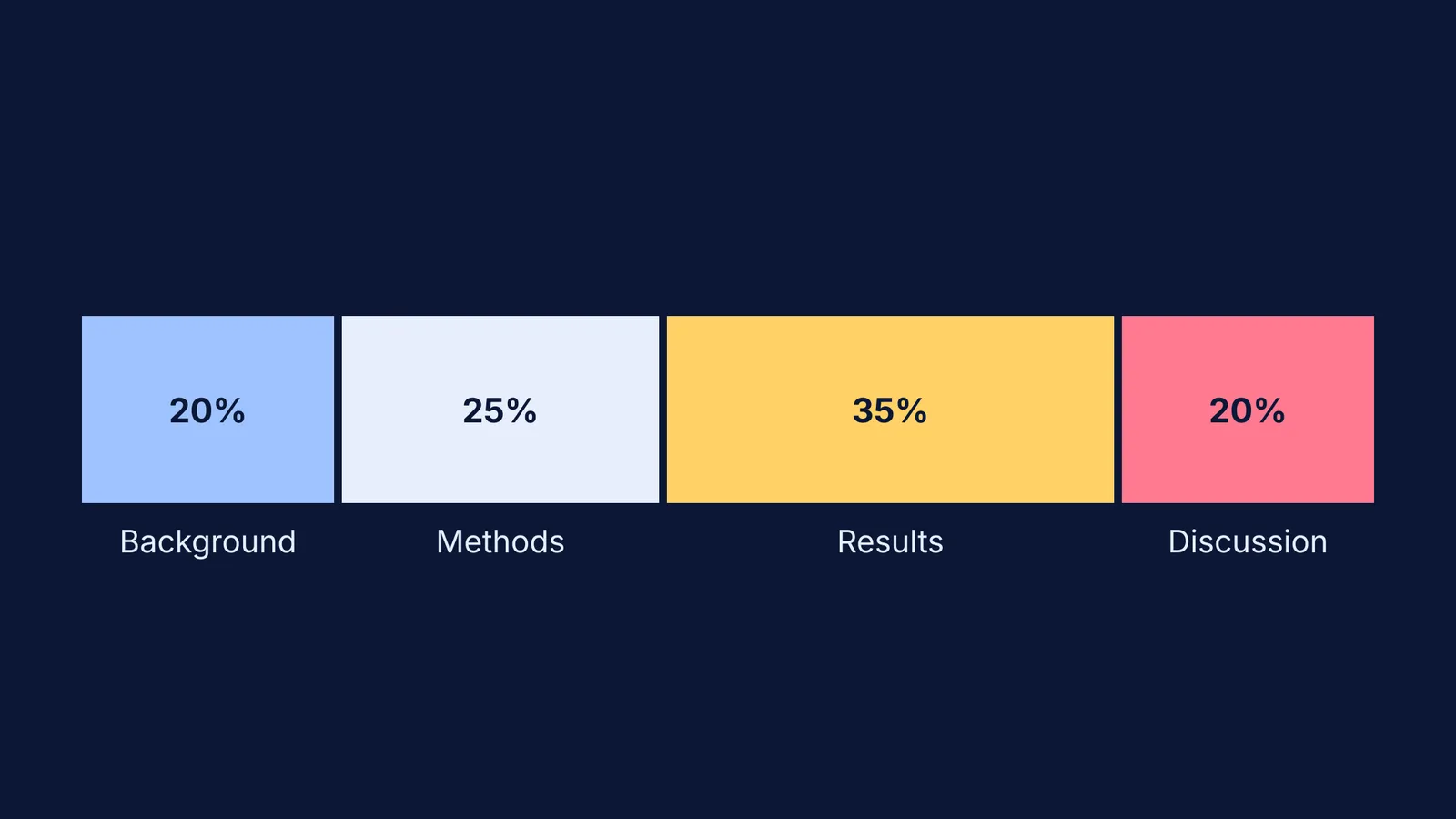
According to academic writing guidelines from SF Edit, most student contests require an abstract of 150 to 250 words. To hit all the requirements without wasting space, use the standard 4-step structure:
Background (20%): What is the problem and why does it matter?
Methods (25%): What did you do to solve it?
Results (35%): What were your primary findings? This is the most important section for reviewers.
Discussion (20%): What do these results mean for the field?
How should you structure your presentation slides?
IEEE student branch contests typically allocate 10 to 12 minutes for the oral presentation, followed by 3 to 5 minutes for audience questions. With such a strict time limit, your slide deck must be concise.
A reliable framework for a 10-minute presentation is the "10-Slide Rule":
Slide 1: Title, your name, and affiliation.
Slide 2: The core problem you are trying to solve.
Slide 3: A brief review of why existing solutions fall short.
Slides 4-6: Your methodology and experimental setup.
Slides 7-8: Your key results, supported by clear graphs or tables.
Slide 9: The conclusion and future scope.
Slide 10: References and acknowledgments.
Avoid crowding your slides with text. Use diagrams to show your apparatus or architecture. If you hit a roadblock while researching the physics behind your paper, whether it is calculating the energy density in an electric field or explaining the dispersion of white light by a glass prism, the Fermi Concept Library explains every concept in physics, chemistry, biology, mathematics and computing, each with its own lesson and its place in the map.
How do you handle judges' questions?
The Q&A session is often the most anxiety-inducing part of the event, but it is also where you can prove your depth of knowledge. Judges ask probing questions not to trap you, but to see how you think on your feet.
When a judge asks a question:
Pause and listen: Do not interrupt, even if you know the answer immediately.
Clarify if needed: If the question is complex, rephrase it out loud to ensure you understand it correctly.
Be honest: If you do not know the answer, do not guess. Say that it is an excellent question that falls outside the scope of your current data, but explain what your hypothesis would be.
Practice delivering your presentation to a friend who is willing to ask difficult questions. By treating the Q&A as a conversation rather than an interrogation, you can turn the most intimidating part of the tech fest into your strongest asset.