

On this page
India's science olympiad programme begins with the National Standard Examination (NSE). Organised by the Indian Association of Physics Teachers (IAPT), the NSE is the first hurdle for students aiming to represent the country in international olympiads for physics, chemistry, biology, astronomy, and junior science.
Whether you are preparing for the NSE in Physics (NSEP), Chemistry (NSEC), Biology (NSEB), Astronomy (NSEA), or Junior Science (NSEJS), the registration process is strict but straightforward.
Here is exactly how the enrolment works, the fees involved, and what to do if your school is not part of the IAPT network.
What is the National Standard Examination?
The NSE is the Stage I examination for the Indian National Olympiads. It filters tens of thousands of applicants down to the top few hundred students per subject. These successful candidates move on to Stage II, which is coordinated by the Homi Bhabha Centre for Science Education (HBCSE).
If you are just beginning, you might find our guide on Getting started with the physics olympiad in India helpful.
The exams are typically held in November, with registration opening in August. The registration fee is ₹300 per student per subject (IAPT, 2026).
How to register for the NSE through your school?
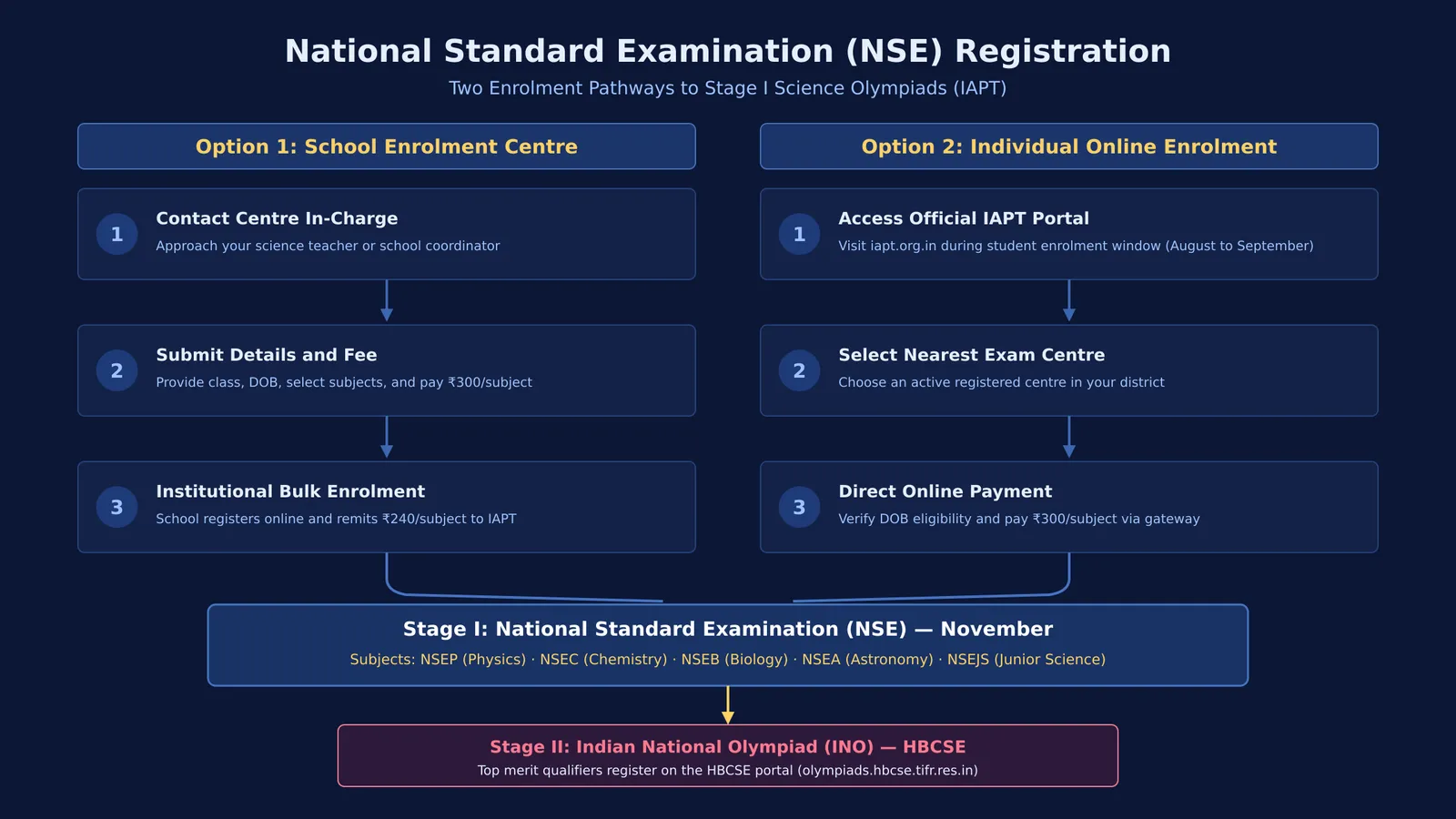
The easiest way to register for the NSE is through your own school or junior college, provided it is a registered IAPT enrolment centre.
Ask your science teacher to find out who the designated Centre In-Charge is at your school.
Submit your details, including your name, class, date of birth, and the subjects you wish to appear for.
Pay the ₹300 fee per subject in cash to the Centre In-Charge (IAPT), who retains a portion for local centre expenses and handles the bulk online enrolment on the school's behalf.
During this stage, many students start tackling past papers. When you get stuck on a difficult problem, the Fermi Problem Library has worked problems with a step-by-step solver that explains the reasoning rather than printing an answer.
How to register if your school is not an enrolment centre?
Not all schools are IAPT centres, but you are not excluded if yours is missing from the list. The IAPT allows direct online enrolment for individual students.
If you are studying for The junior science olympiad: NSEJS for Class 10 students or any of the senior exams, follow these steps to register individually:
Go to the IAPT registration portal (iapt.org.in) during the student enrolment window.
Select a nearby registered centre from the provided list for your state and district.
Enter your personal details, verify your eligibility based on your date of birth, and select your subjects.
Complete the ₹300 per subject payment using the online payment gateway.
What are the fees and deadlines for the NSE?
According to the IAPT schedule, timing is critical as late applications are not accepted. For the 2026 cycle, the official timeline is structured as follows:
Centre Registration: August 1 to August 31, 2026.
Student Enrolment: August 21 to September 16, 2026.
Exam Dates: November 21 and 22, 2026.
If you are reading this after the September deadline, you will have to wait for the next academic year. Use the time to prepare thoroughly; our overview on Getting started with the chemistry olympiad in India: NSEC and INChO offers a roadmap for your studies.
As you build your study plan, you might find that some concepts in Olympiad syllabuses are difficult to visualise. The Fermi Simulation Lab provides interactive simulations for the ideas that are easier to see than to read.
What happens after you qualify?
If your NSE scores meet the cut-off, you qualify for Stage II: the Indian National Olympiad (INO).
Registration for the INO is separate and is handled by the HBCSE. If you clear the NSE, you must register your details on the HBCSE portal (olympiads.hbcse.tifr.res.in) typically in January, ahead of the February exams.
Olympiad preparation demands consistent effort, but the registration itself should be a one-time administrative task. Check the dates, complete the form early, and keep your focus on the science.


