

On this page
Many students assume the olympiad train left in middle school. Coaching orientations often highlight peers who solved advanced problem sets in junior high, creating the myth that without early foundation batches, senior olympiads are out of reach.
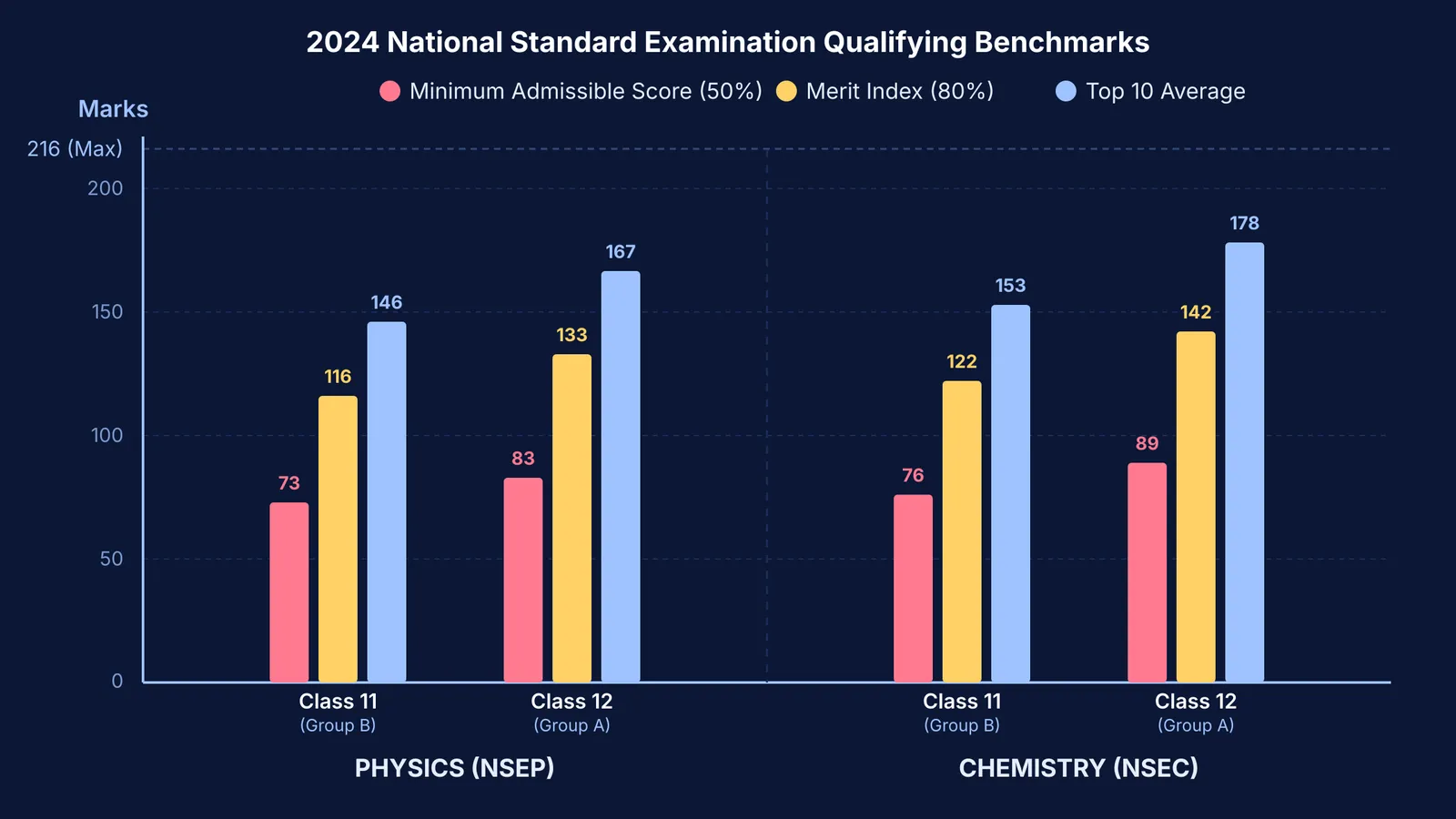
In reality, Class 11 is the formal entry point for national olympiads administered by the Homi Bhabha Centre for Science Education. Under Indian Association of Physics Teachers rules, National Standard Examination candidates are split into Group A (Class 12) and Group B (Class 11 or lower). Qualifying benchmarks—the Minimum Admissible Score at 50% of the top 10 average, and the Merit Index at 80%—are calculated separately for each group. In the 2024 National Standard Examination in Physics, the Group B Minimum Admissible Score cutoff was 73 marks out of 216, compared to 83 for Group A. In chemistry, the Group B cutoff was 76 out of 216, compared to 89 for Group A. You are not competing on an unequal footing against seniors who have finished the full two-year syllabus.
For families, our guide on supporting your child's olympiad preparation details how prioritizing curiosity over trophies maintains motivation.
Which olympiad should you pick in Class 11?
Your choice depends on how cleanly an olympiad aligns with your entrance goals:
Physics: Organized by the Indian Association of Physics Teachers, the paper covers senior secondary physics. Around 50% tests Class 11 mechanics, fluids, and thermal physics, directly reinforcing JEE Advanced concepts.
Chemistry: The chemistry examination matches the NCERT syllabus across physical, inorganic, and organic chemistry. Rigorous physical chemistry problems in stoichiometry and thermodynamics strongly overlap with entrance preparation.
Mathematics: Conducted by the Mathematics Teachers' Association of India, the qualifier tests number theory, combinatorics, Euclidean geometry, and algebra, omitting calculus and coordinate geometry. Starting from scratch in Class 11 requires learning non-school branches with low direct entrance overlap.
Biology: Coordinated by the Homi Bhabha Centre for Science Education, the exam tests physiology, genetics, and cell biology through experimental reasoning.
Physics and chemistry offer higher syllabus synergy for engineering aspirants than pure mathematics. To explore math contest patterns, see our guide on getting started with the maths olympiad.
What are realistic targets for a Class 11 beginner?
Aiming immediately for a six-member international team creates needless anxiety. Research on goal setting shows that specific, challenging, but attainable proximate goals drive sustained effort better than vague ambitions (Locke & Latham, 2002).
For a Class 11 beginner, structure your targets into three stages:
Clear the Group B Minimum Admissible Score: Scoring roughly 33% to 36% of total marks in physics or chemistry, as recorded by the Indian Association of Physics Teachers, qualifies you for state-quota selection.
Target Stage 2 qualification: Qualifying for the Indian National Olympiad—an advanced stage that admits roughly 300 to 500 top-scoring students nationwide per subject according to the Homi Bhabha Centre for Science Education—validates strong problem-solving ability.
Treat Class 11 as calibration: Deep analytical practice in Class 11 builds the conceptual mastery needed for a strong Merit Index attempt in Class 12.
When unfamiliar theoretical gaps appear during practice, the Fermi Concept Library covers every concept in physics, chemistry, biology, mathematics and computing, each with its own lesson and place in the map.
How do you balance olympiads with boards and entrance prep?
A sustainable routine prevents advanced problem solving from derailing school work. Follow an 80/20 time split aligned with Indian Association of Physics Teachers syllabus topics:
Devote 80% to 85% of weekly study time (about 25 to 30 hours) to core coaching lectures, practice assignments, NCERT exercises, and subjective board derivations.
Dedicate 15% to 20% of weekly study time (roughly 5 to 7 hours across weekend sessions) to olympiad problems.
Synchronise topics: only solve olympiad questions for chapters you are actively studying in school or coaching, such as kinematics or chemical bonding.
When tackling complex multi-step problems where standard formulas fall short, the Fermi Problem Library provides worked problems with a step-by-step solver that explains the reasoning rather than printing an answer.
How does deep problem solving transform your regular study habits?
Olympiad practice replaces passive memorisation with generative retrieval. Research indicates that practice testing and distributed problem solving offer high utility for retention and transfer, whereas rereading and highlighting show low utility (Dunlosky et al., 2013).
Wrestling with non-routine physics problems teaches you to dissect constraint equations, examine boundary conditions, and test limiting cases. This analytical muscle translates directly into speed on multi-correct entrance questions. To start building this foundation, read our walkthrough on getting started with the physics olympiad.
Where physical systems are difficult to picture from static figures, the Fermi Simulation Lab offers interactive simulations for ideas that are easier to see than to read. Combining syllabus harmony, realistic targets, and active retrieval makes Class 11 olympiad study an asset rather than a burden.


