

On this page
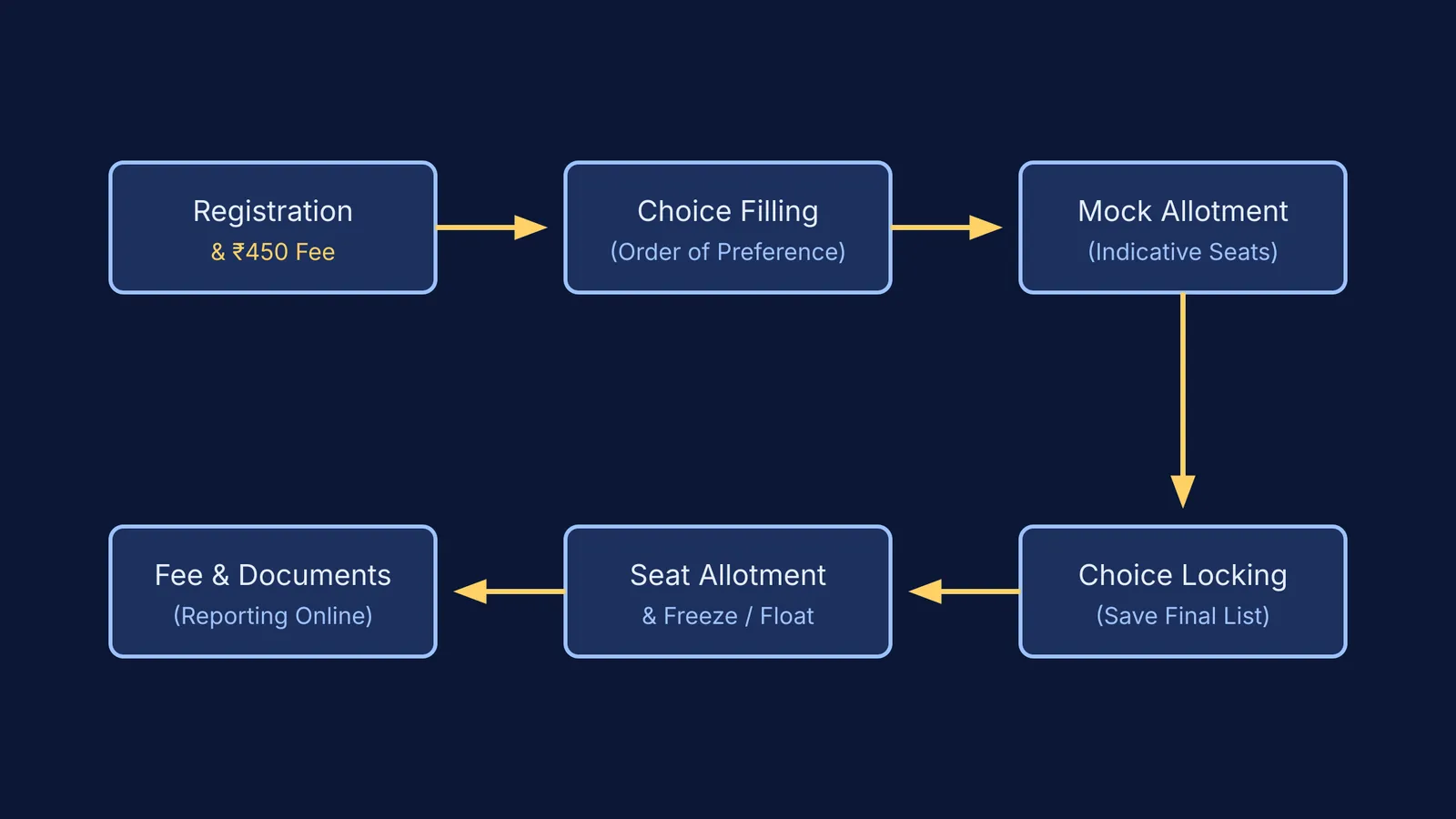
The Odisha Joint Entrance Examination (OJEE) manages the allocation of seats for undergraduate and postgraduate courses in engineering, pharmacy, and management across Odisha. The counselling process is entirely online. Knowing the sequence of steps helps you avoid missing deadlines or losing an allotted seat. The process follows a strict sequence: registration, choice filling, mock allotment, choice locking, seat allotment and final reporting.
How do you register for OJEE counselling?
The first step is to create a candidate profile on the official OJEE web portal. You will need your application number, rank card details, date of birth, and category information. Registration is a one-time process; if you miss the window before the first round, you cannot participate in subsequent regular rounds of counselling.
According to the official OJEE guidelines, candidates must pay a non-refundable counselling fee of ₹450 online (ojee.nic.in). This payment is mandatory; without it, your registration remains incomplete. After payment, you must create a strong password, which you will use repeatedly throughout the counselling rounds to log in, modify choices, and view your allotment status.
You must also provide your banking details. If a situation arises where you are eligible for a refund of your admission fee, the authorities will use these details to transfer the money back.
What is choice filling and mock allotment?
Once registered, the portal displays a list of colleges and courses available based on your rank and category. You are expected to arrange these in order of preference. The system will try to assign you the highest choice on your list that has a vacancy.
Add multiple choices: There is no limit to the number of choices you can fill. Include a wide range of options, placing your most desired courses at the very top.
Mock Allotment: Before the final locking deadline, OJEE typically publishes a "Mock Allotment" result. This gives you an early indication of which seat you are likely to get. If the result is not to your liking, you have time to rearrange, add, or delete choices.
If you are aiming for an engineering seat, see our guide on OJEE: the Odisha joint entrance exam, pattern and eligibility. You can also explore options in other states like KIITEE explained: pattern, phases and marking for KIIT B.Tech or TNEA: how Tamil Nadu engineering admission works without an exam.
How does the seat allotment work?
Seats are assigned over multiple rounds based on merit and seat availability. If you are allotted a seat, you must report online. This involves:
Paying the part-admission fee: This confirms your intention to take a seat. The fee amount is usually ₹10,000 for general category and ₹5,000 for SC/ST/PC students (ojee.nic.in), adjusted against your final college fees.
Uploading documents: You must upload digital copies of your rank card, Class 10 and 12 mark sheets, and category or residency certificates. Nodal officers will verify these documents online.
Exercising the Freeze or Float option: If you are happy with the seat and do not want to participate in further upgrades, choose "Freeze". If you want to accept the seat but remain eligible for a better one in the next round, choose "Float".
After the final round concludes, candidates must download their final allotment letter and report physically to the allotted institute to complete the admission process.
What is a good framework for choice filling?
When building your preference list, a useful rule of thumb is to follow a three-tier strategy:
Dream choices: A few colleges you would love to attend, even if your rank is slightly below their usual cutoff. Place these right at the top.
Realistic choices: The majority of your list, containing colleges where your rank strongly matches the closing ranks from previous years.
Safety choices: Reliable backup options that you are willing to attend if the cutoffs shift unexpectedly.
Using an organised approach ensures you will not be left without a seat. Never list a college you are entirely unwilling to join.
When working through problems for your exams, Fermi's AI tutor can help. It acts as a one-to-one tutor that teaches rather than just answers, noticing where you are stuck and holding a line of reasoning across a session.


