

On this page
If your maths or physics notebook is mostly solved examples copied from the board, you are saving answers to questions you will never see again. What carries over is the method, and that is what your notes should hold.
Why doesn't copying solved examples work?
A copied solution records what was done, not why or when to do it. In a classic study, Chi, Feltovich and Glaser (1981) asked experts and novices to sort physics problems. Experts grouped problems by the physics principle that solves them; novices grouped them by literal features of the problem, such as the objects in it.
Chi and colleagues (1989) reported that, while studying worked mechanics examples, stronger students explained the steps to themselves and related them to principles in the text, while weaker students explained less and then relied heavily on the examples when solving problems.
Richard Catrambone (1998) found across 4 experiments that labelling a group of steps in a worked example helped learners form subgoals, the kind of understanding needed for new problems that require changed steps. Abstract labels were more likely than superficial ones to produce subgoals less tied to surface features.
So good notes do three things a copied example does not: name the problem type, label the steps by purpose, and record when the method applies.
What should maths and physics notes contain?
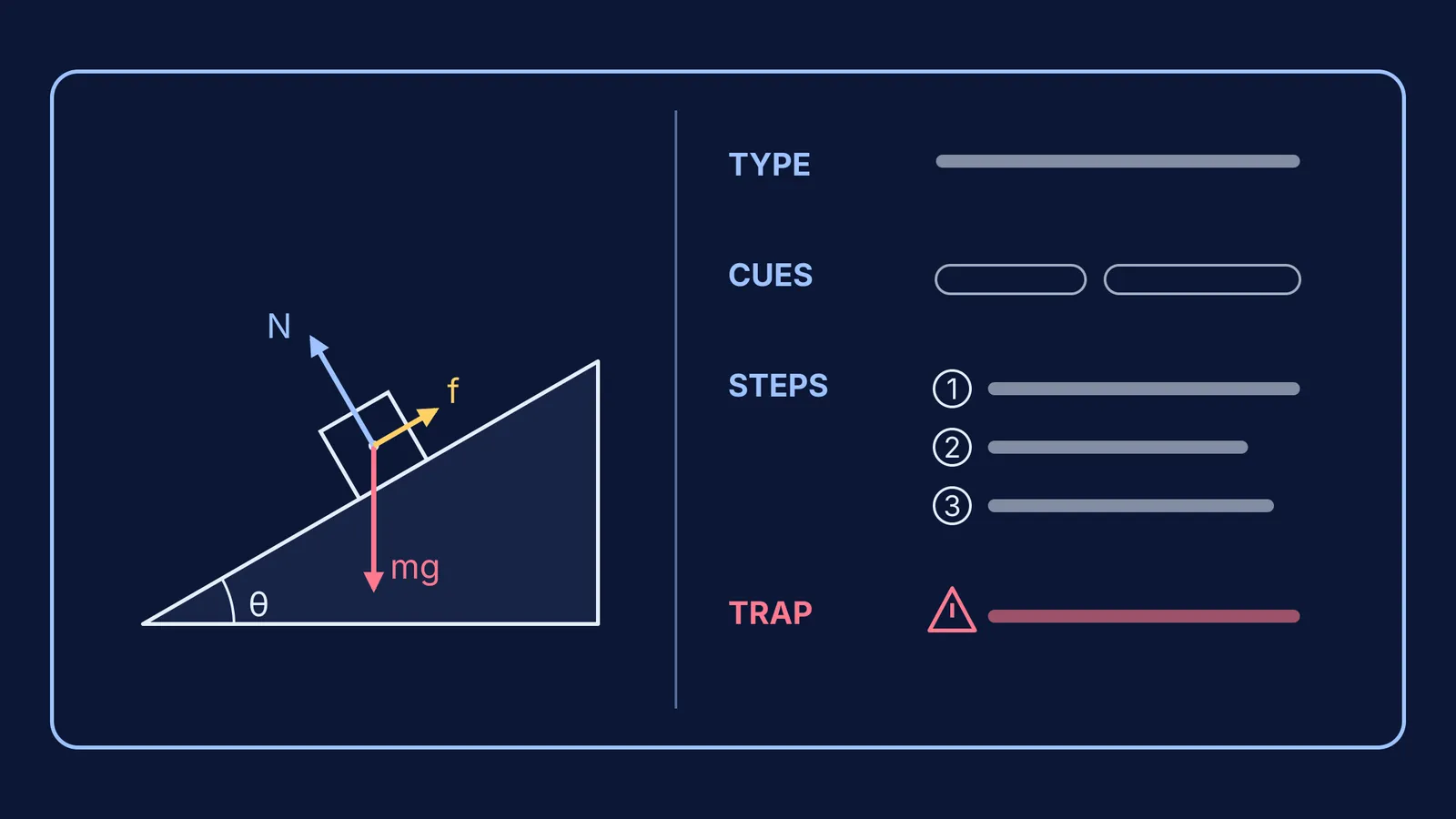
Keep two kinds of notes: a short concept page per chapter (definitions, laws, derivations you must know) and a set of method cards, one per problem type. Each card has five parts:
Type: a name for the problem family, in your own words.
Cues: the words or features that tell you this card applies.
Key steps: three to six steps, each labelled by what it achieves, not by the arithmetic.
Traps: the mistakes you or your classmates actually made.
Check and source: a quick sanity test, and the question number of one solved example.
What does a method card look like?
Here is one for a block on a rough incline, a staple of Class 11 mechanics.
Type: block on a rough incline; find acceleration, friction or the force needed.
Cues: "inclined plane", "coefficient of friction", "just begins to slide", "moves up or down".
Step 1, see the forces: draw the free-body diagram with mg, N and friction, plus any applied force.
Step 2, choose axes: along and perpendicular to the incline.
Step 3, find N: balance forces perpendicular to the surface; with no other force, N = mg cos θ.
Step 4, decide friction: first check whether the block moves at all (with no applied force, is mg sin θ greater than μs mg cos θ?). If it stays at rest, friction is whatever balances it, up to μs N.
Step 5, solve: Newton's second law along the incline.
Traps: writing N = mg; fixing friction's direction before deciding the motion; using f = μN for a block at rest; forgetting that a force applied at an angle changes N.
Check: with μ = 0, a block sliding freely should give a = g sin θ.
A maths card works the same way. For the integral of an expression containing a modulus, such as |x − 1|, the cue is the modulus sign inside the integral, the key step is to split the limits where the expression inside changes sign, and the trap is integrating straight through that point.
How do you revise from method cards?
Do not just reread. Pick a mixed set of problems from different chapters and, before solving each one, name the card it needs. An exam paper does not tell you the chapter, so that choice is what you need to practise.
Mixing problem types this way is called interleaved practice. In a study of 126 seventh-grade maths students over 3 months, Doug Rohrer and colleagues found that interleaved practice produced higher scores than the usual blocked practice on unannounced tests given 1 or 30 days after a final review. Our week-by-week plan for interleaved practice shows how to set this up.
When the method is wrong rather than the arithmetic, the Fermi Problem Library has worked problems with a step-by-step solver that explains the reasoning rather than printing an answer, so you can compare its steps with your card. If the gap is a concept rather than a method, the Fermi Concept Library gives each concept in physics and mathematics its own lesson.
How do you build cards for a chapter?
Finish the chapter's exercise first; cards come from solved work, not from reading.
List the problem types you met and give each a plain name.
Write one card per type, citing one of your own solved questions as the source.
Fill the traps line from mistakes you actually made.
If you are a parent, the useful question is not "Are your notes complete?" but "Show me the traps on this card."
For the habit inside each problem, read our guide to solving physics problems step by step, and see why memorising physics formulas fails.


