On this page
Natural Language Processing (NLP) is the technology that allows computers to understand, interpret and generate human language. It is the engine behind translation apps, voice assistants, and the latest artificial intelligence models.
According to a 2024 analysis by Bloomberry, job postings requiring NLP skills grew by 155%, making it one of the fastest-growing specialisations in technology. The U.S. Bureau of Labor Statistics also projects a 22% growth from 2025 to 2035 for computer and information research scientists, a category that includes NLP engineers.
If you are a student interested in computing and linguistics, NLP offers a career path where you can build systems that reason, summarise, and teach. This field is no longer just for researchers; every industry from healthcare to finance is hiring engineers who can work with language data.
How do computers handle human language?
Computers do not read words the way we do; they only understand numbers. To process text, an NLP system first breaks a sentence down into smaller pieces called tokens. A token might be a whole word, a single character, or a chunk of letters. For example, a word like "unhappiness" might be split into "un", "happy", and "ness".
Once tokenised, the system maps each token to a vector—a list of numbers that represents the word's meaning in a high-dimensional space. This process is called word embedding. Words with similar meanings, such as "cat" and "dog", are assigned vectors that point close to each other. When a computer processes language, it is actually performing mathematical operations on these massive arrays of numbers to determine the relationship between them.
By looking at the context around a word, modern models learn how the meaning changes depending on the sentence. This mathematical representation is what allows Fermi's AI tutor to teach rather than answer. By processing your inputs, it holds a line of reasoning across a whole session, notices where a student is stuck, and decides whether to explain, ask, or show.
What skills do you need for a career in NLP?
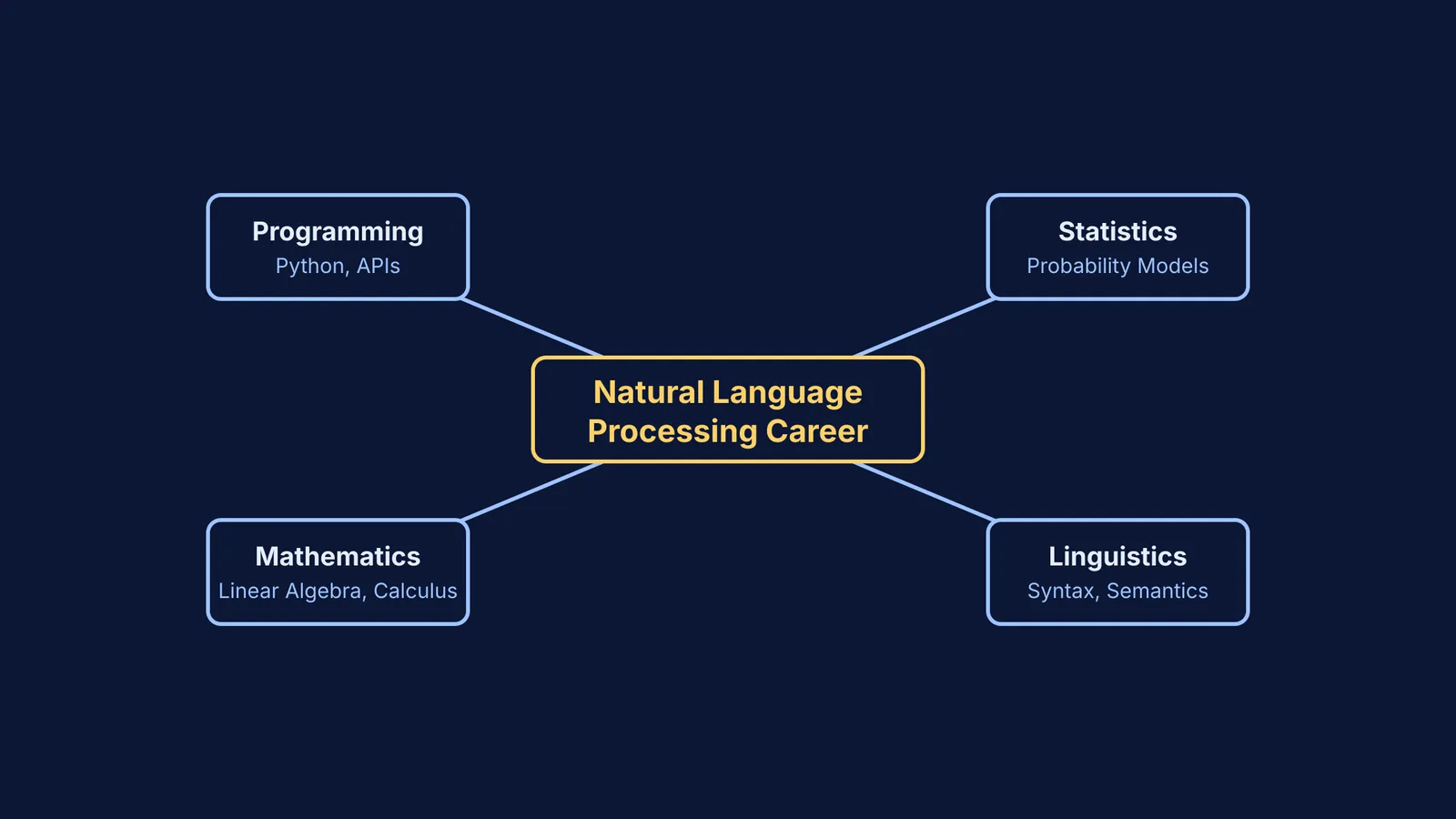
Building language models requires a mix of software engineering and mathematics. If you are looking at university courses or planning your own study schedule, here are the foundational skills to focus on:
Programming: Python is the standard language for NLP and machine learning. You will use it to write scripts that clean text data, call application programming interfaces (APIs), and build neural networks.
Linear algebra and calculus: Because words are represented as vectors, you need linear algebra to understand how models manipulate them. Multivariable calculus is used to optimise the models during training, adjusting the weights to reduce errors.
Probability and statistics: Language models do not "know" facts; they calculate the probability of which word should logically come next. A strong grasp of statistics is essential for evaluating how accurate and safe a model is.
Linguistics: Understanding how language is structured—such as syntax, semantics, and grammar—helps you build better rules for data cleaning and model evaluation.
Machine learning frameworks: As you advance, you will need to learn how to use libraries like PyTorch or Hugging Face Transformers, which provide the building blocks for modern neural networks.
What are good NLP starter projects for students?
You do not need a supercomputer to start learning NLP. You can build foundational projects on a standard laptop by using open-source libraries and small datasets.
Build a sentiment analyser: Write a Python script that reads a dataset of movie reviews and classifies them as positive or negative. This will teach you how to clean text by removing punctuation and stop words, and how to use basic machine learning classifiers.
Create a simple keyword summariser: Build a tool that takes a long news article and extracts the five most important sentences based on word frequency. This introduces you to term frequency-inverse document frequency (TF-IDF), a core concept in information retrieval.
Train a basic chatbot: Use a framework like NLTK or spaCy to create a chatbot that can answer frequently asked questions about your school or a hobby. You will learn how to match user input to pre-defined intents.
Extract named entities: Write a program that scans a historical text and automatically highlights the names of people, places, and dates. This is known as Named Entity Recognition (NER).
If you already know some coding, you can also write your own physics simulation in Python to practice structuring data and writing algorithms before moving on to complex language models.
What does a day in the life of an NLP engineer look like?
The daily work of someone in natural language processing is a mix of coding, reading research, and analysing data. You might spend the morning writing Python code to clean a new dataset of text documents, ensuring there are no formatting errors.
In the afternoon, you could run experiments to see if adjusting the parameters of a neural network improves its ability to summarise text. Much of the job involves reviewing the output of your models to spot patterns in the mistakes they make, and then figuring out the mathematical or logical reasons behind those errors. It is a highly iterative process that requires patience, curiosity, and a willingness to constantly learn as the technology evolves.