

On this page
Moving into a hostel or PG for JEE Main or NEET-UG exam prep often comes with a strict "lights out" rule at 11:00 PM or midnight. When you are used to late night study sessions, this can feel like an unfair limit on your prep time. But before you buy a table lamp to study under the covers, it is worth looking at how the brain actually learns.
Does sleep consistency change your score?
Many students believe that as long as they get enough total sleep, the exact timing does not matter. The science disagrees. A 2019 study published in *NPJ Science of Learning* (doi:10.1038/s41539-019-0055-z) tracked college students and found that sleep quality, duration, and consistency accounted for nearly 25% of the variance in their academic performance.
Crucially, the same study found no relation between the sleep a student got on the single night before a test and their actual test performance. What mattered was the sleep they got during the month and the week leading up to it. Cramming simply does not work for long-term retention.
Similarly, losing just an hour of sleep cuts into your final grades over time. Research in the *Proceedings of the National Academy of Sciences* (doi:10.1073/pnas.2209123120) showed that students who fell below six hours of sleep a night saw a measurable drop in their GPA, losing 0.07 grade points for every hour of sleep lost.
What is social jet lag?
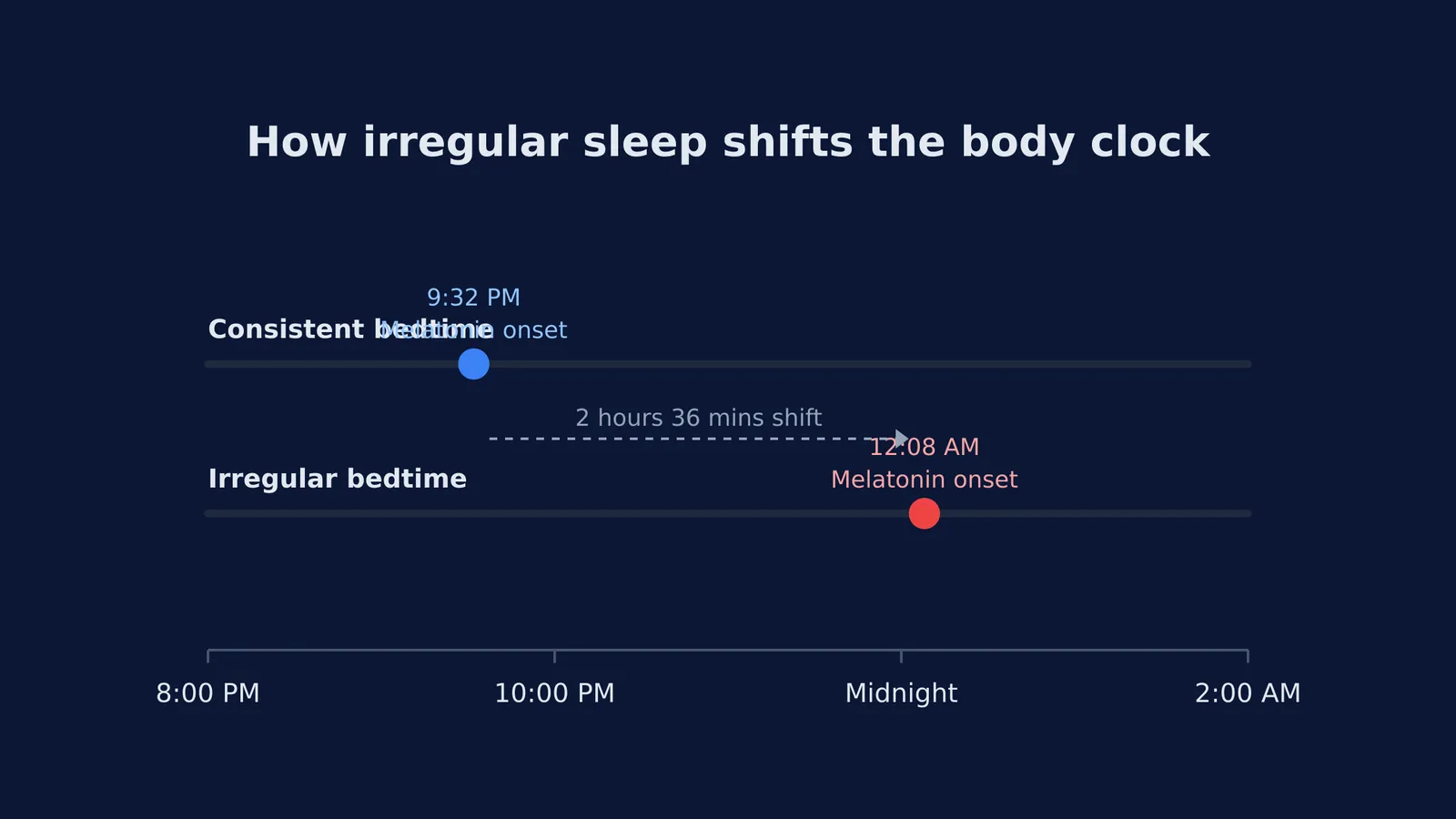
Why is a consistent bedtime so powerful? It comes down to your circadian rhythm. When you study late into the night on weekends but try to wake up early on weekdays, you push back the natural release of melatonin, the hormone that tells your body it is time to rest.
A 2017 study in *Scientific Reports* (doi:10.1038/s41598-017-03171-4) found that students with irregular sleep patterns experienced a biological shift of over two and a half hours. If your body is over two and a half hours out of sync, sitting down for a 9:00 AM exam feels exactly like waking up at 6:30 AM to solve physics problems. Your attention, reaction time, and complex decision-making are all impaired.
A hostel lights out rule forces consistency. By going to sleep and waking up at the exact same time every day, your brain learns when it needs to be alert, ensuring you peak during morning classes and afternoon exams.
How do you shift to a morning study routine?
Transitioning from late nights to early mornings takes a few days of planning. You can start by building a study routine that lasts. If you are struggling with a forced lights out rule, here is a practical plan to adapt over three days:
Move in 30-minute steps: Do not try to shift your bedtime by three hours in one night. If you usually sleep at 2:00 AM, aim for 1:30 AM tonight, then 1:00 AM tomorrow, until you reach your hostel's lights out time.
Set up your morning desk the night before: Waking up at 5:30 AM is hard if you do not know what you are doing. Leave your book open to the exact page, or load the exact problem you want to solve, so there is zero friction when you wake up.
Use the morning quiet: One reason students prefer late nights is the lack of distractions, but early mornings offer the exact same silence in a hostel study hall.
What if you get stuck studying early?
The main challenge of early morning study is what to do when you hit a wall at 6:00 AM and your teachers or peers are still asleep. When you are alone, a single difficult mathematics or physics problem can derail an entire study session.
This is where Fermi's AI tutor helps. Instead of just printing an answer and leaving you confused, it holds a line of reasoning across a session, notices where you are stuck, and decides whether to explain, ask, or show. If you are struggling with wrong-method mistakes, the Fermi Problem Library gives you worked problems with a step-by-step solver that explains the reasoning.
By embracing your hostel's routine rather than fighting it, you give your brain the consistency it needs. Sticking to the lights out rule ensures you consolidate all those hours of hard work, rather than losing them to sleep debt. If you are deciding whether morning or night is naturally better for you, check what chronotype research says about Morning or night study.


