

On this page
In 2024, approximately 24,000 candidates registered for NIFT admissions to compete for roughly 5,289 seats across 18 campuses in India. The National Testing Agency (NTA) conducts the test, and candidates are shortlisted for the second stage at a 1:4 ratio.
Preparing for the Bachelor of Design (B.Des) programme means treating your creative work with the same discipline as your academic subjects.
What is the NIFT entrance exam pattern?
The NTA NIFT examination happens in two stages:
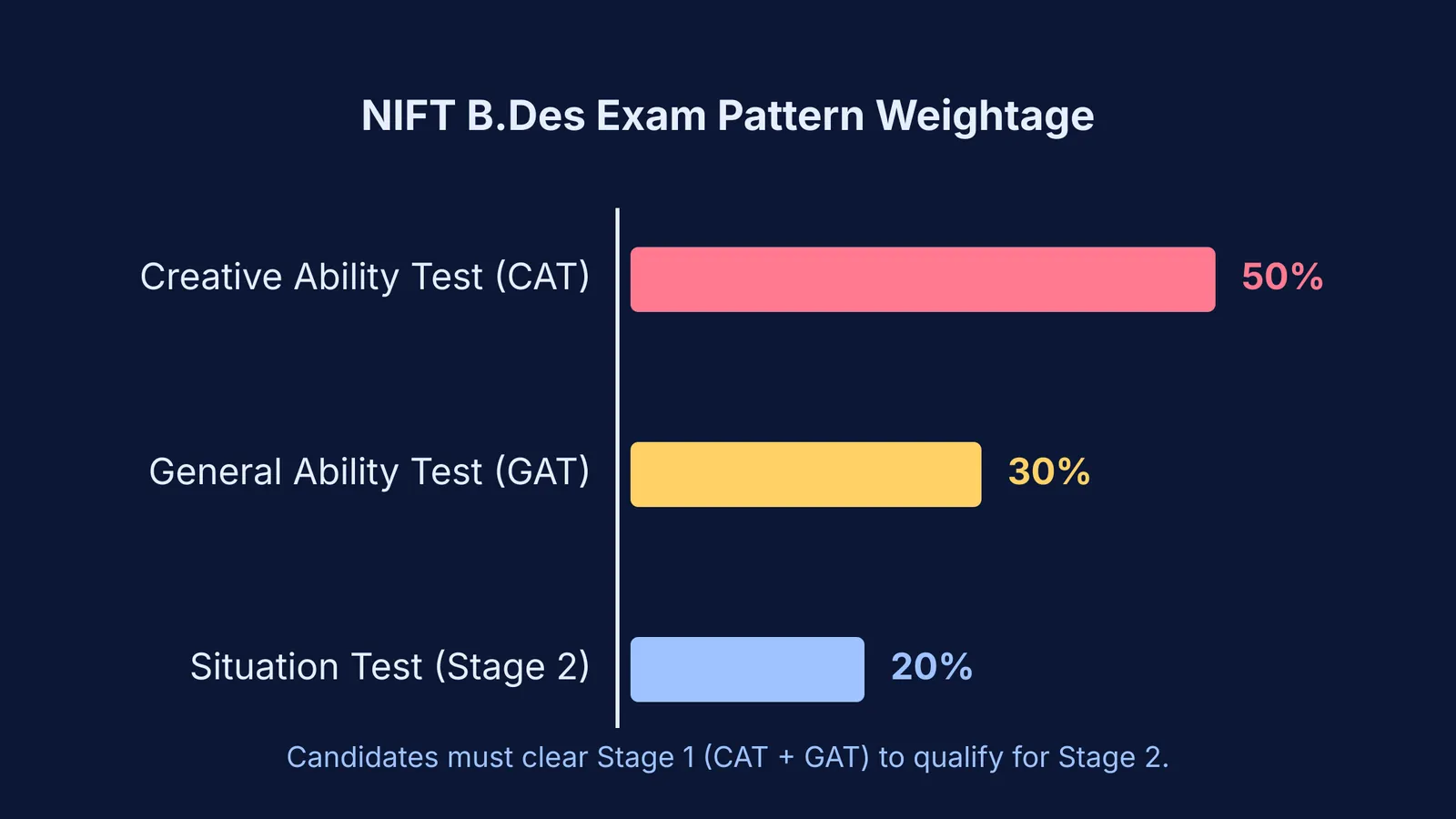
Written Examinations (Stage 1): You take the Creative Ability Test (CAT) on paper for three hours, which carries 50% of the final weightage. The General Ability Test (GAT) is a two-hour computer-based test worth 30%.
Situation Test (Stage 2): Shortlisted candidates take a hands-on test worth the remaining 20%, where they build a 3D model using given materials.
How to prepare for the Creative Ability Test (CAT)?
The CAT does not just test how well you draw; it tests your observation skills, perspective, and ability to tell a story visually.
Memory drawing: You will often be asked to draw a crowded scene, such as a busy market or a waiting room, from a specific viewpoint (e.g., from the height of a child or a bird's-eye view). Practice one-point and two-point perspective grids so you can sketch rooms and streets accurately.
Elements of design: Learn to use lines, shapes, and textures to create balance and rhythm in your composition. When sketching, focus on clean line quality rather than heavy shading. The examiners look for clarity of thought.
Colour theory: Practice with dry colours like pencil pastels, as wet media and sketch pens are typically not allowed. Focus on colour psychology—knowing which colours evoke warmth, tension, or calm.
If you are asked to design a product—like a multi-functional bag or a futuristic chair—make sure to include a short, neat write-up explaining your concept and the materials you envision. Your drawing should communicate the function clearly without needing the text, but the text adds necessary context.
How to study for the General Ability Test (GAT)?
While the CAT is subjective, the GAT is objective and has a negative marking penalty of 0.25 marks deducted per wrong answer. It checks your quantitative ability, communication skills, English comprehension, analytical ability, and general knowledge.
Quantitative ability: Focus on Class 10 mathematics, particularly topics like ratio and proportion, fractions, speed and distance, and percentages.
English and logic: Practice reading comprehension passages and solving logical puzzles like blood relations and series completion to build your speed.
General knowledge: Follow current affairs related to fashion, textile history, and design industry logos.
Because the GAT is a timed computer-based test, your speed matters as much as your accuracy. Do not spend more than one minute on a single mathematics problem; if you cannot see the path to the solution immediately, mark it for review and move on. Regular practice with a timer will help you build this reflex.
If you find yourself stuck on the mathematics portion, Fermi's AI tutor can work out what you already know and build a plan for the session to review those foundational Class 10 concepts step by step. You can also set study goals you actually hit using if-then planning to ensure you practice maths consistently.
A weekly practice routine for NIFT preparation
Balancing sketching with objective test prep is the hardest part. A structured routine ensures neither side falls behind. Consistency is more effective than cramming. If you draw all day on a Sunday but do nothing during the week, your hand will not develop the muscle memory needed for smooth lines.
Daily sketching: Dedicate an hour every day to quick sketches. Focus on human figures in motion and everyday objects.
GAT practice: Spend an hour daily alternating between mathematics, logical reasoning, and English comprehension.
Weekly mock test: Since the GAT is a computer-based test, take a timed online mock test once a week to get comfortable with the interface. Spend the full test duration on a past CAT paper under strict exam conditions.
Material handling: For the Situation Test, practice cutting, folding, and joining materials like cardboard, wire, and clay neatly at home. A sloppy model with a great concept often scores lower than a simple, cleanly executed design.
Review and rest: Look over your mock test mistakes. Know what to do in a study break so you return to your desk refreshed, and understand how rewards affect your study motivation before setting up a complex prize system for yourself.


