

On this page
The National Institute of Design (NID) evaluates candidates through a two-stage Design Aptitude Test (DAT). Unlike standard academic exams, the DAT does not rely on a fixed syllabus. Instead, it tests how you see the world, how you solve problems, and how clearly you can communicate your ideas on paper.
What is the NID DAT exam format?
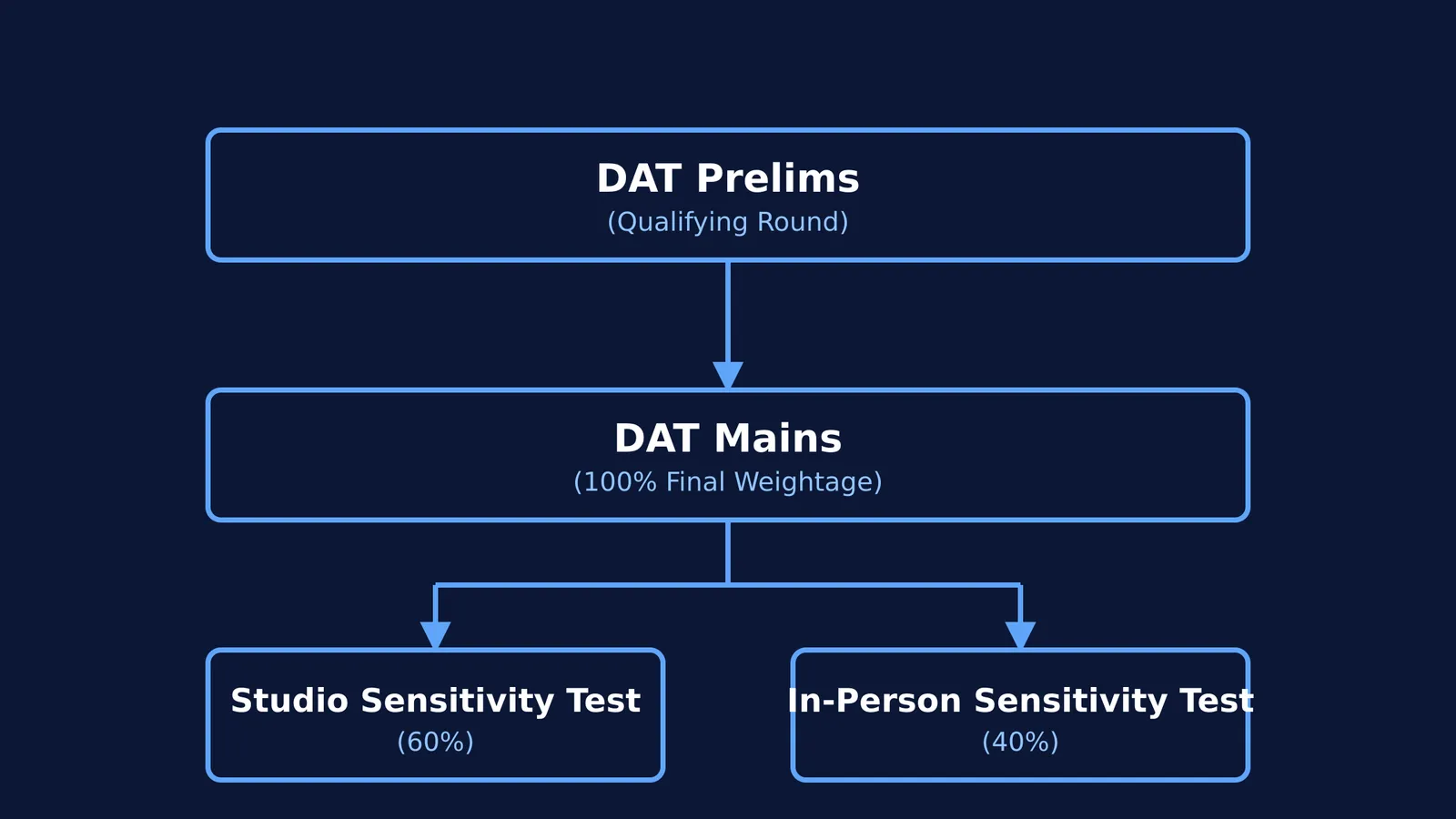
The NID DAT process is divided into two distinct stages:
DAT Prelims: A written exam. It is split into a General Aptitude Test (GAT) focusing on logical reasoning and general awareness, and a Creative Ability Test (CAT) that requires subjective, drawing-based answers.
DAT Mains: A hands-on studio test involving material handling, model making, and audio-visual exercises.
Because design is a practical discipline, the final selection leans heavily on your ability to make things. For the B.Des final merit list, the DAT Prelims is a qualifying round, and the DAT Mains carries 100% of the total weightage. Within the Mains, the studio sensitivity test accounts for 60% and the in-person sensitivity test for 40%.
Why does the NID DAT have no fixed syllabus?
Many students feel anxious when they realise there is no textbook to memorise for the NID entrance exam. However, this is intentional. The institute is looking for students who can think independently, not those who have merely memorised facts.
If the exam had a set syllabus, it would test your ability to recall information rather than your ability to solve new problems. By keeping the prompts unpredictable, examiners can see how you react to an unfamiliar challenge. They are testing your raw design aptitude—your innate ability to observe, imagine, and communicate visually.
What kind of creative tasks are set?
During the CAT section of the Prelims, you typically have a strict time limit to complete each drawing. The examiners are not looking for fine art masterpieces. They want to see correct proportions, logical perspective, and a clear narrative. A simple, communicative line drawing beats a heavily shaded but confusing sketch.
Common task types include:
Perspective shifts: Drawing a room from a bird's-eye view, or sketching a kitchen from the perspective of an ant on the floor.
Process breakdown: Illustrating the step-by-step sequence of an everyday action, such as a person opening a tight jar of pickles or folding an umbrella.
Creative problem solving: Redesigning a stapler so a young child could use it safely, or finding several alternative uses for a broken brick.
How to build observation and sketching habits?
Designers must notice details that others ignore. If you are asked to draw a busy railway station from memory, the examiners will check if you remembered the different types of luggage, the posture of people waiting, and the placement of ticket counters.
To train this, try these three exercises:
Blind contour drawing: Look at an object, such as your shoe or hand, and draw its outline without ever looking down at your paper. This trains your brain to trace actual physical edges rather than drawing what you assume the object looks like.
Visual journaling: Carry a small sketchbook and a fine-liner pen. Sketch three ordinary things every day: a cup on a table, a curtain folding, or a person at a bus stop. Using a pen forces you to commit to your lines without erasing.
Deconstruction: Pick a complex object, like a bicycle, and mentally break it down into basic shapes—cylinders, cubes, and spheres—before you try to sketch it.
A practical weekly sketching plan
Here is a simple routine to fit around your academic studies:
Monday and Tuesday: Memory drawing. Look at a room or object for a short time, walk away, and sketch it from memory.
Wednesday and Thursday: Blind contour drawing. Trace the edges of an object with your pen while keeping your eyes fixed on the object, not the paper.
Friday: Process breakdown. Sketch the sequence of an everyday action in four distinct frames.
Weekend: Scenario sketching. Draw a full scene using one-point or two-point perspective.
How to balance NID prep with board exams?
Balancing board exams, which require intense academic study, with design entrance preparation can be overwhelming. The secret is consistency rather than long, exhausting sessions.
Instead of waiting for a free weekend to do a massive block of drawing, integrate small bursts of sketching into your daily breaks. When you finish a chapter of physics or chemistry, spend a few minutes doing a blind contour drawing. This gives your analytical brain a rest while training your creative muscles.
If you are struggling to keep up with your academic workload, Fermi's AI tutor can help. It works out what you already know in your core subjects and builds a plan for the session, so you sit down to a clear next step instead of a blank page. This efficiency leaves you more time to focus on your visual journaling.
For more advice on staying consistent, see our guide on how to build a study routine that lasts longer than a week or read about managing perfectionism and studying.


