

On this page
Under the University Grants Commission (UGC) 2023 guidelines, internships are now a mandatory component for all undergraduate students in India after their 4th semester, requiring between 60 to 120 hours of work. Working with a Non-Governmental Organisation (NGO) is one of the most fulfilling ways to meet this requirement, build your resume, and make a tangible difference.
Whether you are helping to run a rural education programme, organising health camps, or managing social media for a climate change charity, an NGO internship teaches you how to operate with limited resources and solve real-world problems. Unlike corporate internships where you might be restricted to shadowing a single department, NGOs often give interns significant responsibilities and hands-on experience from day one.
How to find an NGO internship?
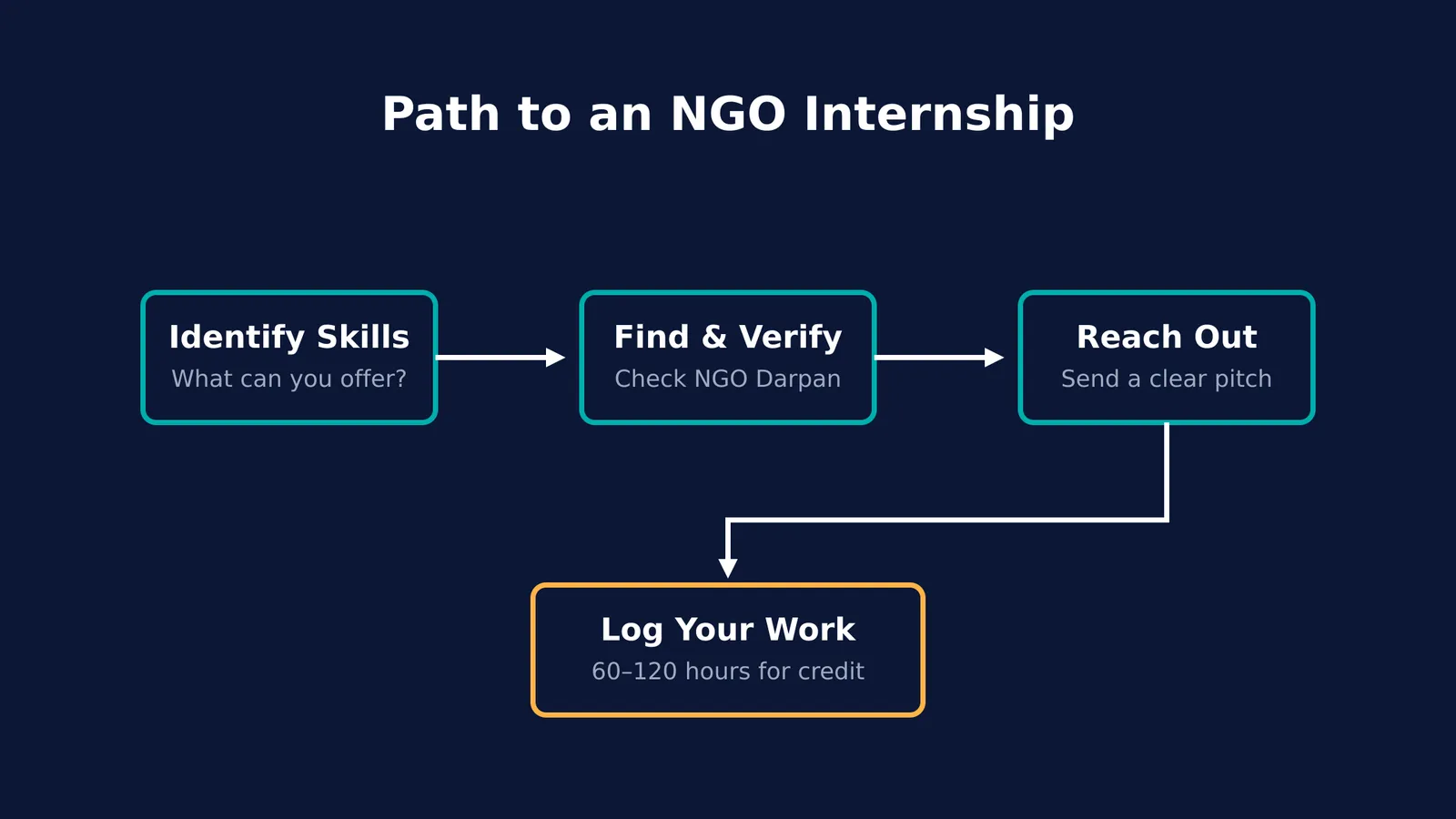
While many students rely on word-of-mouth or college placement cells, there are structured ways to find legitimate opportunities that match your interests:
Dedicated portals: Platforms like Internshala have dedicated NGO categories that filter out commercial roles. The government-run National Internship Portal (AICTE) also aggregates verified internships directly from NGOs, startups, and various government ministries.
Government programmes: If you are interested in policy and large-scale governance, the NITI Aayog Internship is highly regarded. Applications are predictable and open from the 1st to the 10th of every month.
Direct outreach: You do not have to wait for a formal listing. Find an organisation whose mission you care about and email their volunteer coordinator directly. State what you study and exactly how many hours you can commit.
Before sharing personal details, bank information, or committing your time, always verify the organisation's credibility. The simplest way is to check if they are officially registered on the government's NGO Darpan portal.
The cold email script
If you are reaching out to an NGO directly, keep your message focused on what you can do for them, not just what you want to learn. Use this template:
"Hi [Name/Team],
I am a [Year] year [Major] student at [College]. I have been following your work on [specific project or cause], and I would love to contribute.
I have skills in [Your Skill, e.g., web design, accounting, or social media management] and can commit [Number] hours a week for the next two months to help your team.
Would you be open to a quick chat about how I might be able to support your current projects? I have attached my resume for reference.
Thank you, [Your Name]"
What skills can I offer an NGO?
When students think of NGO work, they often picture fieldwork, distributing relief materials, or teaching children. While those are vital community services, NGOs are also businesses that desperately need professional, back-office skills. Do not just offer to "help out"—offer something specific that saves them time or money.
If you are a computer science student, you could build or update their website, or set up a secure database for their donor contacts. If you are studying commerce or finance, offer to streamline their accounts, track their expenses, or write grant proposals. A design or communications student can create campaign posters, write newsletters, and run their social media accounts.
Skill-based volunteering gives the NGO exactly what it needs to survive, and it gives you a concrete, professional project to discuss in future job interviews.
How to document your internship?
To ensure your work counts towards your mandatory college credits, you must document it properly from your very first day.
The paperwork: Confirm with the NGO beforehand that they can provide a formal Completion Certificate on their official letterhead.
The logbook: Maintain a daily or weekly activity logbook. Write down what you did, the software or tools you used, the people you interacted with, and what you achieved. You will likely need this logbook endorsed and signed by your supervisor to submit to your college's Internship Cell.
The red flags: You should never pay an NGO for an internship or a certificate. Legitimate internships are either volunteer-based (unpaid) or provide a small stipend to cover your travel and food. Any demand for a "training fee" or "registration charge" is a strong sign to walk away.
Making time for your internship
Balancing daily college coursework with a mandatory internship is demanding. It requires careful planning, a disciplined routine, and the ability to learn efficiently when you do have time to sit at your desk.
This is where having a reliable study system makes a difference. Fermi's AI tutor can work out what you already know and build a plan for the session, so you sit down to a clear next step instead of wasting time figuring out where to start. Learning efficiently helps you build a study routine that lasts and stay on track for your exams. If you have to study in a hostel or commute to your NGO, a clear plan allows you to confidently clear your schedule for time dedicated entirely to your internship.


