

On this page
Batch timings are often picked in a hurry at the admission counter, but you will live with the choice most days of the week, often for a year or two. Here are the four things that decide it, and one student's day worked through both ways.
Morning or evening coaching batch: which is better?
Neither is better for everyone. The right batch fits around school hours, travel and sleep, and still leaves a regular slot for self-study.
Sleep is the hardest limit. The CDC recommends 8 to 10 hours of sleep a day for teenagers aged 13 to 17. The American Academy of Pediatrics names school start times before 8:30 am as a key changeable cause of sleep loss in adolescents, and urges schools to aim for start times that let students get 8.5 to 9.5 hours of sleep.
The cause is biological, not laziness. A 2018 review in the Journal of Adolescence describes a "perfect storm": during the teenage years, the body's sleep systems shift towards later sleep just as school and social pressures push wake-up time earlier. So a plan that depends on you being asleep by 9 pm is fragile. We cover chronotypes in more detail in morning or night study: what chronotype research says.
What should you check before choosing a batch?
Use these four checks and write the times down on paper.
School timing. Note when you leave home and get back, including days with practicals.
Travel. Time the door-to-door trip to the centre at the hour you would actually travel.
Self-study slot. Find a 60 to 90 minute block, on the same day as class, for doing problems on your own.
Energy. Choose the batch that puts your hardest subject at a time when you are usually alert.
The self-study slot matters because of how memory works. In a study by Roediger and Karpicke, students who practised recalling a prose passage remembered substantially more of it a week later than students who simply reread it. So a short recall session the evening after class is likely to beat rereading notes days later.
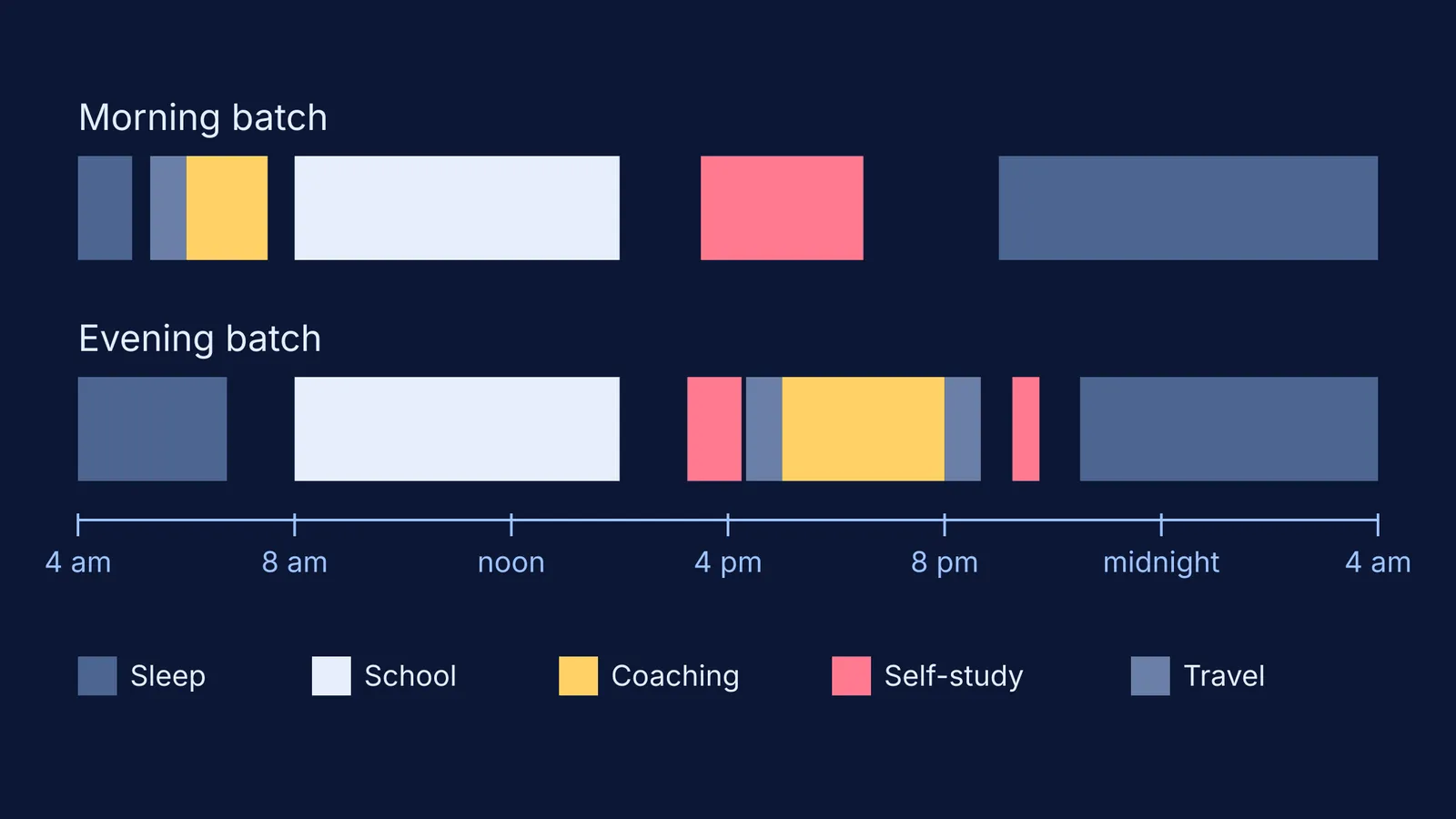
A worked example: one student's day, both ways
Take Aarav, who is in Class 11. His school runs from 8:00 am to 2:00 pm, and the coaching centre is 40 minutes from home.
Morning batch (6:00 to 7:30 am, then school):
Wake at 5:00, leave at 5:20, class from 6:00 to 7:30, then go straight to school.
Home by 2:30, rest, then self-study from 3:30 to 6:30.
He has to be asleep by 9:00 pm to get 8 hours. If bedtime slips to 10:30 pm, he gets 6.5 hours, below the CDC's 8 to 10 hour range for teens.
Evening batch (5:00 to 8:00 pm):
Wake at 6:45, school from 8:00 to 2:00, home by 2:30.
Lunch and rest, then self-study from 3:15 to 4:15, and leave at 4:20.
Class from 5:00 to 8:00, home by 8:40, dinner, and 30 minutes of recall from 9:15 to 9:45.
Asleep by 10:30 pm, which gives 8 hours 15 minutes.
On paper, the morning plan gives more self-study time. But it needs a 9 pm bedtime every night, which is hard to keep when teenage body clocks run late. For Aarav, the evening batch wins. If your school starts at 11 am, or you have finished school and are preparing full time, the answer can flip.
How many hours of coaching a day is too many?
Rules on this differ by state, so check your own state's. The Union Ministry of Education issued guidelines for coaching centres in 2024, and PRS Legislative Research_Bill_2025.pdf) notes that the Select Committee's version of the Rajasthan Coaching Centres Bill, 2025 would bar classes longer than five hours a day and require a weekly day off. If school, coaching and travel together leave no room for self-study or sleep, you have taken on too much, whichever batch you choose.
What to say at the counter
Ask the centre these questions before you pay:
"Can I attend a trial class in both batches?"
"Are the same teachers and the same syllabus pace used in both batches?"
"If my school timetable changes, can I switch batches, and is there a fee?"
Once your timetable is fixed, use time blocking for students juggling school and coaching to plan the week. Parents can read how much sleep teenagers need, and how parents can help.
If you get to your self-study slot and don't know where to start, Fermi's AI tutor can work out what you already know and build a plan for the session. If a problem from class still has you stuck, the Fermi Problem Library has a step-by-step solver that explains the reasoning rather than just giving the answer.
If tiredness or worry starts to wear you down, talk to a parent, a teacher or a doctor, or call Tele MANAS on 14416.
This week, write both versions of your day on paper and count the hours of sleep in each.


