

On this page
Most monthly study plans either list chapters with no tests, revision or slack, or assume every day goes perfectly. Here is how to build one that survives a bad day, with a worked 30-day example you can copy.
How do you make a monthly study plan for exams?
Work in this order, because each step limits the next.
Fix the dates first. Write down every unit test, mock test, practical and school event this month. Take them from the official notice, not from memory.
Block the revision. Put a revision block of four to five days just before the biggest test, plus one revision day before any smaller test.
Add buffer days. Leave one empty day each week for the chapter that ran over, a fever or a family function.
Fill what is left with chapter targets. Count the days still free and only then decide how many chapters fit.
Split it into weeks. Each week gets two or three goals you can tick off, not a vague "do physics".
How many chapters can you realistically finish in a month?
Fewer than you think. In a 1994 study by Roger Buehler, Dale Griffin and Michael Ross, psychology students predicted they would finish their honours thesis in 33.9 days on average, but took 55.5 days. Only about 30% finished by the date they had given as their best guess. This is known as the planning fallacy: when people predict their own work, they picture the plan going smoothly and forget how long similar tasks took before.
So estimate from your past, not your hopes. Check how long your last two chapters really took and plan with that figure. In the study, 55.5 days is about 1.6 times 33.9. If you are still going on gut feeling, multiplying your estimate by at least 1.5 is a sensible start.
Where should revision weeks and buffer days go?
Put revision some time after you first study a chapter, not straight after it. In a study of more than 1,350 people, Nicholas Cepeda and colleagues found that the best gap between first study and review grew as the test got further away. For a test one week away, the best gap was about 20 to 40% of that delay; for a test a year away, about 5 to 10%. Applied loosely to a one-month plan, this suggests a chapter you finish in week one should come back in week two or three, and again in the final revision block. Our 4-week spaced revision schedule for any chapter shows that pattern for one chapter at a time.
Put buffer days at the end of each week or just before a test. If you are on track, a buffer day becomes extra practice or rest; if you are behind, it soaks up the overflow.
What does a 30-day study plan look like?
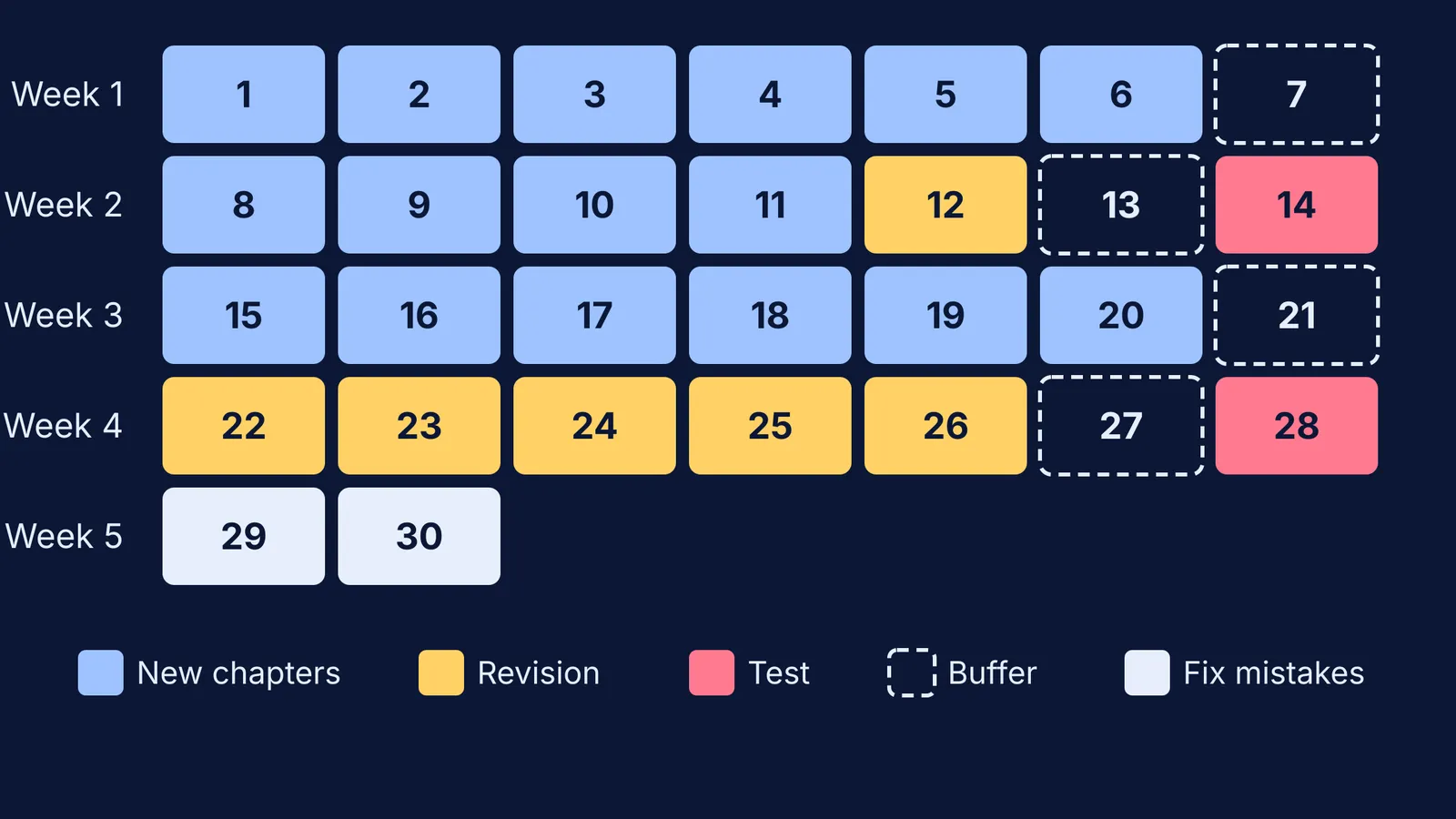
Here is a worked example for a student with five chapters to cover, a unit test on day 14 and a full mock test on day 28. The diagram at the top of this page shows the same plan.
Week 1 (days 1-6): chapters 1 and 2, three days each. Day 7 is a buffer.
Week 2 (days 8-11): chapter 3, a lighter week. Day 12: revise chapters 1-2. Day 13: buffer. Day 14: unit test.
Week 3 (days 15-20): chapters 4 and 5, three days each. Day 21 is a buffer.
Week 4 (days 22-26): revision week covering all five chapters, with mixed problems and timed sets. Day 27: buffer. Day 28: mock test.
Days 29-30: go through every mistake from both tests and note what went wrong: a concept, a method or a careless slip.
That comes to 16 days of new chapters, 6 of revision, 4 buffer days, 2 tests and 2 days of fixing mistakes. If you keep failing problems because of the method, the Fermi Problem Library has worked problems with a step-by-step solver that explains the reasoning rather than printing an answer.
How do you break a monthly plan into weekly goals?
Every Sunday, turn that week's part of the month into a few specific "when, where, what" goals. In a 2006 meta-analysis of 94 independent tests, Peter Gollwitzer and Paschal Sheeran found that plans spelling out when, where and how someone would act had a medium-to-large effect on reaching goals (d = 0.65).
For example:
"Monday to Wednesday, 6-8 pm at my desk: chapter 4 theory, then the solved examples."
"Thursday, after school: 20 chapter 4 problems from the exercise set, marking every one I get wrong."
"If I miss a session, it moves to Sunday, the buffer day, and nothing else moves."
To fit these sessions around school and coaching hours, see our guide to time blocking for students juggling school and coaching.
Pin the month where you will see it, check it every Sunday, and adjust next week instead of throwing out the whole plan.


