

On this page
If your mock test score plunges well below your past-paper average, you are not alone. In India, students preparing for competitive entrance examinations like JEE Main, NEET-UG, and Class 12 board exams routinely experience a steep drop in marks when sitting for commercial coaching test series. Staring at an unexpected score dip weeks before exam day shakes student confidence. Understanding why test series are engineered this way helps you use them productively without panicking.
Why are mock papers harder than the actual exam?
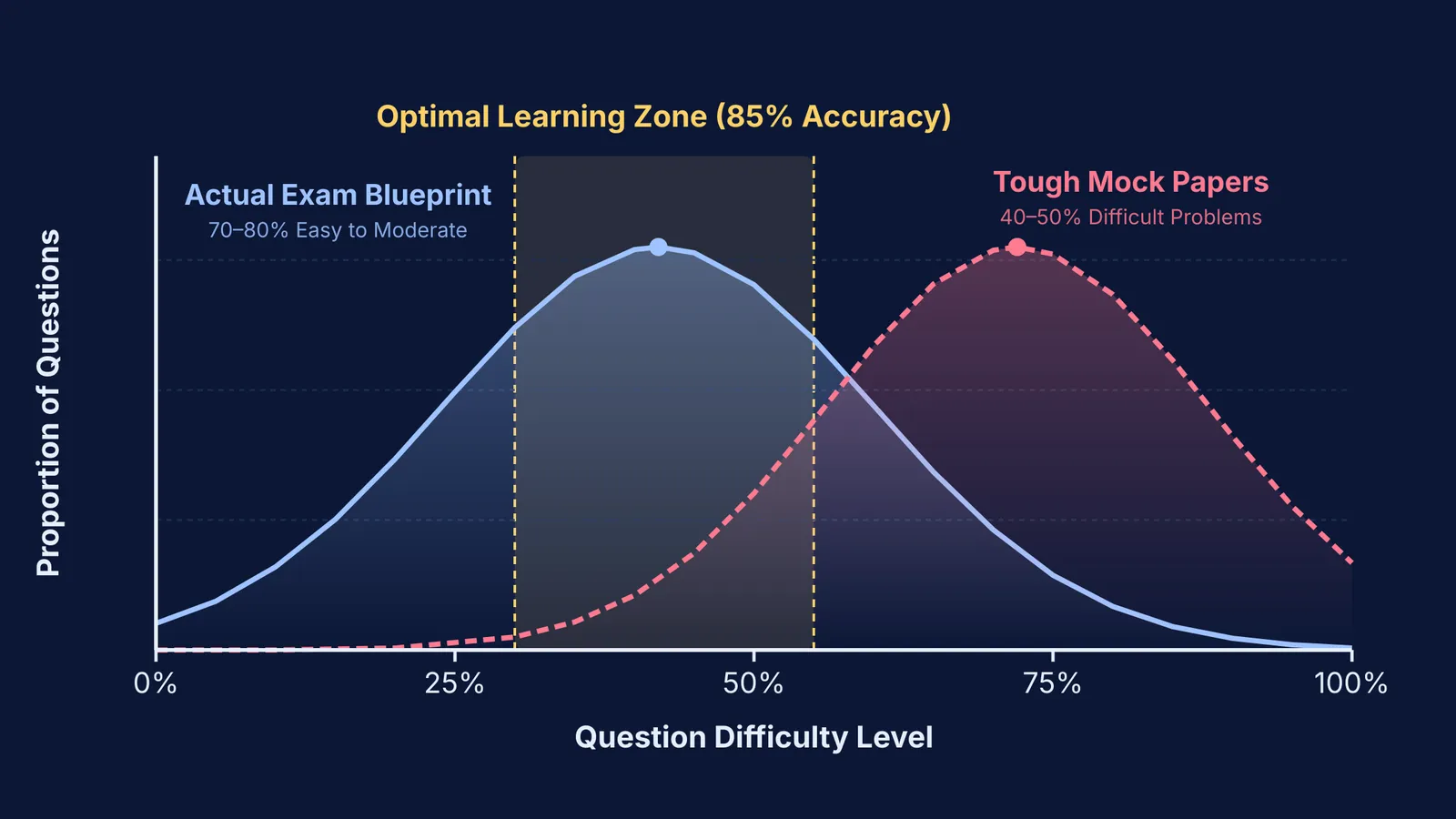
Commercial mock tests feel punishing because their question distribution is deliberately skewed. Official blueprints published by the Central Board of Secondary Education allocate roughly 20% easy questions, 60% average questions, and 20% difficult questions to ensure balanced, reliable assessment across diverse student cohorts. Similarly, examination data from the National Testing Agency indicates that 70% to 80% of questions in exams like JEE Main fall into the easy-to-moderate bracket, testing direct conceptual application and core NCERT formulas.
Commercial test series invert this structure, frequently packing 40% to 50% difficult problems into a single paper for three reasons:
Stress inoculation: Writers simulate extreme time pressure and computational load so that the actual exam hall feels comparatively manageable.
Edge-case coverage: Coaching brands test rare mechanisms and obscure exceptions to ensure no surprise topic goes unseen on exam day.
Setter bias: Experienced teachers find standard questions routine and naturally add multi-step algebra to separate top scorers.
When does test difficulty help or hurt your learning?
Cognitive scientists Robert A. Bjork and Elizabeth L. Bjork showed that desirable difficulties enhance retention, but only when learners have the foundational knowledge to eventually solve the problem; impossible tasks become undesirable difficulties that impair learning.
In Nature Communications, Robert C. Wilson and colleagues demonstrated that across biological and artificial learning systems, the optimal training error rate is approximately 15.87%, meaning that a training accuracy near 85% provides the steepest learning rate (Wilson et al., 2019). When a brutal mock pushes error rates past 60%, the feedback signal becomes noise, triggering cognitive overload rather than durable skill acquisition.
Yet struggling on hard problems works when paired with immediate review. Across six experiments, Nate Kornell, Matthew Jensen Hays, and Robert A. Bjork found that unsuccessful retrieval attempts enhance subsequent learning more than restudying when corrective feedback follows (Kornell et al., 2009). Furthermore, Janet Metcalfe showed that errors made with high confidence are corrected especially quickly when students analyze their line of reasoning (Metcalfe, 2017).
How should you calibrate your score with past papers?
In Psychological Science in the Public Interest, John Dunlosky and colleagues rated practice testing as high-utility because it reliably boosts retention across subjects and ages (Dunlosky et al., 2013). But mock testing only helps if you calibrate against official benchmarks.
We recommend practising with previous-year papers under strict exam timing to maintain an objective anchor:
If your score drops on an institute mock but remains steady across recent official shifts, your baseline is sound. The drop reflects artificial test skew.
If your scores decline on both past papers and mock tests in a specific chapter, you have found a genuine conceptual gap.
How should you triage your mistakes after a tough mock?
Instead of dwelling on your raw mark, analyze your paper using a 60-minute mock test review routine, sorting mistakes into three bins:
Bin A: Concept Gaps. Questions where you missed the core physical law or governing theorem. Reviewing the topic in the Fermi Concept Library helps you understand where the principle fits in the concept map before trying another problem.
Bin B: Execution Errors. Calculation slips, sign errors, or misread questions. Checking your solution against a step-by-step solver that explains the reasoning rather than printing an answer—such as the Fermi Problem Library—shows exactly where your calculation drifted.
Bin C: Outlier Traps. Questions requiring tortuous multi-page algebra or niche curricular trivia. Note any useful algebraic identity, and discard the score deficit from your memory.
What should parents say after a disappointing mock score?
When mock scores crash, parental reactions set the emotional tone for the coming week. Viewing practice tests as predictive verdicts breeds defensive guessing and fear of failure.
If you are supporting an exam aspirant at home:
What to say: "This paper was designed to test your endurance. Let us pick two execution errors from your review to fix before next week."
What to avoid: "If you score poorly on this test, how do you expect to clear the cut-off?"
Focus on relative rank rather than raw marks: on difficult test series papers, a modest raw mark often places a student well within the top percentiles of the test cohort.
For practical steps to reset momentum after a difficult test, read our guide on bouncing back after a bad test. If academic stress leads to severe anxiety or sleep loss, seek professional guidance: India's Ministry of Health provides free, confidential 24/7 tele-counselling via Tele MANAS at 14416 (or 1800-891-4416).


