

On this page
After clearing the MHT CET, securing a place in your preferred engineering or pharmacy college comes down to the Centralized Admission Process (CAP). Once you submit your option form and the first round of allotments is released, you face a critical choice: should you lock in the seat you have, or try for a better one?
The decision comes down to two options on your portal: Freeze and Betterment. Understanding how these work ensures you do not accidentally lose a seat you wanted.
What is the MHT CET CAP round process?
When the CAP round results are published, you log into your portal to see your allotment. The system matches your merit rank against the preference list you submitted. If you are allotted a seat, you must choose an option and pay a one-time Seat Acceptance Fee of ₹1,000. If you do nothing, your allotted seat is cancelled, and you may be locked out of the current seat for future rounds.
There are two ways a seat can be "frozen", meaning you are taking it and leaving the CAP process.
How do you choose between Freeze and Betterment?
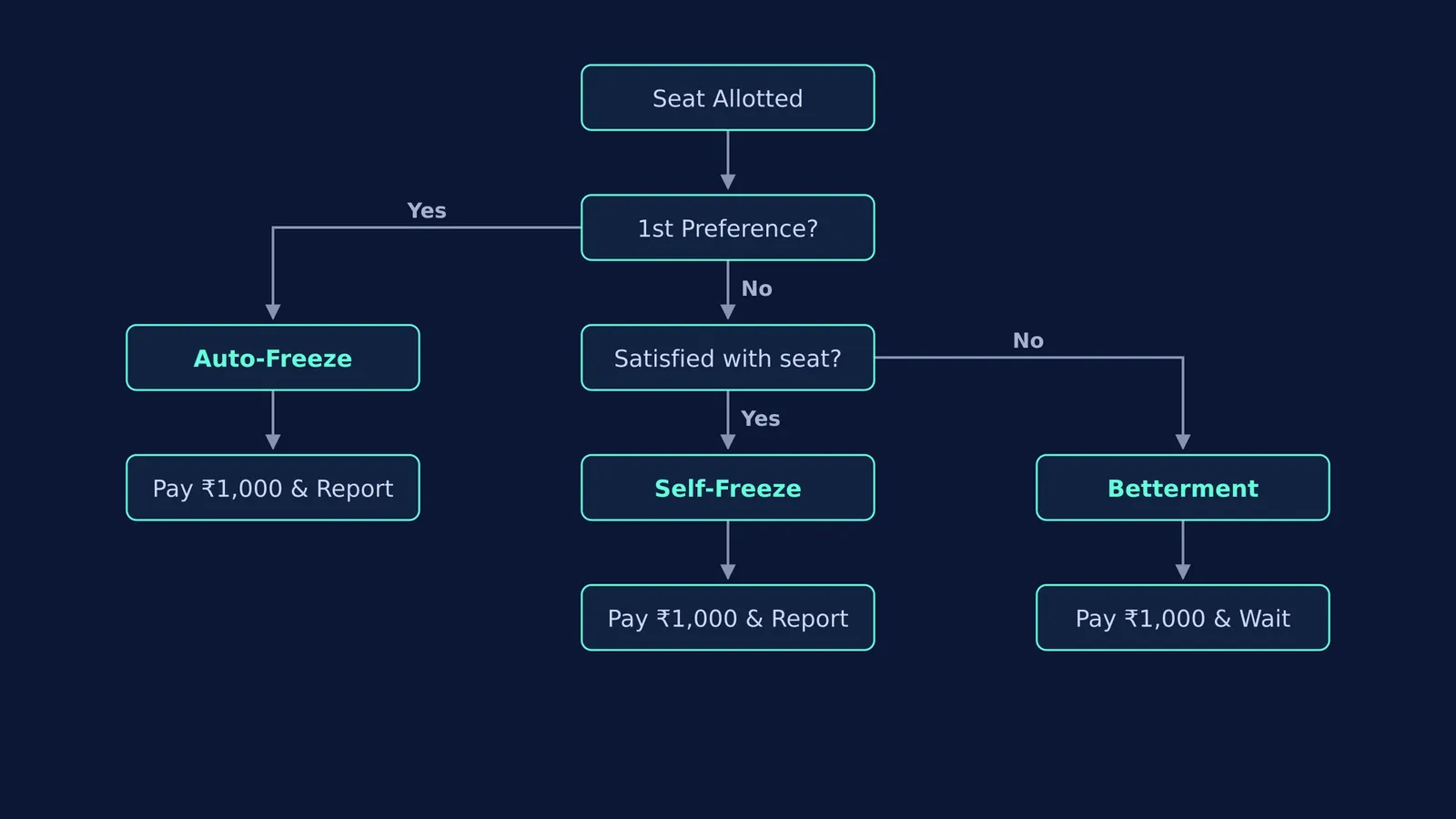
If the system allots you the college and branch you listed as your first preference, it automatically freezes the seat. You have no choice but to accept it. You must pay the ₹1,000 fee and report to the college to confirm your admission. Because you got your top choice, you cannot participate in subsequent CAP rounds for a different seat.
If you are allotted a seat that was not your first preference (for example, your third or fourth choice), but you are completely satisfied with it, you can choose Self-Freeze. By doing this, you are telling the system that you do not want to participate in further rounds. You pay the ₹1,000 fee, download your allotment letter, and report to the college.
How does the Betterment option work in CAP rounds?
If you are allotted a seat but want to see if you can get a higher-ranked preference in the next round, you must choose Betterment (also called "Not Freeze").
Choosing Betterment secures your current seat as a provisional backup. You pay the ₹1,000 Seat Acceptance Fee, but you do not need to report to the college yet. In the next CAP round, the system will only try to place you in the colleges you ranked above your current allotment.
If you get a new seat in the next round, your old seat is automatically cancelled and given to someone else; you cannot ask for it back. If you do not get a new seat, your backup seat is safe, and you can claim it.
What is the Seat Acceptance Fee?
When you see your allotment, use this quick checklist to guide your payment and reporting steps:
Is it my first preference? The system will Auto-Freeze it. Pay the ₹1,000 fee and report to the college.
Am I completely happy with it? Choose Self-Freeze. Pay the fee, report to the college, and your admission process is done.
Do I want a better college, but want to keep this one just in case? Choose Betterment. Pay the fee, wait for the next round, and do not report to the college yet.
The ₹1,000 fee is paid only once per admission cycle. If you pay it in the first round for Betterment, you do not pay it again if you freeze a seat in a later round.
As you prepare for engineering entrance exams, solving tricky problems correctly the first time gives you an edge. The Fermi Problem Library has worked problems with a step-by-step solver that explains the reasoning rather than printing an answer. If you find it hard to picture physics concepts while studying, the Fermi Simulation Lab offers interactive simulations for the ideas that are easier to see than to read.
For more practice with the kinds of questions that determine your rank, try working through the Energy density in an electric field: u = ε₀E²/2 worked or Wurtz-Fittig and Fittig reactions: coupling aryl and alkyl halides. Getting the core concepts right is the first step to ensuring your option form is filled with top-tier choices.


