

On this page
Which maths chapters need daily practice in Class 11 commerce?
In Class 10, mathematics revolves around predictable algorithms. In Class 11, whether you choose core Mathematics (Code 041) or CBSE Applied Mathematics (Code 241) under the CBSE Senior Secondary Curriculum, the syllabus demands abstract modelling and multi-step reasoning.
Commerce students frequently treat mathematics as a secondary subject behind Accountancy, Economics, and Business Studies. Postponing problem solving to weekend marathons creates an illusion of competence that fails under exam pressure. Three chapter clusters need daily practice:
Sequences and Series: Arithmetic and geometric progressions form the backbone of commercial finance. Calculating compound growth and annuities requires fluent manipulation of general term aₙ and sum Sₙ formulas without stumbling over exponent rules.
Permutations, Combinations, and Probability: Combinatorics demands active logic rather than mechanical calculation. Without solving two or three constraint-based arrangement problems daily, your ability to partition sample spaces and recognize independent events fades quickly.
Limits and Derivatives: Introductory calculus carries direct marks in Class 11 and forms over 30% of the Class 12 syllabus. Mastering derivatives from first principles in Class 11 through daily algebraic simplifications prevents severe deficits in Class 12 calculus.
Applied mathematics students also need regular practice with descriptive statistics, where calculating standard deviations and variance requires sustained arithmetic precision.
Why should you study NCERT worked examples before solving exercises?
Many commerce students skip the solved examples in official NCERT textbooks to jump directly into the end-of-chapter exercises. This brute-force approach leads to frustration when faced with complex word problems in financial mathematics or probability distributions.
In a study published in the Journal of Educational Psychology, Graham Cooper and John Sweller demonstrated the worked-example effect. Studying worked solutions before attempting unguided problems reduces cognitive load, allowing students to acquire problem-solving schemas and automate mathematical rules more efficiently than unguided trial and error.
NCERT worked examples model the exact layout CBSE marking schemes reward:
Explicit conditions: Stating given parameters and interval boundaries before computing.
Step-by-step reduction: Showing intermediate factorisations rather than skipping directly to numerical answers.
Contextual interpretation: Interpreting the practical meaning of a rate of change or statistical variance.
To study worked examples actively, use the cover-and-solve method. Read the question, cover the solution with an index card, and write each line independently. If you stall, uncover only the next step as a cue, then complete the problem. When stepping through intricate proofs or multi-stage algebra, the Fermi Problem Library offers worked problems with a step-by-step solver that explains the reasoning rather than printing an answer.
How can you build speed for applied topics and financial calculations?
Commerce mathematics papers test both conceptual clarity and computational speed. Multi-step calculations for annuities, tax slabs, and combined variance demand steady arithmetic. Because calculators are prohibited in Class 11 and 12 examinations under CBSE examination guidelines, using phone calculators during homework ruins your speed during exams.
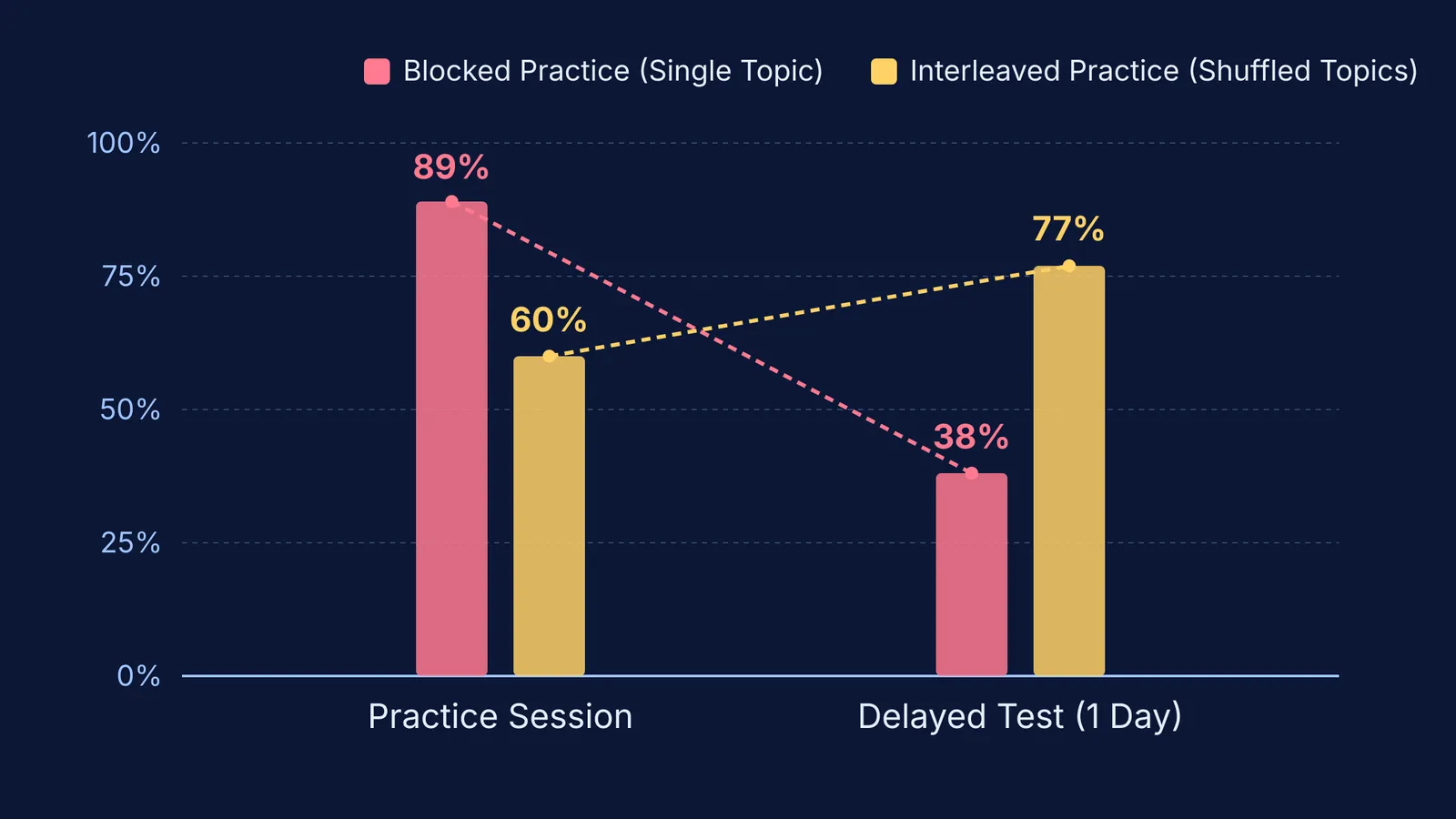
Speed develops through deliberate practice design. In an experiment in Applied Cognitive Psychology, Kelli Taylor and Doug Rohrer compared blocked practice with interleaved practice in mathematics. During initial practice, students solving blocked sets achieved 89% accuracy, compared to 60% for students solving shuffled problems. One day later, the interleaved group achieved 77% accuracy on a delayed test, while the blocked group dropped to 38%.
Blocked homework creates an illusion of mastery because students apply the same formula repeatedly without choosing a strategy. Exam questions appear without chapter headings. Shuffling daily problems trains discrimination, teaching you to match the right mathematical model to an unfamiliar question.
A review in Psychological Science in the Public Interest by John Dunlosky and colleagues rated practice testing and distributed practice as high utility for retention, which we examined in our review of the 2013 Dunlosky study techniques rating. Short daily problem sets build far greater fluency than a single weekend marathon.
When unfamiliar word problems or conceptual roadblocks interrupt your practice, Fermi's AI tutor can work out what you already know and build a plan for the session, noticing where you get stuck and guiding your reasoning step by step.
What does an effective 45-minute daily study routine look like?
You do not need two hours of daily mathematics to excel in Class 11 commerce. A focused 45-minute daily session built on principles of distributed practice is sufficient when structured intentionally:
Minutes 1 to 20 (NCERT Schema Acquisition): Study two worked examples from your current chapter using the cover-and-solve technique, writing out every algebraic step.
Minutes 21 to 35 (Interleaved Exercise Solving): Solve three unguided questions: one from today's lesson, one from last week's topic, and one from a month ago.
Minutes 36 to 45 (Timed Speed Drill): Solve five arithmetic operations from financial maths or statistics by hand against a timer.
Consistent execution builds the computational speed required for applied mathematics while leaving ample time for Accountancy ledgers and Economics.


