

On this page
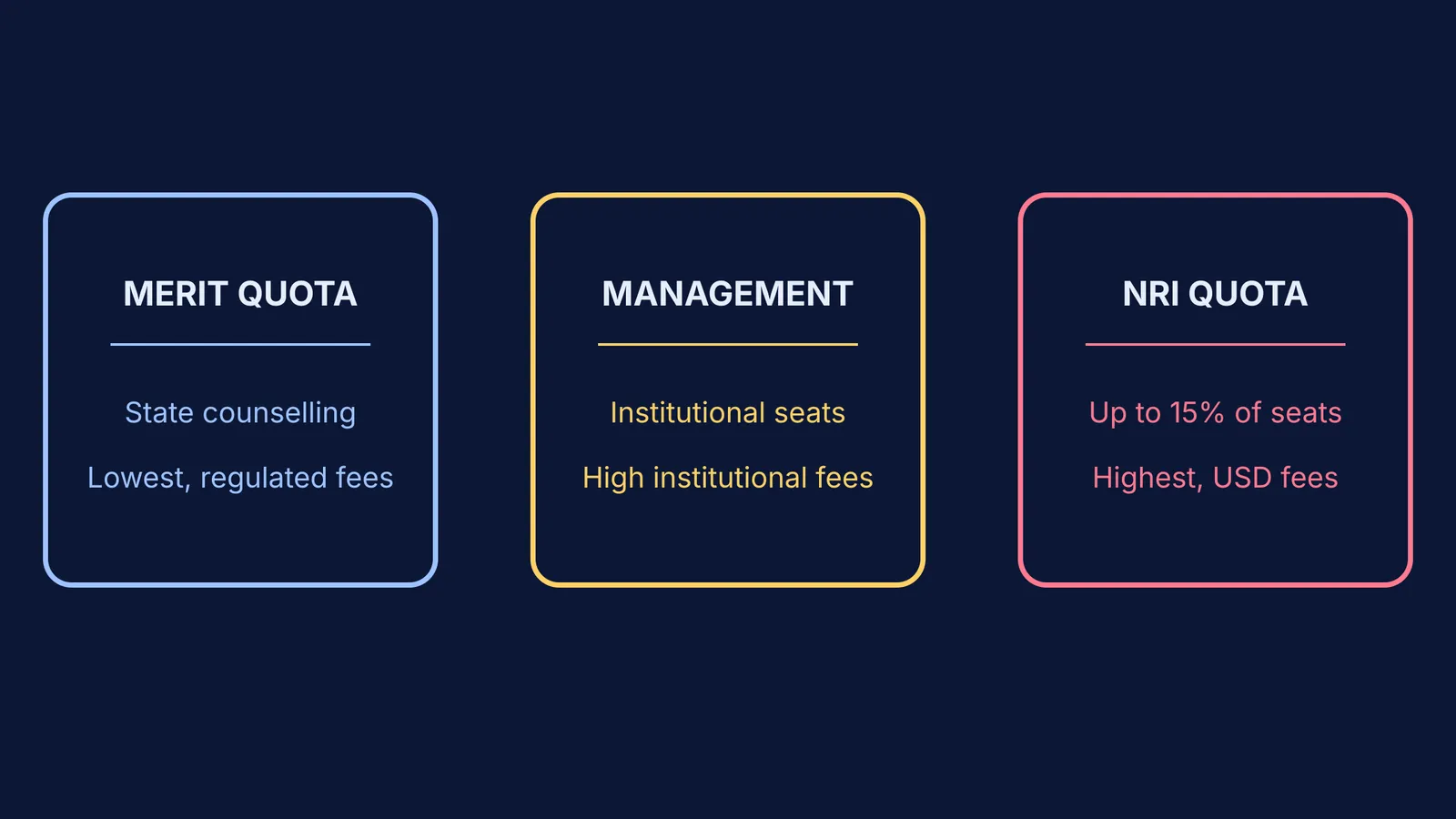
When state and national admission counselling begins, students applying to private and deemed universities in India often see seats divided into merit, management, and NRI categories. For parents planning a budget and students weighing their options, understanding the exact differences between these quotas is an essential part of the admissions process.
The choice of quota changes not only the tuition fees you pay, but also the specific documents you must produce and the level of competition you face. Here is a closer look at how management and NRI seats compare on eligibility, costs, and paperwork.
What are management quota seats?
Management quota seats are a specific proportion of the total intake reserved by private or deemed universities. These seats are filled at the institution's discretion, though the process still runs through official state or central counselling authorities. Management quotas offer a pathway for students who meet the basic academic eligibility and pass the entrance exams, but who miss the rigorous cut-offs required for heavily subsidised government or state-merit seats.
According to admission regulations, the management quota typically accounts for a significant portion of a private college's total seats. Because these seats do not receive government subsidies, institutions charge significantly higher tuition to maintain their infrastructure, laboratories, and faculty.
While the fees are higher, admission is still governed by an internal merit list based on entrance scores among those who applied for the quota.
What are NRI quota seats?
Non-Resident Indian (NRI) quota seats are strictly reserved for students who hold NRI, Overseas Citizen of India (OCI), or Person of Indian Origin (PIO) status. In many Indian states, resident Indian students can also claim these seats if an immediate NRI relative legally sponsors their education.
Institutions generally reserve up to 15% of their total intake for the NRI quota. Because these seats target families earning abroad, they carry the highest fee tier, and tuition is often paid in foreign currency such as US dollars.
Do you still need to clear NEET or JEE?
Yes. A common misconception is that paying higher management or NRI fees allows a student to bypass entrance exams. The Supreme Court of India and regulatory bodies such as the National Medical Commission (NMC) strictly mandate that all medical admissions, across every quota, require a qualifying NEET UG eligibility: age, subjects and qualifying marks score.
Similarly, most reputable engineering colleges require a qualifying Who can sit JEE Main: Class 12 year, subjects and no age limit rank or an equivalent state entrance score. If you are struggling with a difficult physics or chemistry topic, the Fermi Concept Library holds every concept in physics, chemistry, biology, mathematics and computing, each with its own lesson and its place in the map.
What documents are required for counselling?
Preparing for counselling requires gathering extensive paperwork, especially for sponsored NRI seats where proof of status is heavily scrutinised. Use this checklist to ensure you have what colleges typically ask for during document verification.
For Management Quota:
Entrance exam admit card and official scorecard.
Class 10 and Class 12 marksheets and passing certificates.
Transfer Certificate (TC) and Migration Certificate from your previous school.
Valid government identity proof.
Passport-size photographs.
Domicile certificate (only if applying for state-specific management seats).
For NRI Quota (Additional to the above):
Sponsor's Passport and Visa: A valid foreign passport and residence or employment permit of the NRI sponsor.
Relationship Proof: Legal documents proving you are a first-degree relative of the sponsor.
Sponsorship Affidavit: A notarized affidavit confirming that the sponsor agrees to cover all educational and living expenses.
Embassy Certificate: A document issued by the Indian Embassy or Consulate verifying current NRI status.
Financial Proof: Recent foreign bank statements to prove financial capacity.
Equivalency Certificate: A certificate from the Association of Indian Universities (AIU) if the student studied under a foreign school board.
Navigating admission rules is complex, but separating merit seats from management and NRI quotas early on makes it easier to plan a realistic path to college. You can read more about special entry routes and medical admission processes in our guide to AFMC Pune MBBS admission through NEET: the steps and conditions.


