

On this page
Balancing school assignments and high-stakes exam preparation often feels impossible. You finish school, get home, and face a mountain of homework that eats up the entire evening, leaving no energy for your JEE or NEET modules.
However, you do not have to choose between failing your internal assessments and bombing your competitive exams. By treating your time as a strict budget and changing how you approach mandatory homework, you can complete your school tasks efficiently while retaining the concepts you need.
How much time should assignments actually take?
It is easy to let a single worksheet consume an entire evening. This happens because of Parkinson's Law, a psychological principle stating that work expands to fill the time available for its completion. If you give yourself all night to write an essay, it will take all night.
To combat this, look to the "10-minute rule." Based on a review of dozens of studies by Harris Cooper at Duke University, this guideline suggests that the maximum amount of daily homework should be 10 minutes multiplied by your grade level. For a 12th-grade student, the benefits of homework peak at 120 minutes (two hours) per night; spending more time than this does not improve academic achievement.
Set a timer before you start. Give yourself exactly 45 minutes for physics and 30 for chemistry. When the timer rings, stop. This time blocking forces focus and breaks the procrastination trap.
Why should you satisfice on school homework?
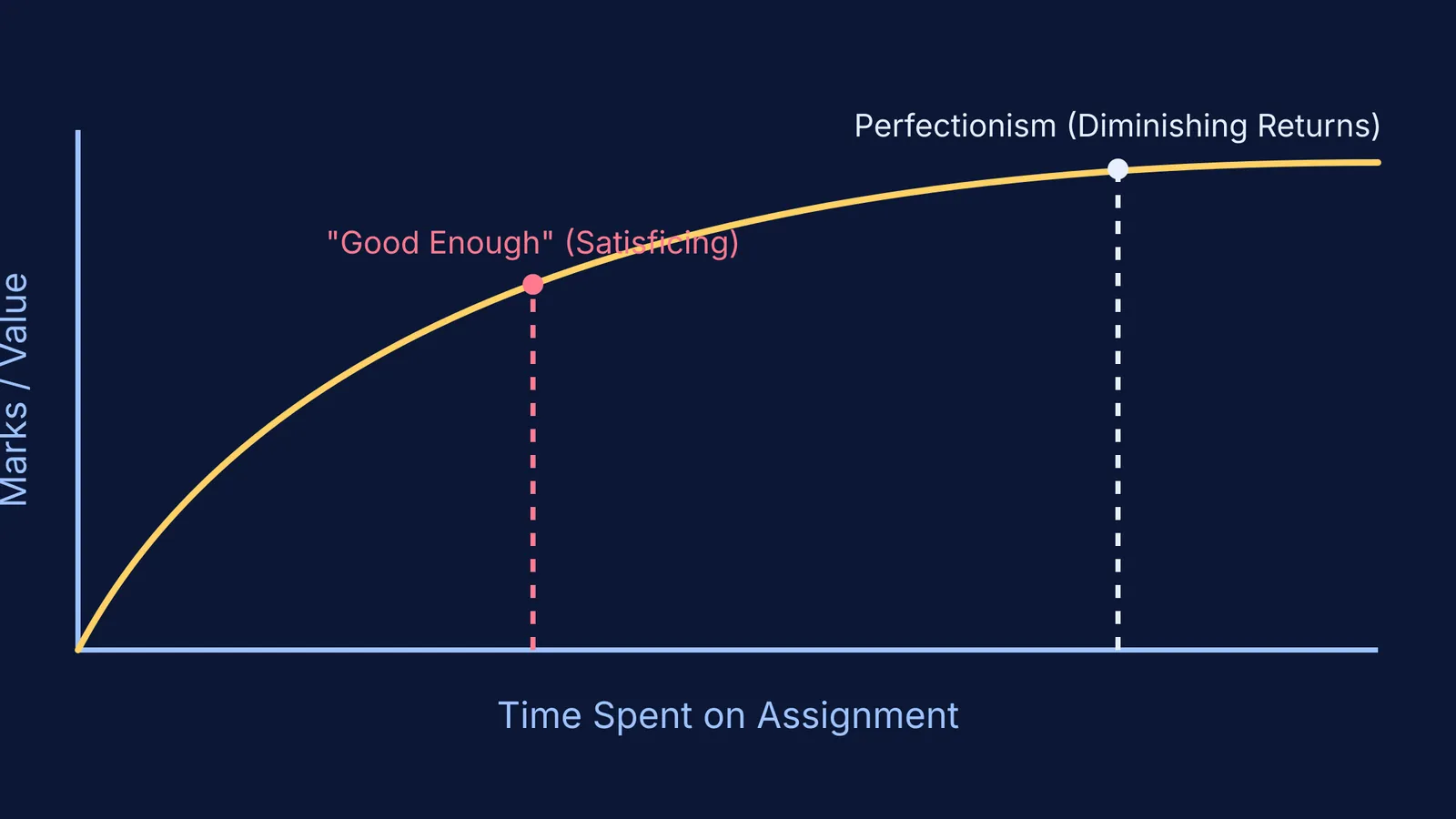
When a school project does not directly help your exam prep, it is a prime candidate for "satisficing." Coined by Herbert Simon, satisficing is a decision-making strategy that involves finding a solution that is "good enough" rather than perfect.
Perfectionist students (maximizers) spend hours refining a school presentation to get a 10/10. Satisficers aim for an 8/10, finish the task in a fraction of the time, and use the remaining hours to master challenging exam topics. By satisficing, you secure most of the marks for minimal effort.
If a school problem is surprisingly difficult, do not spend an hour staring at it. You can get unstuck quickly, or bring the topic to Fermi's AI tutor. When you upload a question or topic, Fermi works out what you already know, builds a plan for the session, and teaches through it—guiding you to the concept faster without doing the homework for you.
How can you turn assignments into active exam prep?
Sometimes, school homework aligns perfectly with your competitive exam syllabus. When it does, you can use it to build long-term memory through a technique called interleaved practice.
Instead of doing a block of 20 identical problems on today's lesson, mix them up. Psychologist Doug Rohrer from the University of South Florida demonstrated the power of this method. In a 2019 study of seventh-grade math classes, students who used interleaved worksheets scored 61% on a surprise test a month later, compared to just 38% for those who used traditional blocked practice.
To apply this, do a few problems from your current school assignment, then deliberately mix in two or three questions from a chapter you covered a month ago. If you hit a wall while mixing in old topics, this is a great time to learn from your errors. Instead of reading a generic solution, you can use the Fermi Problem Library. It offers worked problems with a step-by-step solver that explains the reasoning rather than printing an answer, forcing you to think through the strategy.
What is a good daily schedule for assignments and prep?
If you want to integrate school work and exam preparation, try this structured evening routine based on the 10-minute rule:
School Work Slot (Max 2 Hours): Set a hard deadline. Apply satisficing for low-value tasks.
Break (30 Minutes): Step away from your desk to reset your focus.
Exam Prep Slot (2–3 Hours): This is your protected time for deep work. Use interleaved practice to review past topics, which can help maintain your study routine.
Review and Plan (15 Minutes): Look at tomorrow's schedule and lay out your materials.
Managing school and competitive exams is not about sacrificing sleep; it is about treating your time as a finite resource. Timebox your school work, settle for good enough on routine tasks, and vigorously protect your deep preparation hours.


