

On this page
The night before a board exam, the most common question is not about the syllabus, but about the paper itself: exactly how much do you need to write for a five-mark question?
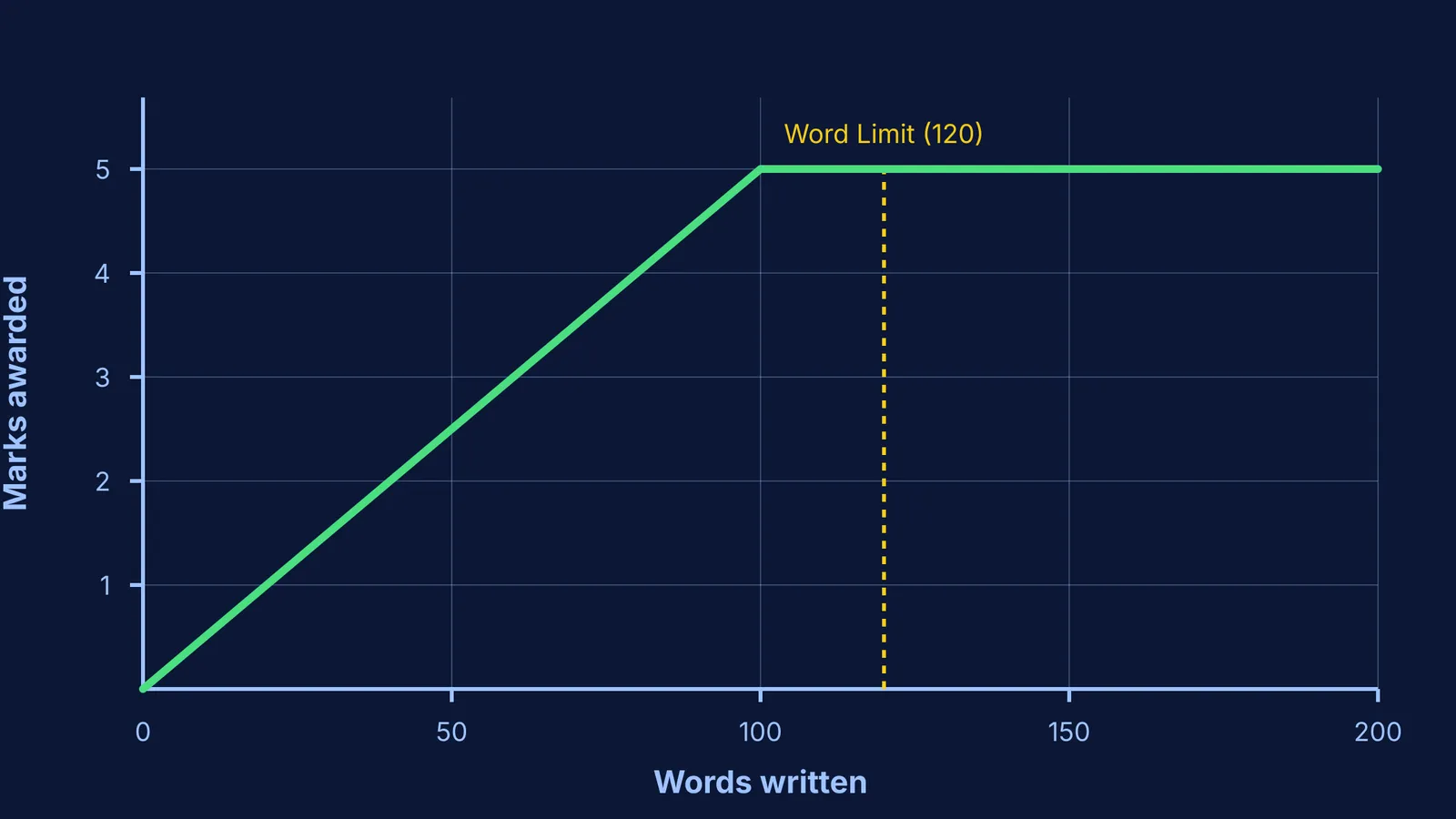
Many students believe that filling more pages will somehow guarantee a higher score, treating the exam like an essay competition. But exam marking schemes are rigid, and padding your answers with irrelevant information only wastes the time you desperately need for the rest of the paper.
How long should long answers be?
The Central Board of Secondary Education (CBSE) publishes strict word limits for every subject. These limits are not suggestions; they are designed to test your ability to present information clearly and concisely. For a 5-mark long answer, the official 2024–25 marking scheme sets these boundaries:
Class 10 Science: 80 to 120 words.
Class 12 English: 120 to 150 words.
Class 10 Social Science: 120 words.
While exceeding the word limit by a small margin will not result in negative marks, writing a 300-word answer for a 120-word requirement yields zero return on your time investment.
Why does padding your answer not work?
Examiners grade hundreds of papers a day. They do not read dense paragraphs looking for a reason to give you marks. Instead, they scan your answer against a pre-written marking scheme to find "value points" or "step marks".
If you write a full page that only contains three of the five required value points, you will score 3 out of 5. If you write a 90-word answer that clearly lists all five value points, you will score 5 out of 5. The extra padding earns zero marks, but it costs you the crucial time you need to properly check your answers in the last 10 minutes of an exam.
How do you write a 5-mark answer?
To secure full marks quickly, structure your long answers to make the value points completely obvious to the examiner, as shown in the CBSE marking scheme.
Start with a definition: Write one clear sentence introducing the core concept.
Use bullet points: Write exactly five bullet points. This naturally prevents long, rambling paragraphs.
Add subheadings: Start each point with a short subheading, and underline the key technical terms (like "Sustainable Development" instead of "caring for the environment").
Draw a diagram: In science or geography, a neat, labelled diagram often counts as one full value point (and sometimes two).
Write a brief conclusion: End with a one-sentence summary or the final formula with correct SI units.
If you struggle with laying out your answers, reviewing Class 10 CBSE maths mistakes will show you how clearly separating your steps prevents you from losing marks to messy working.
Are numerical and theory questions marked differently?
The word limit rules apply differently depending on what you are solving. For subjects like English or History, the 120-word limit is a strict guide for how much content to provide.
However, for Physics and Mathematics, the focus shifts entirely to the steps. You do not need to write 100 words of text for a 5-mark numerical problem. Instead, the 5 marks are divided across the process, as shown in the CBSE Class 12 Physics marking scheme:
1 mark for writing the given values and the correct formula.
1 mark for the correct substitution of values.
2 marks for the step-by-step calculation.
1 mark for the final answer with the correct SI unit.
If you make a calculation error at the very end, you will still earn 4 out of 5 marks for the correct steps. But if you jump straight to the final answer without showing your working, you risk losing almost all the marks.
How can you practise writing to the limit?
You cannot learn to write concise answers just by reading the textbook. You must practise writing them out under timed conditions. When you study, try to list the five key facts for a concept without looking at your notes. If you find yourself writing too much, you may not fully understand the core idea.
This is where Fermi's AI tutor can help. Rather than just giving you the final answer to memorise, it works out what you already know and builds a plan for the session, guiding you to spot the essential concepts yourself.
For numericals and derivations, the Fermi Problem Library has a step-by-step solver that explains the reasoning behind each step. Practising this way trains you to see exactly which parts of a solution earn the marks, so you can write the steps that matter, skip the padding, and finish your paper on time.


