On this page
A LinkedIn profile is no longer just for professionals with years of experience. It is where you build a network, find internships, and research careers long before you graduate. But staring at a blank profile can be intimidating when you feel you have no real-world experience to list.
The good news is that recruiters do not expect a student to have a long work history. They are looking for potential, foundational skills, and a clear direction. Here is how to set up your profile to show what you can do.
Why is a LinkedIn profile important for students?
Before you even finish your degree, your profile acts as a living resume. While a traditional paper resume is limited to a single page, your online profile can host links to your portfolio, certificates, and detailed descriptions of your coursework. It allows recruiters to find you for internships, rather than you having to hunt down every opportunity manually.
Having a profile early also lets you track your own progress. When you finish a major assignment or master a new concept, adding it to your profile helps you build a record of your learning.
What should a student put in their LinkedIn headline?
Your headline is the most visible part of your profile. When you leave it blank, the platform defaults to "Student at [Your University]". This does not tell a recruiter or a senior what you actually do or what you are looking for.
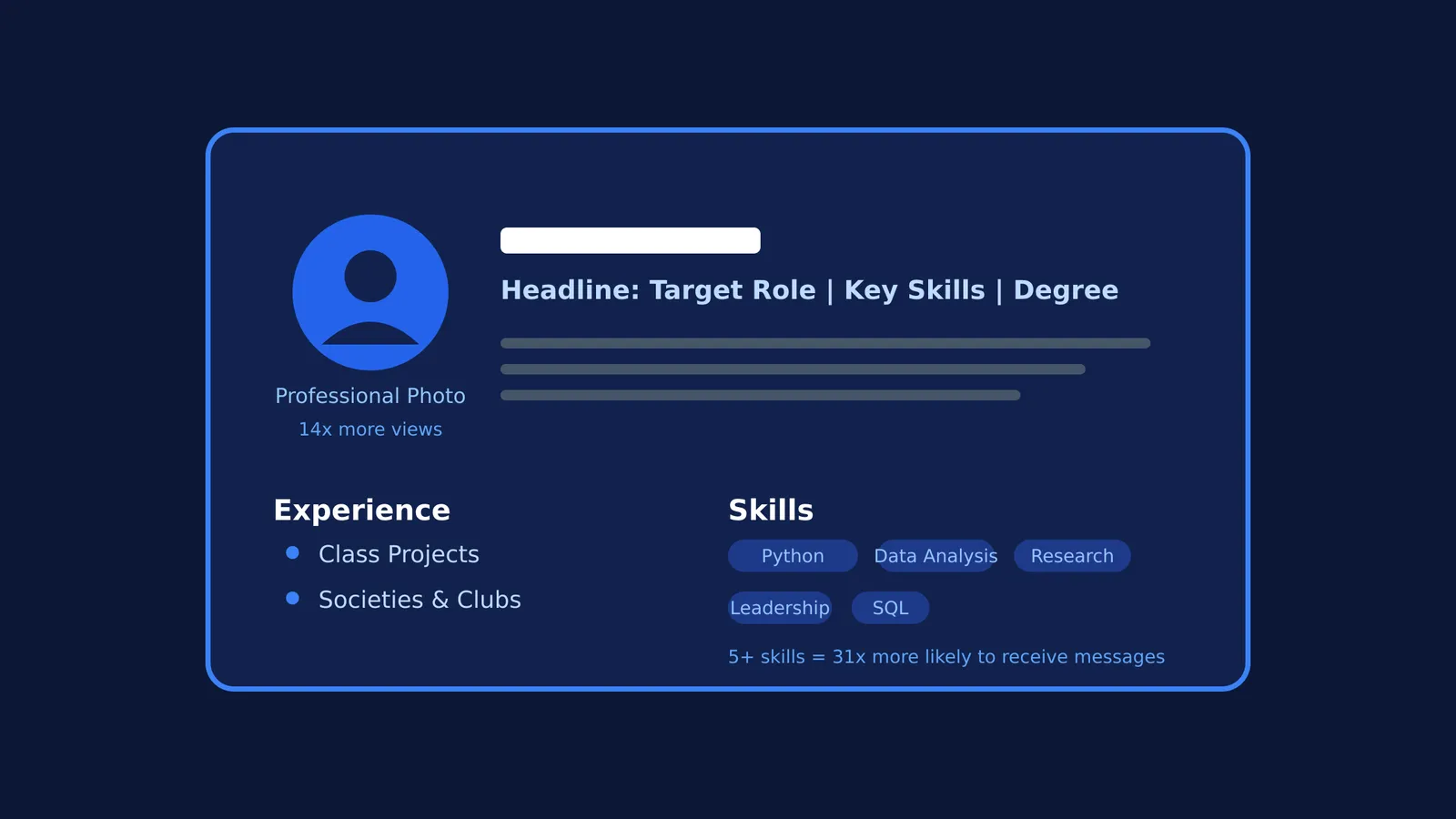
Instead, use a formula that includes your target role, key skills, and your current academic status. The format [Target Role] | [Key Skills] | [University/Major] works well.
For example:
Aspiring Data Analyst | Python, SQL | B.Tech Computer Science at NIT
Biology Undergraduate | Lab Research, Data Analysis | Seeking Summer 2027 Internships
This matters because recruiters search for specific skills and job titles, not the word "student."
Does a profile photo really matter?
Yes, the image you choose has a massive impact on how many people see your profile. Profiles with a professional photo receive an average of 14 times more views than those without one (Kinsta).
You do not need to pay for a studio headshot. A clear, well-lit photo taken against a plain background with your phone is enough. Dress as you would for an interview in your chosen field, and make sure your face is clearly visible. Avoid group photos or images where your face is obscured.
What should a student put in their experience section?
When you have not had a full-time job, you can still show your competence. The experience section is not restricted to paid employment.
Include these elements to show your capability:
Class projects: If you built a database, designed a circuit, or wrote a major research paper, list it as an experience. Explain the core problem, the tools you used, and the final result.
Societies and clubs: Leadership roles or active participation in technical or cultural clubs show teamwork and organisation.
Volunteering: Unpaid work still requires dedication and builds the soft skills that every workplace needs.
If you need to strengthen the foundations behind your technical projects, the Fermi Concept Library covers every concept in physics, chemistry, biology, mathematics and computing.
How to write a strong summary?
Your summary is your elevator pitch. It sits right below your headline and photo, making it one of the first things a visitor reads. A good summary for a student should be concise and well-structured, split into a few short paragraphs.
Start with who you are and what you are currently studying. Then, mention what drives you. Are you fascinated by renewable energy, or do you love finding patterns in large datasets? Finally, end with a clear call to action, such as stating that you are looking for an internship in a specific field for the upcoming summer.
How to connect with seniors without spamming?
Building a network is the main reason to be on the platform, but sending generic connection requests to hundreds of alumni is rarely effective. People are much more likely to accept a request if they know why you are reaching out.
When you want to connect with a senior from your college or someone working in a role you admire, always add a personal note. Keep it short, polite, and specific.
Here is a script you can use: "Hi [Name], I am a second-year student at [University] studying [Subject]. I read your recent post on [Topic] and found your insight on [specific detail] really helpful. I would love to follow your work and connect."
This approach shows you have taken the time to read their profile and have a genuine interest in their work. Once connected, you can follow up later to ask a specific, well-researched question about their career path. For more on discussing future paths, read our guide on talking about STEM careers beyond engineering and medicine.
Building a profile takes time, but it is an ongoing process. Update it at the end of each semester as you finish new projects, learn new tools, or complete a study routine that lasts through your exams. A complete profile is your professional introduction to the world.